Deep Half Guard No-Gi: 5 Sweeps That Actually Work
Jeff Glover submitted multiple black belts at ADCC 2009 largely from deep half guard — a position most competitors dismissed as a stalling tactic. That tournament performance changed how a generation of grapplers saw the position. In no-gi specifically, deep half guard creates problems that are genuinely difficult to solve: your opponent cannot post or grip fabric to stabilize themselves, wrist control disrupts their base faster, and the leg entanglement puts you one hip escape away from a back take or a leg attack. The catch is that no-gi removes your lapel and sleeve anchors too. What replaces them is an aggressive underhook on the far leg and tight control of the near wrist — two grips that hold the position together and set up everything covered here.
What Makes Deep Half Guard Work in No-Gi
In the gi, deep half guard players use sleeve grips and the lapel to slow the pass, create friction, and control timing. Strip those away in no-gi and the position changes character entirely. It becomes more dynamic — both a threat and a liability — which is exactly why it rewards the player who understands its mechanics.
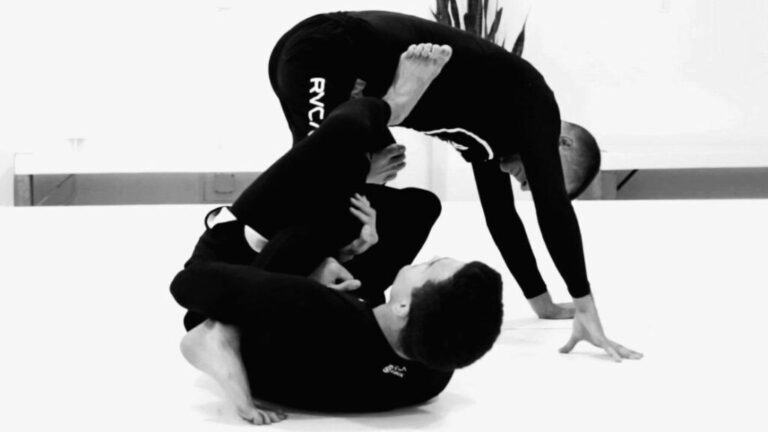
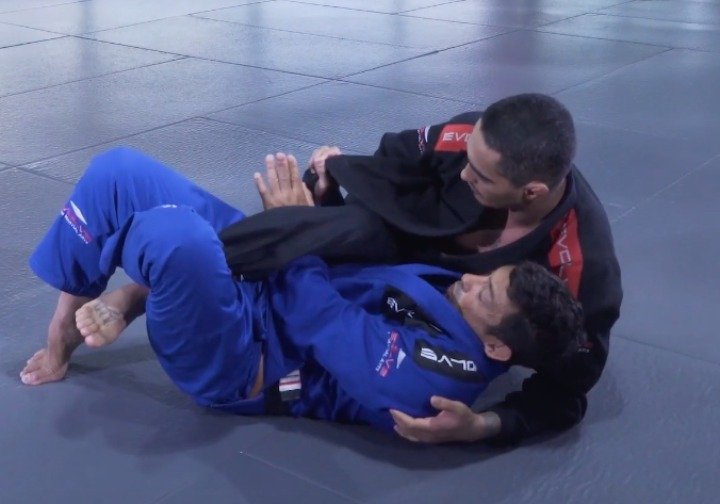
The foundation in no-gi is the underhook on the far leg. Your head goes to the inside (between the opponent’s legs, facing their far hip), your near shoulder pins their near thigh, and your top arm reaches deep to underhook behind their far knee. That underhook is not optional — it is the position. Without it you are just lying under someone’s legs.
Wrist control on the near hand matters almost as much. When you pin the near wrist to the mat, your opponent cannot post on that side, cannot base out, and cannot strip your underhook cleanly. In the gi they can post on their sleeve; in no-gi they have to fight the wrist pin directly or shift their weight, and either reaction gives you a sweep cue.
Hip position closes the loop. Your hips should be turned toward your opponent, not flat on the mat. Flat hips make you easy to flatten and pass. Turned hips let you come up explosively. Every sweep below depends on getting your hips oriented correctly before you commit.
Sweep 1: The Old School Sweep
This is the sweep that put deep half guard on the map at high-level no-gi competition, and Jeff Glover made it famous at ADCC. It is still the highest-percentage option when your opponent is standing relatively upright over you.
Set up starts with your standard deep half position: head inside, underhook behind the far knee, near wrist controlled. From here, shoot your underhooking arm deeper so you are gripping behind the far knee or calf — you want to own that leg completely. Your hips turn toward them as you begin to come up off your shoulder.
The motion is a sit-up combined with a leg sweep. As you sit up off your back, you pull the far leg toward you with the underhook while your body weight drives into their near leg. Think of it as lifting one support out from under them while pushing through the other. They have nowhere to post because you are controlling the near wrist.
As they fall, follow them up. Post your near foot on the mat, drive through, and come to top position — ideally landing in half guard on top or passing directly to side control if they give you the angle. The finish is a controlled top pass, not a scramble. Stay connected to the leg through the entire rotation or they recover guard.
Sweep 2: The Back Take
The back take is not exactly a sweep in the traditional sense — you end up behind your opponent rather than on top — but it produces the same result and is arguably the most dangerous weapon in no-gi deep half. In rulesets with rear naked choke finishes, it ends matches.
The entry happens when your opponent tries to posture away and straighten their arms to push your head or frame on your hip. That defensive reaction is exactly what you want. When they extend away, they shift their weight back and take pressure off your hips. That is your window.
Come up off your elbow on the underhook side. As you rise, release the far-leg underhook and reach your arm up and over their back, shooting for a body lock or a seatbelt grip. Your legs follow — the near leg kicks out and your body rotates behind theirs. You are essentially coming up to a knee and spinning to their back in one motion.
From the body lock, finish by taking your hooks in and flattening them to the mat, or transition directly to a rear naked choke setup. In no-gi competition this is one of the cleanest back entries available because the opponent’s defensive posture does exactly half the work for you — their extended arms and backward weight shift clear the path to their back. Most training partners who have not spent time at the bottom of deep half have no trained response to this entry.
Sweep 3: The Homer Simpson
The Homer Simpson is the belly-up variation, and it is your answer to a pressure passer who tries to flatten you and drive through. Where the Old School sweep punishes an upright opponent, the Homer Simpson punishes someone who comes forward aggressively.
When your opponent drives their weight into you trying to flatten your hips to the mat, go with it. Rather than fighting the pressure, flip belly-up — rotate toward their legs so your chest faces down and your hips roll through. This sounds counterintuitive, but the rotation moves you under their center of gravity faster than they can react.
As you flip, grab the near ankle with both hands or one hand while the other posts on the mat. The ankle grip stops them from stepping over and gives you leverage to pull their leg while you come up on the outside. They are now off-balance in the direction they were driving — their own forward pressure becomes the problem.
Come up to your knee on the outside of their leg, keep the ankle grip, and drive through to top position. The finish mirrors the Old School in that you are aiming for side control or half guard on top. The key technical point is the rotation timing — belly-up happens as the pressure comes, not after you are already flat. If you wait until they have you pinned, the rotation becomes much harder to execute.
Sweep 4: The Roll-Under to Leg Attack
This is where no-gi deep half guard connects directly to the leg lock game, and it is why the position has gained renewed attention among submission wrestlers. When your opponent squares up and weights their far leg heavily, the roll-under converts that into a toehold or heel hook entry.
From the standard deep half position, drop the underhook. Frame on their hip with your top hand and execute a sit-up that sends you rolling under and past their far leg. Think of it as a short, controlled Imanari roll entry — your body goes under the leg rather than driving through it. As you complete the roll, your near leg threads through their legs and you arrive in an outside heel hook position or a toehold setup on the far leg, depending on how their foot is positioned.
This transition is particularly effective in no-gi rulesets that allow heel hooks — ADCC, EBI, and most submission-only formats. In point-based no-gi where heel hooks are restricted, you can still arrive at a toehold or knee bar position depending on the angle. The traditional analysis of deep half guard focuses almost entirely on the sweep options; treating it as a leg entanglement entry as well is what separates modern deep half players from the old-school version of the game.
Drilling the roll-under in isolation first makes sense before wiring it into the deep half sequence. The mechanics are simple but the timing — knowing when the opponent is weighted correctly — takes repetitions to develop.
Sweep 5: The Deep Half to Single Leg
When your opponent tries to step over your body to clear the position, they hand you a single leg. This is less a planned attack and more an opportunistic read — but once you drill the pattern, you will start seeing the step-over constantly.
As they lift their near leg to step over, release the underhook and shoot your arms around the lifted leg, locking your hands behind the knee or the thigh. Their momentum is already moving — they are mid-step. That is when you sit up into them, driving your shoulder into their hip while you pull the leg toward you.
From here the finish is a standard single leg: drive through to put them on their back, run the pipe, or lift and dump depending on their reaction. In no-gi the leg is slippery, so locking your hands together rather than cupping the knee gives you better retention. If they base out on the free leg, run the pipe by driving your inside knee behind their posted leg and continuing your drive forward.
The deep half to single leg works best in combination with the Old School sweep. If you threaten the Old School and they react by stepping the near leg back to avoid it, they often step right into the single leg entry. Run both threats together in live rolling and your opponent cannot safely commit to either defensive reaction.
How to Enter Deep Half Guard in No-Gi
The sweeps are only as good as your entries. Deep half guard does not materialize on its own — you have to earn the position.
From regular half guard: This is the most common entry. When you are in standard half guard, slide your head to the inside — duck under your opponent’s near arm and drive your head between their legs. As your head clears, shoot your far arm deep to underhook the far leg. Your hips turn toward them as the underhook locks in. This entry works when the opponent is squared up and not actively trying to flatten you.
From seated guard: When an opponent sprawls or stands in front of you, shoot under them on the far side. Your near shoulder hits the mat, your head threads to the inside, and your arms reach for the far leg underhook simultaneously. Done correctly you arrive directly in deep half. This is essentially an entry from a failed guard pull or a seated attack.
From a failed guard pull: If you attempt a guard pull and your opponent steps out or passes before you can close guard, you often end up with one leg inside. Rather than scrambling, slide your head to the inside, accept the position, and build from there. Deep half guard from a failed guard pull is often less controlled than the above entries, so prioritizing the underhook and wrist control before doing anything else matters here.
Common No-Gi Deep Half Mistakes
Most grapplers who struggle with deep half are making the same few errors consistently.
Wrong head position. Your head must be on the inside — between their legs, facing their far hip. The moment your head drifts to the outside, your opponent can post on your head and drive into you freely. This is the single most common error and the one that kills the position fastest. Inside head position is non-negotiable.
Losing the underhook. If the far-leg underhook comes out, you have no position — you are just lying on the mat under someone. Opponents will actively try to step the far leg back to strip it. When you feel them retreating, do not chase; instead, switch to the single leg entry (Sweep 5) rather than giving up your hip connection trying to re-establish the underhook at a distance.
Staying flat on your back. Flat hips are a dead position in no-gi deep half. If you are on your back with hips square to the ceiling, you cannot execute any of these sweeps — you can only be passed. Turn your hips toward your opponent constantly. If you feel yourself getting flattened, the Homer Simpson rotation is your reset, not an attempt to muscle your hips back over.
Not reading which sweep you are given. All five sweeps here are reactions to specific opponent behaviors. The Old School works when they stand upright; the back take works when they extend away; the Homer Simpson works when they drive forward; the roll-under works when they weight the far leg; the single leg works when they step over. Drilling the reads — not just the mechanics — is what makes deep half dangerous in live rolling. Attempting the Old School against someone driving forward just gets you flattened.
Conclusion
Most no-gi grapplers leave deep half guard entirely untrained, and that is a mistake worth exploiting. The current meta at high-level no-gi competition tilts heavily toward leg lock entries and single leg attacks from the top. Effective bottom games have narrowed as a result — which means a well-developed deep half guard hits opponents in a space they have not prepared for. The back take alone justifies learning the position, but the five-sweep system here gives you answers to every common defensive posture you will face. If you want to extend the leg attack connections off this position, the electric chair from deep half is a natural next study — it adds a submission threat from a position that already carries sweep and back take danger. Grapplers who avoid learning deep half because it looks passive are leaving a high-percentage weapon on the table.
Sources
- Evolve MMA — BJJ 101: The Deep Half Guard
- BJJ Fanatics — Complete Guide to the Deep Half Guard Sweep
- Jeff Glover vs. Baret Yoshida, ADCC 2009 — match footage reference
- ADCC Official Site — adcombat.com
Image credit: bjjee.com