Triangle Choke: 7 No-Gi Setups That Force the Tap
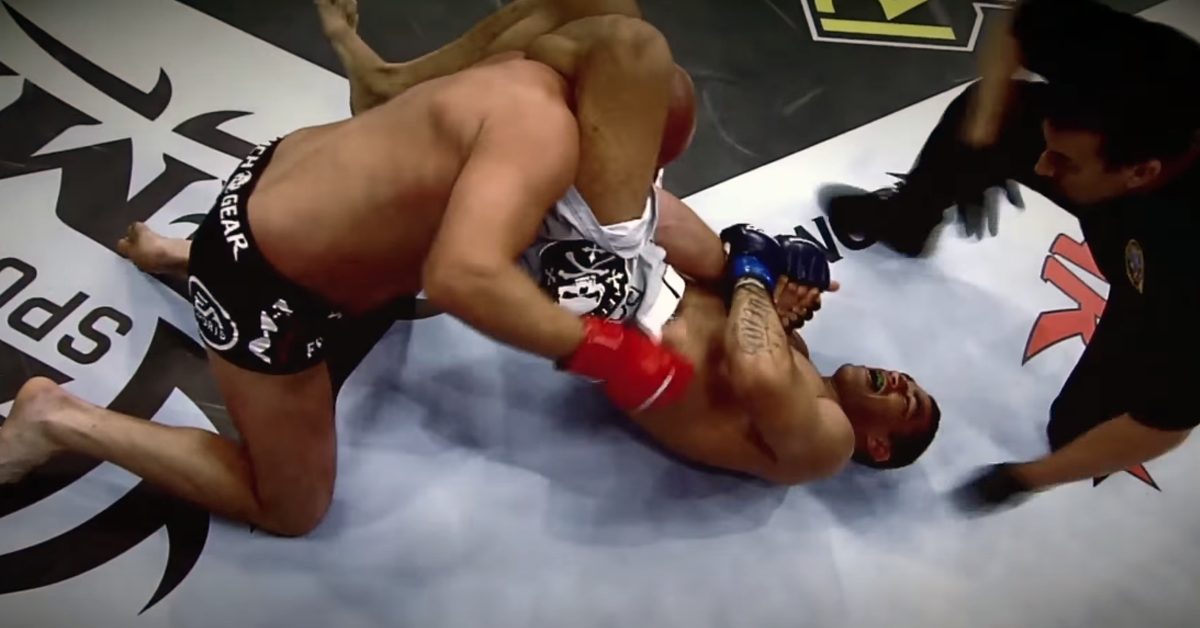
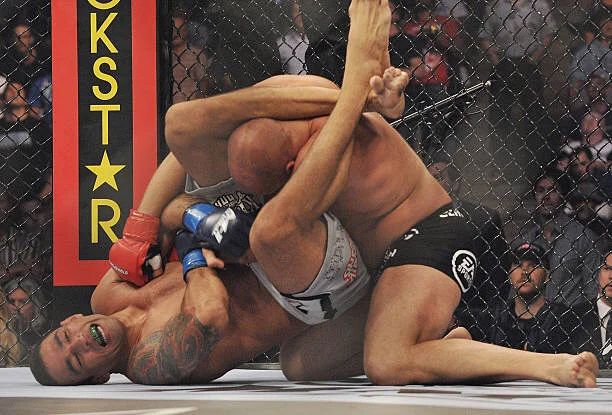
The triangle choke ended a 28-fight unbeaten streak in 69 seconds when Fabricio Werdum locked one on Fedor Emelianenko in June 2010 — a single submission that rewrote heavyweight history and reminded everyone that no-gi grappling at the highest level still bows to the figure-four. The triangle choke remains one of the highest-percentage submissions in modern no-gi competition, and the techniques that make it work without sleeves to grab are different enough that gi-trained finishers often miss them entirely. The seven setups below all rely on grips you can actually hit in a sweat-soaked rashguard scramble.
Why the Triangle Choke Still Dominates No-Gi
Strip away the gi and most chokes lose 30 percent of their setups overnight. Cross collar, baseball, ezekiel — all dead in no-gi. The triangle is different. It uses your legs as the trapping structure and your hips as the tightening engine, so the sweaty-skin problem that ruins arm chokes barely touches it. That’s a big reason the triangle still finishes roughly four out of every ten attempts at black belt no-gi competition once the lock is established, putting it in the top tier of submissions alongside the rear naked choke.
The other reason is geometry. A triangle works because your shin cuts across the carotid artery on one side of the neck while the opponent’s own shoulder collapses the other side. Cloth or no cloth, that vascular pressure doesn’t care. Your job in no-gi is just to break their posture without a lapel grip and then own the angle.
Setup 1: Closed Guard Off the Wrist-Snap Break
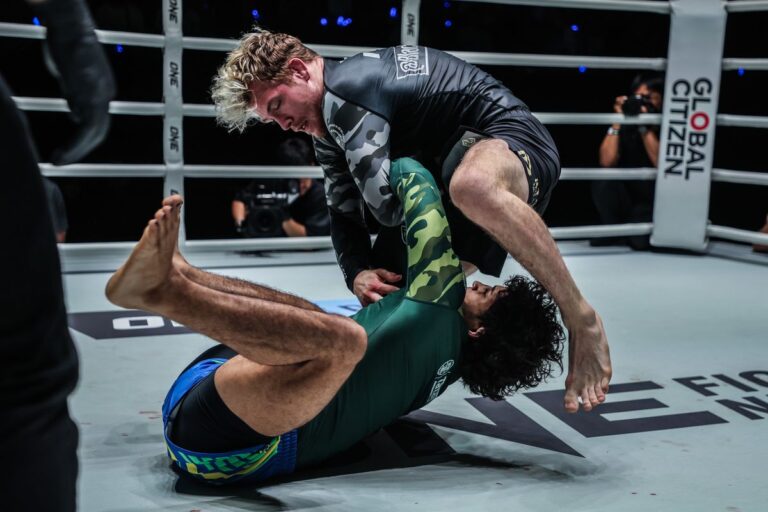
This is the bread and butter, and it’s where most beginners ruin their triangle game. You’re in closed guard. They’ve planted their right hand on your hip and posted their left forearm on your sternum. Don’t try to break the post with a straight pull — you’ll lose every time. Instead, two-hand the wrist of their posting arm, snap it down toward your hip on a 45-degree angle, and the second their elbow passes your centerline, kick that same-side leg up high over their shoulder.
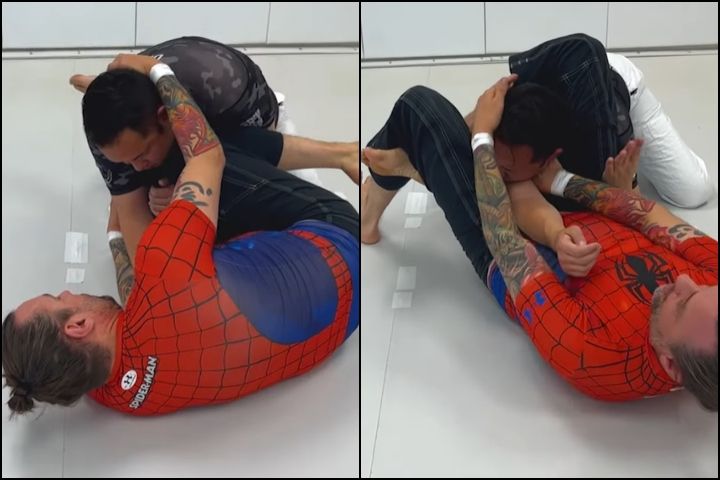
The wrist-snap is what makes this no-gi specific. In the gi, a sleeve grip lets you yank the arm down even when the elbow is still tight. In no-gi, the slipperiness forces you to commit to a two-handed control and a sharp angle change. Snap, lift the hips, kick the leg over, and lock the figure-four with your shin biting horizontally across the back of the neck — not the side. The horizontal shin is the difference between a real choke and a 45-second stall.
Setup 2: The Hip-Bump Fake
If you only have one trick in closed guard, make it this one. Pretend to hit the hip-bump sweep — sit up hard, grab the back of their tricep with your right hand, swing your left arm behind you like you’re committing to the bump. The instant they post their right hand behind them to base out, you’ve created the exact gap a triangle needs. Drop your shoulders back down, kick your left leg over their right shoulder, and trap the arm that’s now stuck out wide.
Chess Club Jiu-Jitsu’s beginner breakdown of this trap is one of the cleaner free walkthroughs on the technique, and it covers the timing detail most people miss — that you don’t actually need them to fall for the sweep. You just need them to react with a base.
Setup 3: Spider Guard to No-Gi Shin Slide
“Spider guard in no-gi?” Yes — just not the spider guard you learned in the gi. Without sleeves, you can’t grip-fight from open guard the same way, but you can hook the crook of their elbows with your shins and use the same biomechanics. Push their right bicep with your left shin, drag their left arm across your body with a wrist control, and the moment their shoulders square up off-center, your right leg has a free highway over their left shoulder.
Stephan Kesting has called this the “T-grip triangle” because the wrist-pull plus the shin-push create a perpendicular force the opponent can’t post against without surrendering the arm. The angle change happens before the lock — that’s the part beginners reverse, and it’s why their spider triangles in no-gi never finish.
Setup 4: Triangle from Mount
This one wins fights you should already be winning. You’ve climbed to mount. They turn to their side to escape, framing with their elbow and forearm against your hip. Instead of forcing back into top mount, ride the rotation — slide your knee up to their shoulder line, post your hand on the mat, and swing the opposite leg over their head. You land in a high mount triangle with their trapped arm already pinned to their chest.
Demian Maia made an entire UFC career off the mounted triangle — Chael Sonnen tapped to one of his at UFC 95 in 2009. The mounted version is the most punishing because the finish doesn’t require you to elevate your hips. Gravity does the work. You sit back, lock the figure-four, and the only escape is to give up an arm.
Setup 5: Off the Failed Armbar
Every armbar attempt your opponent stacks creates a triangle window. They’ve defended by clasping their hands and driving their weight down on your chest. The arm you wanted is stuck — but their head is now isolated on the other side, and that’s all you need. Release the armbar grip, swing the trapped leg up and over their head, and lock the figure-four on the side opposite the original attack.
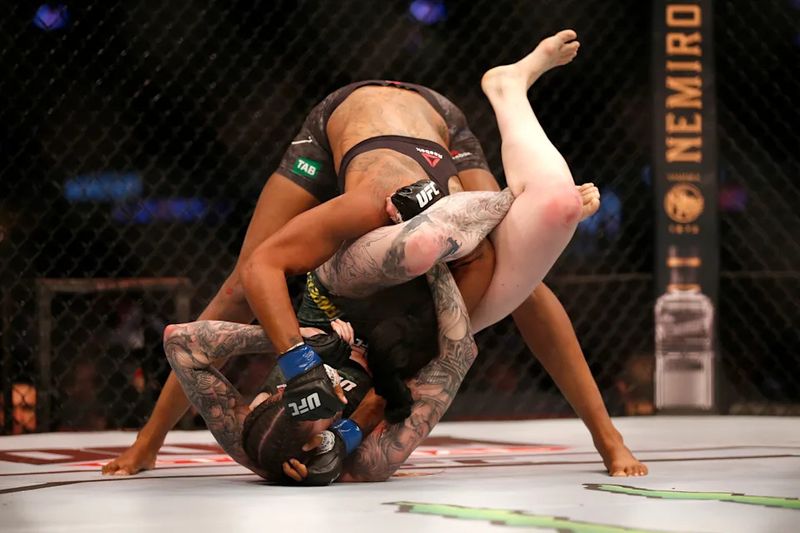
Megan Anderson hit a textbook version of this against Zarah Fairn at UFC 243 in 2019 — armbar attempt to triangle inside three minutes. The lesson isn’t that armbars fail. It’s that the failed armbar is a feature of the system, not a bug. You go for the joint, you take the choke when they defend. Both attacks share the same controlling grip on the neck-side arm, which is why the transition costs almost nothing.
Setup 6: Off a Sprawled Front Headlock
This is the no-gi setup wrestlers never see coming. You’ve sprawled on a single-leg shot and snagged a front headlock. They’re driving forward expecting a guillotine or a darce. Instead, you sit back to your hip, throw your free leg over their head from the same side as your trapped arm, and lock the triangle from a flattened position. It looks like you’re giving up the front headlock — you’re actually upgrading to a finishing position.
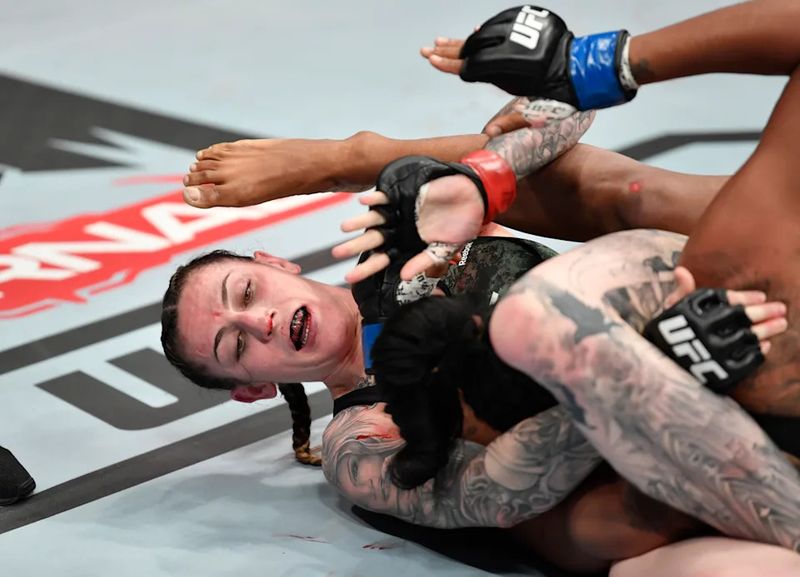
Tony Ferguson hit a version of this on Kevin Lee at UFC 216 in October 2017 to win the interim lightweight title. He threw elbows off his back, drew Lee in tight, and once Lee committed to the posture, the leg came over. Three minutes of pressure, one tap, one belt.
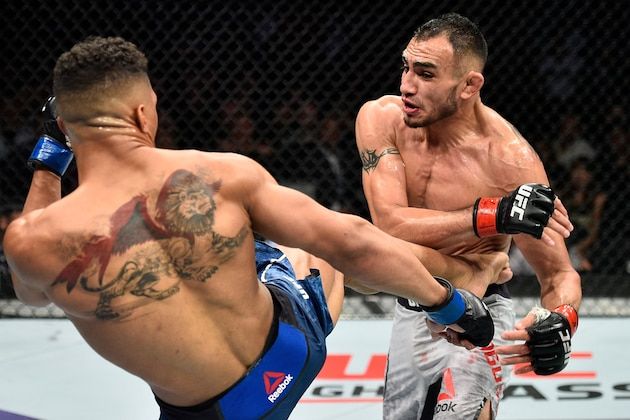

Setup 7: The Reverse Triangle from Back-Take Scramble
Modern no-gi grappling is built on scrambles, and the reverse triangle is the submission that lives in those scrambles. You’ve shot for the back. They’ve turned in instead of going belly-down. As they roll, their far arm gets isolated by your bottom leg and their head is stuck between your hip and your top leg. Lock the figure-four backward — same shin-across-the-neck principle, just rotated 180 degrees.
This is the version Roger Gracie used to submit Xande Ribeiro in under 30 seconds at the 2006 Pan Ams, and modern no-gi competitors like Gordon Ryan have turned it into a closing move from the back-attack system. It’s also the reason “give up the back to defend the triangle” is bad advice — the reverse waits for exactly that mistake.
The Finish: 3 Things Most People Miss
The lock isn’t the finish. Most no-gi triangles fail at the squeeze, not the entry. Three things separate a tap from a stall.
First, the angle. Your hips must be perpendicular to their spine, not parallel. If you’re facing the ceiling when you lock up, you can’t finish — you have to cut to the side, reaching under their far leg or hooking around their hip to drag yourself into the 90-degree position. The angle change shortens the distance your legs need to travel and seals the choke around the neck instead of pinching the chin.
Second, the trapped arm has to be across the throat. If their arm is just sitting next to their neck, they can breathe and stall. Pull the wrist of the trapped arm hard toward your opposite hip — across the centerline. That’s what jams their own shoulder into the carotid on the open side.
Third, lift the head and pull, don’t just squeeze. A two-hand grip on the back of the skull, elbows pinched in, lifting their head off the mat and pulling it into your sternum — that’s the engine. Your legs hold the structure. Your arms drive the tap.
Drilling the Triangle Choke for No-Gi
The triangle is a high-rep skill, not a high-IQ skill. The grapplers who finish it consistently are the ones who’ve done a thousand hip escapes into the lock from closed guard and a thousand kick-over reps from butterfly. Five minutes of triangle-specific drilling at the start of every no-gi session — alternating sides, partner offering progressive resistance — builds the timing that lets you hit the entry against a live, sweaty opponent.
Pair the drilling with two live-roll constraints. First: in every round, your only submission attempt is a triangle. You’ll fail more, but you’ll learn the entries that don’t depend on stalling on top. Second: drill the failed-armbar-to-triangle transition until it feels like one technique. Going for a kimura or armbar should set up the triangle automatically — and vice versa.
The Triangle Choke at the Elite Level
Paul Craig holds the UFC record for triangle-choke finishes with four — a stat made stranger by the fact that he hits them off his back from full guard against opponents who have him pinned and being punched. Craig’s career is a one-man case study in the no-gi triangle’s survival value. When you’re losing position, the triangle is the only submission that rewards bottom position more than top position.

At the pure grappling level, Diogo “Baby Shark” Reis closed out his second straight ADCC gold in 2024 with an arm-triangle variation against Diego Pato in the -66kg final, part of a tournament where arm triangles climbed to 10 percent of all finishes. The classic figure-four and the arm-in variation share enough mechanics that learning one accelerates the other.
The takeaway from a decade of elite no-gi tape is plain: the triangle is not a position you graduate from, it’s a position you keep sharpening. Anderson Silva versus Chael Sonnen, Ferguson versus Lee, Werdum versus Fedor — those are championship-level fighters tapping to a submission most people learn in their first six months of training. The difference at the top isn’t a new technique. It’s a cleaner angle, a meaner squeeze, and the patience to wait for the elbow to cross the centerline.
Train the Triangle Until It’s Reflex
Pick one setup from this list and drill it every session for the next 30 days. Same setup, same side, same partner if possible. At rep 500 you’ll start hitting it live. By rep 1,000 it’ll feel like a punch — something your body does before your brain decides. That’s the bar for a no-gi finisher, and it’s the same bar a 14,800-search-a-month keyword still gets fewer than a hundred clear, no-gi-focused breakdowns to meet. Outwork the field at the technique level, and the rankings — both in the gym and on Google — start to take care of themselves. While you’re at it, fold the triangle into the rest of your submission tree by stacking it next to a guillotine choke off the front headlock and a heel hook off the failed leg drag — three finishes, one scramble, every round.
Sources
- Fighters Only — Werdum submits Fedor (triangle/armbar) — June 2010 Strikeforce match, 1:09 of round one
- UFC — Anderson Silva vs Chael Sonnen UFC 117 triangle — Hall of Fame induction context
- Bleacher Report — Ferguson submits Lee at UFC 216 — Triangle choke for interim lightweight title
- Yahoo Sports — Megan Anderson UFC 243 triangle breakdown — Arm-in triangle off back
- FloGrappling — Diogo Reis arm triangle in ADCC 2024 -66kg final
- Grapplearts — Spider guard triangle setup for no-gi — Stephan Kesting / Elliott Bayev breakdown
- Wikipedia — Paul Craig UFC career — Four triangle-choke finishes record
- Chess Club Jiu-Jitsu — No-gi triangle off hip-bump fake — YouTube technique walkthrough
Browse our top-rated rashguards and no-gi gear at the RashguardGuy shop →