
No-Gi Mount Attacks: 7 Submissions That Work at the Top Level
Holding top mount and doing nothing with it is one of the most expensive mistakes in no-gi BJJ. Mount looks dominant on the scoreboard, but it earns no submission percentage unless you have a system. What separates grapplers who consistently finish from mount from those who just hold the position is simple: they have at least three attacks they can chain together, and they know exactly what opens when one closes.
The no-gi mount has specific challenges that the gi doesn’t. Without a collar to grip, your opponent’s hip escapes are harder to stop and the bridge-and-roll defense is more reliable. This pushes you toward faster attack timing, better weight distribution, and the S-mount position — where escape mechanics change entirely. These seven submissions account for the practical realities of no-gi and give you a complete attack framework from the top.
1. Arm Bar From S-Mount
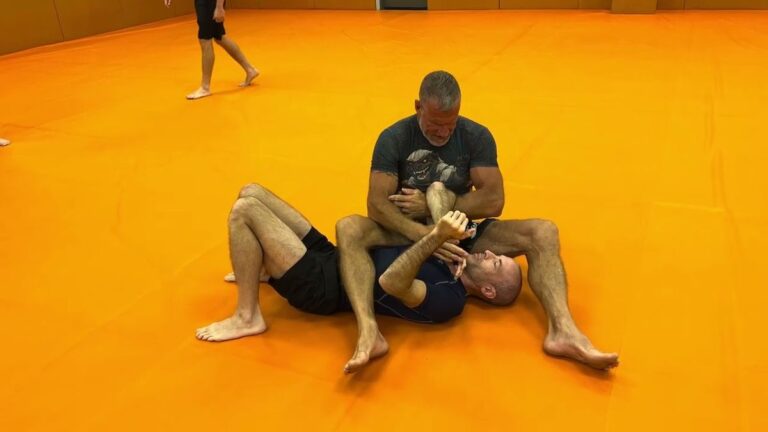
Standard mount gives your opponent room to bridge and roll because your weight sits on their pelvis. S-mount does not. To get to S-mount, shift your weight forward so your near knee slides up into the armpit and your other foot hooks their hip. Your base moves from their hips to their upper torso, and the bridge-and-roll escape loses most of its effectiveness because they can’t generate the rotation.
From S-mount, the arm bar entry appears every time they try to push your knee away from their armpit. Reach behind their elbow with your near hand, control their wrist with your other hand, then step your foot across their chest and pivot backward to finish. In no-gi, the grip is the critical detail — without a sleeve, you need to secure wrist control before you begin the pivot. Lose the wrist and they pull the arm out before you’re positioned.
What makes this chain useful is its built-in logic: the more they try to recover guard and frame against your knee, the more their arms come up into arm bar range. The defense creates the opening.
2. Kimura From Top Mount
Most people associate the kimura with half guard or closed guard. From mount, it’s less common — which is exactly why it works. The entry appears when your opponent pushes their forearm into your hip with a straight-arm defensive frame. That straight arm is an open kimura invitation.
When you see the frame, post your hand on their forearm to keep it in place, tighten your knee against their hip to close the space, then reach over with your far arm to grab their wrist. Thread your near arm under their elbow and grab your own wrist for the figure-four. Walk your hips backward to create the rotation angle and apply the lever. The finish is identical to the half-guard kimura — the setup is entirely different.
The kimura from mount works particularly well when combined with the arm bar: threaten the arm bar from S-mount, they pull the arm in and frame, then you transition to the kimura on the framing arm. Two attacks from a single position, each defensive response feeding the next. For more on how the kimura chains from turtle and standing entries, see the breakdown of the kimura trap no-gi — the grip mechanics are the same across all positions.
3. Americana From Mount
The Americana is one of the first submissions taught from top mount. That ubiquity is a double-edged sword — everyone knows the defense, which means the setup has to be cleaner. The entry appears when your opponent frames with their forearm at roughly 90 degrees to their body, which they often do instinctively when trying to push you off their chest.
Pin their wrist to the mat with your palm (not by squeezing — by posting your weight through your arm), then slide your other arm under their elbow and grab your own wrist to form the figure-four. The key is keeping their elbow below shoulder height throughout. The moment their elbow rises above the shoulder, the joint mechanics change and the lock loses its effect.
In no-gi, the biggest challenge is preventing them from turning into you to escape the lever. Anchor your knee hard against their ribs to limit that rotation. If they start to turn in despite the anchor, don’t fight it — transition immediately to the mounted triangle, which opens from precisely that turning motion.
4. Ezekiel Choke From Mount (No-Gi Variation)
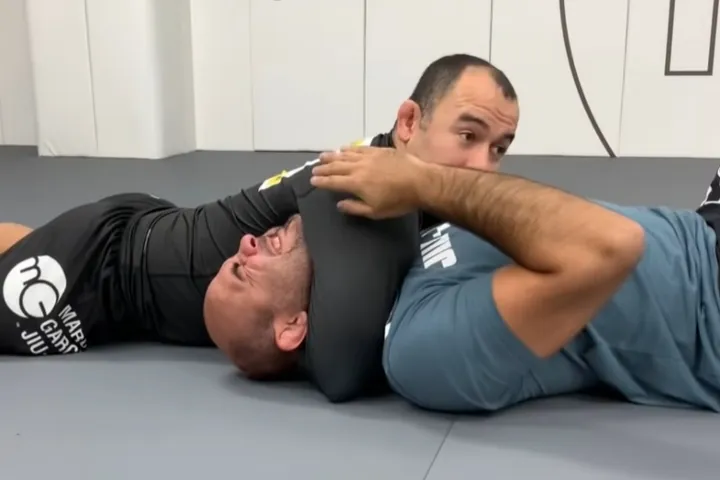
The gi Ezekiel uses the sleeve as the choking surface. In no-gi, the mechanics shift to a forearm-based attack. The setup requires a tight, low mount where your chest is heavy on their chest and your arms are in a headlock position around their head. From that position, thread one forearm under their chin until it crosses their near-side carotid, then use the palm or forearm of your other arm to create pressure on the opposite carotid. Both arteries are attacked simultaneously, and the tap arrives quickly.
What makes the no-gi Ezekiel particularly effective from mount is that their most common defensive response — framing both arms against your hips to push you away — actually sets up the attack. When they push, you follow forward and establish the headlock position. Their frame does the work of loading the entry angle for you. Once the headlock is tight and the threading arm is under the chin, they’re locked in position and can’t bridge to escape.
The Ezekiel choke no-gi breakdown covers the arm configuration in detail, including the variation where they’ve defended the standard approach by tucking their chin. The chin-tuck defense has a specific counter that depends on the headlock tightness, not extra force.
5. Mounted Triangle
The mounted triangle appears when your opponent defends aggressively by posting both forearms against your hips or neck — the same defensive framing that slows down the arm bar and Ezekiel setup. Snatch one of the framing arms across their body with your near hand, swing your leg over that arm and their head, lock the triangle with your other leg, and apply the finish: hip angle shift, pull their head into your body, close the leg lock.
The reason this works from mount specifically is that your weight and position already load the entry angle. Your opponent’s framing motion — which they intend as a defensive push — pulls their arm precisely into the position you need. The faster you recognize that framing posture, the faster the mounted triangle closes.
For the specific mechanics on the finish, including the hip rotation that prevents them from posturing out and the angle adjustment when they try to stack, see the mounted triangle no-gi breakdown. The finish from mount is slightly different from the closed guard triangle because your weight is already on top — you can use that pressure rather than fighting to create it.
6. Back Take Into Rear Naked Choke
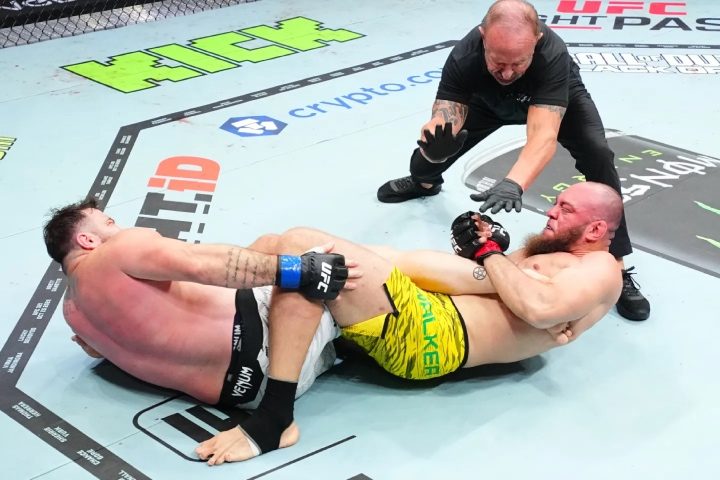
This is not a submission from mount — it’s a submission chain that travels through mount. When your opponent commits to the bridge-and-roll escape, you follow their movement and take the back. When they roll to their knees to defend, you take the back from turtle. Either path leads to the rear naked choke, which has one of the highest finish rates of any submission in no-gi competition.
The key in no-gi is reading the bridge early. As they load the bridge (hips rising, pushing off one foot), shift your weight into the rising side, post your hand, and follow the roll rather than resisting it. You end with your chest on their back and both hooks in. Rushing the rear naked choke before both hooks are set is where the position gets lost — establish control first, then attack the neck.
The back take from a failed mount escape is one of the cleanest transitions in no-gi grappling precisely because you’re not forcing a position against resistance. Their escape attempt is what creates the back exposure. The more committed their bridge is, the easier the follow.
7. Arm Triangle Transition to North-South
The arm triangle from mount targets the defensive posture where your opponent pushes one arm up into your body at mid-height to prevent your weight from settling. When they extend that arm, slide it across their own neck with your forearm, cinch your arm under their head and over their extended arm, and either stay on top (for a mounted arm triangle) or transition to a north-south position and complete the blood choke from there.
In no-gi, the arm triangle works identically to the gi version: your opponent’s own shoulder creates the carotid compression once you close the figure-four and apply downward pressure. The transition to north-south is often more efficient because it removes their ability to bridge and creates a more direct compression angle. Walk your knee up toward their head, slide to north-south, then complete the choke.
The arm triangle is the most positionally disruptive of these seven attacks — it begins in mount and often finishes from side control or north-south, which means even if they partially defend it, you’ve passed their guard and improved your position.
How to Chain These Attacks Together
Each of these seven submissions works in isolation. But they work better as chains, because each defensive response to one attack creates the geometry for another. Threaten the arm bar from S-mount and they pull their arm in and frame: the mounted triangle and Ezekiel both open from that frame. Push into the Ezekiel and they bridge to escape: the back take follows the bridge. Go for the Americana and they turn in to escape: the mounted triangle closes on their turning arm.
The mental model that makes mount attacks consistent is simple: attack, observe the defense, attack the defense. You’re not forcing one submission until it works — you’re using each attack to create the opening for the next. The back take is often the submission that closes a long chain, because the opponent runs out of options and commits to an escape attempt that hands you the position.
Start with two attacks: the arm bar from S-mount and the back take. Chain those until they’re automatic. Add the Ezekiel once you can reliably hold a tight, low mount. The mounted triangle and kimura come next as you develop sensitivity to specific defensive patterns. Over time, what started as seven separate techniques becomes one connected problem your opponent can’t solve.
Sources
- Evolve MMA — 5 Attacks From the Mount Position in BJJ — Overview of fundamental mount submissions and their mechanics
- BJJ World — The Best BJJ Submissions From Mount — Competition data on which submissions finish most frequently from mount
- NAGA Fighter — The Mount in BJJ: Mechanics, Importance, and Usage — Positional breakdown of top mount control and why position precedes submission
Image credit: fab.com