High Elbow Guillotine No-Gi: 7 Details That Make the Choke Actually Work
Marcelo Garcia won four ADCC World Championships. At the 2011 final, he tapped Vítor Ribeiro with a guillotine in 40 seconds. The match before that, David Hart went out in under two minutes — same choke, same finish. Garcia’s total ADCC submission count remains the highest in the event’s history, and most of those taps came from one variation of one technique. Not from superior wrestling or leg lock skill. From a specific elbow position most grapplers still misunderstand today.
High Elbow vs. Standard Guillotine: The Mechanical Difference
The standard guillotine — what most people learn first — wraps the choking arm under the opponent’s chin with the elbow pointing toward the hips or ribs. It finishes when the angle is right and the opponent is tired. It also gives up a lot.
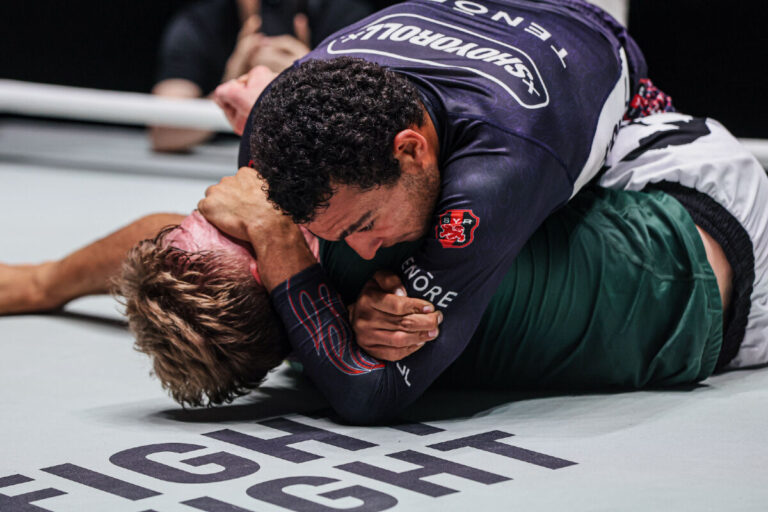
The high elbow version changes one thing: the elbow drives up, past the opponent’s shoulder, pointing toward the ceiling. That single shift does several things simultaneously. The forearm sinks deeper into the carotid arteries. The opponent can no longer stack forward to escape, because there’s no structure for their body weight to push against. And the Von Flue choke — the standard counter to a lazy guillotine — stops working entirely.
This isn’t a subtle variation. It’s a different mechanical problem for the person being choked. The ADCC data backs it up: Garcia’s guillotine was not just a preference — it was reliable across weight classes, against elite competition, under pressure. When Garry Tonon and the Danaher Death Squad made front headlock attacks a cornerstone of their no-gi system, the high elbow guillotine was the submission that anchored it.
The Grip: Where Most Grapplers Lose the Finish
The grip for the high elbow guillotine is precise, and getting it wrong means relying on muscle instead of mechanics.
The contact point is the bony ridge of the wrist — the hard surface just below the thumb. That’s what presses against the carotid artery, not the soft forearm muscle. The palm faces toward the opponent’s neck. The support hand cups the choking hand from the outside to prevent the grip from sliding — it’s not there to pull, it’s there to hold the contact point in place.
From there, the elbow drives upward. Not laterally, not toward the opponent’s far shoulder — straight toward the ceiling. That direction locks the wrist ridge against the carotid from a high angle and compresses the blood choke without requiring arm strength to finish. Many grapplers try to squeeze with the bicep or forearm and burn out before the tap comes. The wrist ridge position applies targeted pressure on a smaller area and finishes faster.
The support hand is often underappreciated. A pull creates movement that lets the grip slip. A reinforcing squeeze holds the contact point fixed. Small distinction, big difference in how long the choke holds under resistance.
Setting Up the High Elbow from the Snap-Down
The snap-down to high elbow guillotine is the entry Garry Tonon built much of his no-gi attack game around, and it runs on a single predictable reaction.
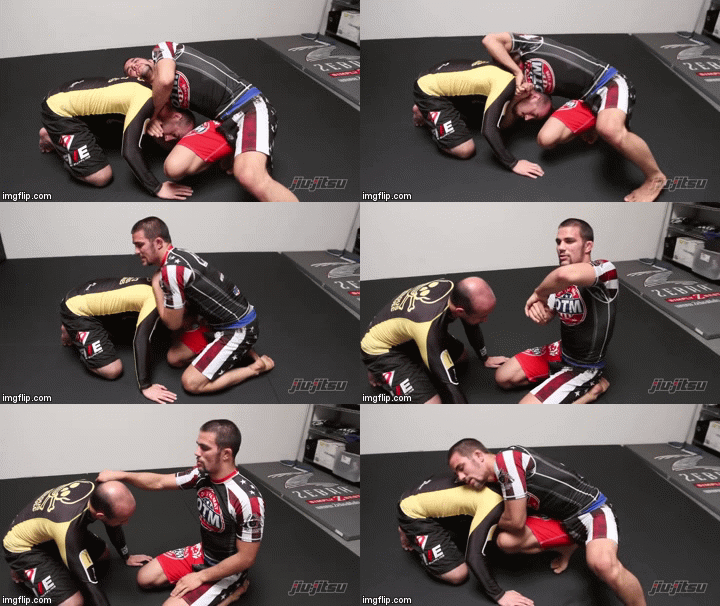
From a collar tie or two-on-one grip, the snap-down drives the opponent’s head toward the mat. Their natural response is to push back — to recover posture. That push-back is the window. As the head drives upward through the center, the neck passes through front headlock range. The choking arm shoots under the chin during that upward motion, not after it. The elbow goes high immediately on entry.
Timing here is everything. Waiting for the opponent to fully recover posture before shooting the arm closes the window. The arm goes in while they’re mid-reaction. See our detailed breakdown of the no-gi snap-down for the grip and footwork mechanics in isolation.
Once in the front headlock with the arm in position, walk toward the choking-arm side. That lateral movement closes the angle, adds downward pressure through body weight, and tightens the choke without any additional grip force.
Finishing from Guard: Closed and Butterfly
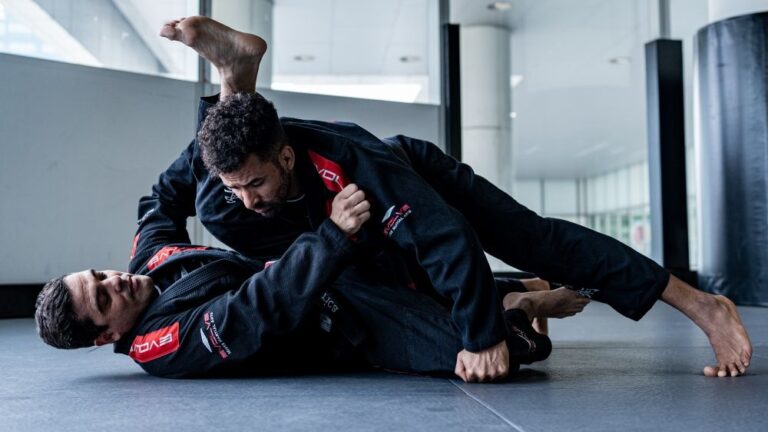
Some of Garcia’s most memorable finishes came not from front headlock scrambles but from guard — specifically butterfly guard, where he would pull deliberately to attack the high elbow.
From closed guard, the setup triggers when the opponent postures hard or shoots in with their head low. The choking arm goes under the chin with the elbow already tracking upward. The legs wrap around the hips to stop the stack, and the hips drive forward to compress from below while the arm compresses from above.
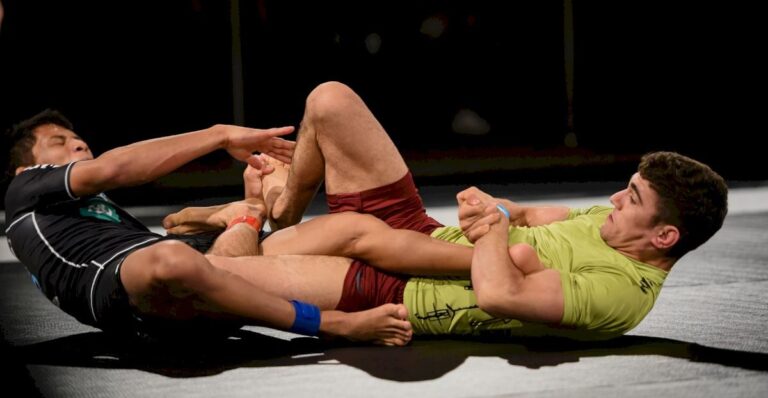
Butterfly guard changes the geometry. Hooks inside the opponent’s thighs allow a hip extension — you drive the butterfly hooks forward while the choke compresses — creating two-directional pressure that finishes faster than closed guard alone. Garcia used this combination repeatedly at ADCC, pulling opponents into the position deliberately rather than waiting for it to appear.
One adjustment worth knowing: if the opponent stacks hard into closed guard, don’t fight it. Roll toward the choking arm’s side. Most of the time, the guillotine finishes during the roll. Resisting the stack tires the arms; moving with it often earns the tap.
Why the Von Flue Counter Stops Working
The Von Flue choke works when a grappler shoots a guillotine with a low elbow. The opponent sprawls, pins the attacker’s shoulder under their chest, and applies neck pressure from that shoulder — finishing the attacker with their own attack. It’s a reliable counter specifically because low-elbow guillotines expose the shoulder.
The high elbow removes that exposure. When the elbow points toward the ceiling, there’s no shoulder surface available for the opponent’s chest to pin. They can sprawl all they want, but the mechanical lever that powers the Von Flue never engages. The sprawl just creates a little space — which you use to walk your feet around toward the choking-arm side and tighten the angle.
This is the practical reason the elbow position matters beyond just generating more choke pressure. It’s not only about squeezing harder. It’s about pre-empting the response that would otherwise let the opponent escape or reverse the situation. A correctly positioned high elbow guillotine removes the opponent’s best defensive option before they can use it.
Seven Details That Separate a Tight Finish from a Bail-Out
The high elbow guillotine has a reputation for reliability — but only when the mechanics are right. These are the checkpoints:
- Elbow points toward the ceiling, not sideways. If the elbow drifts horizontal or toward the mat, the angle is wrong and the choke won’t finish without force.
- Wrist bone contacts the carotid. The bony ridge below the thumb does the choking. Squeezing with the forearm meat means relying on muscle, and the opponent can wait it out.
- Palm faces the neck. If the palm rotates away, the wrist bone isn’t connecting properly and the pressure vector shifts off target.
- Head on the far side. Your head goes to the side opposite the choking arm. This keeps the body alignment tight and makes it harder for the opponent to pull you off position.
- Walk to the choking-arm side. Lateral movement improves the angle and compresses the choke through body weight rather than arm strength.
- Whole body closes the choke. Hunch the torso forward while squeezing the elbows toward each other. Arms alone can’t finish cleanly against a resisting opponent.
- Close every gap at first contact. The second the arm goes in, eliminate space between your body and theirs. Gaps give opponents room to posture out or pop the head free.
Training the High Elbow Guillotine Into Your No-Gi Game
Understanding the technique and finishing it in live rolling are two different problems. The high elbow guillotine requires a specific arm path that doesn’t feel natural early, and the timing window for the entry is short.
Two drills are worth isolating. The first: snap-down entry from collar tie. Drill the arm path slowly with a cooperative partner, focused on tracking the elbow high from the moment the arm goes in. Do it until the elbow position is automatic — then add resistance. Slow deliberate reps build the correct motor pattern; timing develops from there.
The second: pull to butterfly guard, attack the high elbow immediately as the opponent reacts to establish base. This trains the opportunistic version — the finish you get from reading how the opponent responds to position, not from a rehearsed setup.
In sparring, start from front headlock specifically. This bypasses the entry problem and puts you directly into finish practice against real resistance. Most training partners fight hard from front headlock. That’s the point — the finish has to work against someone actively defending.
The goal is to make the guillotine family your primary no-gi threat — something opponents account for from the moment contact is made. That’s what Garcia’s version did. It wasn’t just a submission; it shaped how every opponent approached him. Understanding the full guillotine choke family gives the high elbow its context and shows how the variations connect.
Sources
- What Makes the Marcelotine Better Than a Regular Guillotine — BJJ World, technical breakdown of the Marcelotine’s mechanics and why the high elbow position changes the choke
- Arm-In Guillotine vs. High Elbow Guillotine (Marcelotine) — BJJ Fanatics, comparison of guillotine variations with mechanics breakdown
- Top Finishers of All Time in ADCC — BJJ Heroes, Marcelo Garcia’s ADCC submission record and career statistics
- ADCC 2011 Results: Is Marcelo Garcia the Greatest of All Time? — Bloody Elbow, ADCC 2011 championship coverage including Garcia’s guillotine finishes
- Garry Tonon, High Elbow Guillotine — ADCC News, Tonon’s technique breakdown from Jiu-Jitsu Magazine Issue 27
- The Guillotine Index — FloGrappling, analysis of guillotine variations across elite no-gi competition
Image credit: bjj-world.com