Estima Lock No-Gi: The Foot Lock Most Grapplers Can’t See Coming
Victor Estima discovered this technique by accident while drilling with his brother Braulio ahead of the 2009 ADCC Submission Wrestling World Championship. Braulio pushed his foot into Victor’s midsection during a guard pass attempt, and instead of letting it go, Victor trapped it to his body. The result was a foot lock that Braulio had no answer for — and one that would later catch Rafael Lovato Jr. at ADCC and cement the Estima name in grappling history.
What separates this submission from the 20 other footlocks you’ve drilled is the counter-intuitive entry. You do not hunt the foot. You wait for your opponent to hand it to you.

What Makes the Estima Lock Different from Other Footlocks
Most leg lock systems are offensive — you initiate, you chase, you dive for the foot. The estima lock works the opposite way. The submission window opens when your opponent pushes their foot into your torso to create distance or defend a pass. That moment of extension is the entire setup.
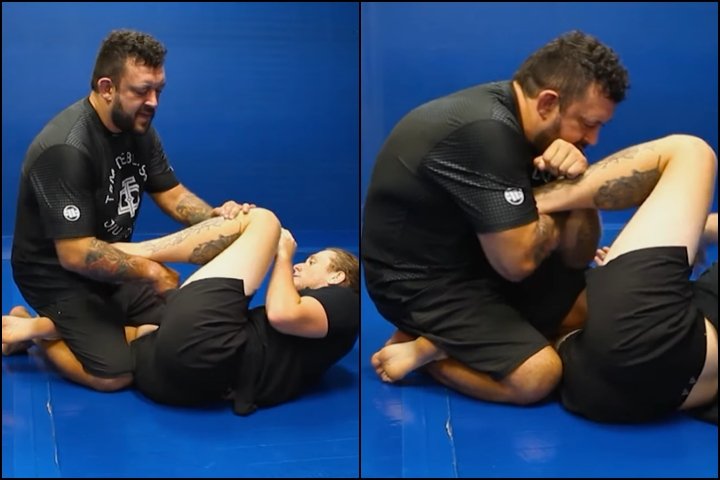
The mechanical difference is in the grip and body position. A standard toe hold typically involves isolating the foot from the outside and wrist-wrapping across the top of the foot. The estima lock traps the foot against the midsection with both arms forming a closed system: one arm hooks under the Achilles, the other clamps the top of the foot while the heel is pinched against your ribcage. When you fall backward, the ankle rotates inward and the joint runs out of room fast.
This is why the submission catches people who know it’s coming. By the time the defender feels the grip, the foot is already fully captured. Grapplers who actively kick into their opponent’s body during open guard — a reflex most people develop to maintain distance — are handing over the exact position this lock requires.

The Mechanics: How to Finish the Estima Lock
Getting the grip right is everything. Here is the sequence as Braulio and Victor Estima teach it:
- Trap the foot against your body. As your opponent pushes their foot into your midsection, clamp it tight with your elbows. The heel should be against your lower ribcage or hip.
- Hook wrist under the Achilles. Your inside arm slides under the Achilles tendon. This is the fulcrum point for the rotation.
- Top arm locks the foot. Your outside arm comes over the top of the foot and grabs your own bicep (like an RNC-style grip) or grips the ankle. The foot cannot rotate out of position once this is set.
- Block their hip. Before you fall, post your outside leg against their hip to prevent them from rolling away.
- Fall to the outside and rotate. Drop to the mat away from your opponent, turning the heel upward as you go. The ankle runs out of rotation and the tap comes quickly.
The finish needs to be deliberate, not explosive. A panicked crank is how training partners get hurt. Control the drop, feel the tension build, and stop the moment they tap.

3 Setups That Reliably Create the Entry
The estima lock does not require a specific guard system. It appears naturally in several common no-gi positions whenever your opponent extends a foot into your body. These three setups generate that moment consistently.
Lasso Guard Counter
When your opponent has a lasso grip on your arm and you close your elbow to break it while faking a knee slice pass, they often push their bottom foot into your hip to reset. Close your elbow tight, drive your hip into the foot to deepen the trap, set the two-arm grip, and fall away. The lasso guard player’s instinct to push — exactly what you need — works against them here. This is the setup Victor Estima specifically highlighted when teaching the technique’s origin.
In-and-Out Pass Attempt
You loop an arm under the ankle from the outside while driving your hip forward in a pressure pass. Instead of completing the pass, you overhook the ankle with the outside arm, drive your body into their extended foot, and execute the lock from a standing or kneeling position. The timing window is tight — the entry happens mid-pass, not after — so drilling the transition until it’s automatic matters more here than in any other setup.
Reverse De La Riva Hook
From reverse De La Riva, hook under the leg on their hip. As you crunch your abdomen toward your opponent, their foot naturally extends into your midsection during their attempt to maintain the hook and keep you at distance. That extension is the entry. Trap the foot, close the grip, fall to the outside. From RDL, the position already puts you at the correct angle for the finish.

What the Estima Lock Does to the Joint — and Why It’s Dangerous
The submission targets the ankle ligaments and the talocrural joint. As the heel rotates inward against the fulcrum of your forearm, the lateral ligaments of the ankle — primarily the anterior talofibular ligament (ATFL) — come under increasing tension. The foot simultaneously externally rotates at the subtalar joint. The combined stress is similar to a severe inversion sprain, except delivered with mechanical assistance that makes the damage happen faster than a natural roll.
That speed is the main safety concern. The estima lock can injure before the defender processes what is happening. Train it at controlled speed. The IBJJF ruleset classifies it as an illegal submission at lower belts for this reason — it is permitted starting at brown belt in gi competition, and openly in most no-gi formats.

Common Mistakes That Kill the Submission
Three errors account for most failed estima lock attempts:
Chasing the foot. The moment you lunge for the foot, your opponent retracts it and the window closes. The lock works because the opponent brings the foot to you. If they don’t extend, keep passing — the entry will come later.
Incomplete foot entrapment. A loose grip lets the foot slip free as you fall. The foot has to be completely locked against your body before the rotation starts. If you can feel slack in the grip, reset.
Forgetting to block the hip. Without a hip block, the defender can simply roll with the rotation and come out on top. Your outside leg posts against their hip before you fall, not after. This detail is the difference between a submission and a scramble that costs you position.
If you want a detailed drill breakdown from one of the best instructors in this area, Tom DeBlass covers all three setups and the finish mechanics in this video:

Defending the Estima Lock
The defense starts before the grip is set. Once the foot is fully trapped against the body with both arms closed, your options narrow fast. Getting out clean requires recognizing the threat early.
- Retract before the grip closes. The moment you feel a hand on your foot during a pass attempt, pull the leg back sharply. This is a reflex to drill — feet that extend during open guard need to come back the instant something closes on them.
- Roll into the lock, not away from it. If the grip is already set, rolling toward the submission relieves some of the ankle torque and may create a scramble. Rolling away from it lets the mechanical advantage compound against you.
- Counter with your own footlock. If you recognize the entry early, your free leg can engage their leg for a heel hook or straight ankle attempt. The threat forces them to abandon the estima lock or accept a simultaneous submission race.
The best defense at the competitive level is grip awareness — understanding which guards and pass sequences create the foot extension that starts this chain, and modifying your open guard mechanics to reduce that exposure. Grapplers who rely heavily on lasso guard or spider guard to stop passes extend their feet frequently. For those guard systems, adding the estima lock to your passing game turns one of your opponent’s primary tools into a consistent submission threat.
For grapplers developing a more complete leg lock system, the principles here complement techniques like the kimura trap in no-gi — where a single grip creates a web of submission threats. And if you want another submission that catches people from unexpected angles during passes, the wrist lock in no-gi operates on the same catch-them-by-surprise mechanic.

Where the Estima Lock Fits in Your No-Gi Game
This submission is most useful for grapplers who do a lot of pressure passing. The entries appear naturally when you are driving forward to break someone’s guard, and the foot extension is something your opponent produces as a response to that pressure — not something you have to manufacture.
If you train with someone who relies on lasso guard, extended spider guard, or reverse De La Riva to stop your passes, start adding the entry awareness now. The technique does not require a complete overhaul of your game — it plugs into what you already do. You are already creating the moment where the foot extends. You just have not been capturing it yet.
The snap down offers a different kind of entry into leg lock territory, and if you haven’t worked it yet, this breakdown on the snap down in no-gi gives you another route to the same attacking positions that feed into foot lock sequences.
Victor Estima was drilling with his brother when they stumbled into something neither could explain technically at the time — they just knew it worked. Braulio used it to win ADCC. Fifteen years later, it still catches high-level competitors who know it’s coming because the entry is baked into natural guard-passing mechanics. That is what makes a submission worth adding to your game.
Sources
- Low Kick MMA — Estima Lock: BJJ Submission Explained — Origin story from Victor Estima, ADCC 2009 context.
- Evolve MMA — Everything You Need to Know About the Estima Lock — Mechanics and no-gi application overview.
- Digitsu — Estima Lock Breakdown & Stats — Competitive application data and technique breakdown.
- IBJJF General System of Rules — Classification of footlocks by belt level.
Image credit: bjjee.com