Chuck Norris Martial Arts Legacy: How He Shaped Combat Sports
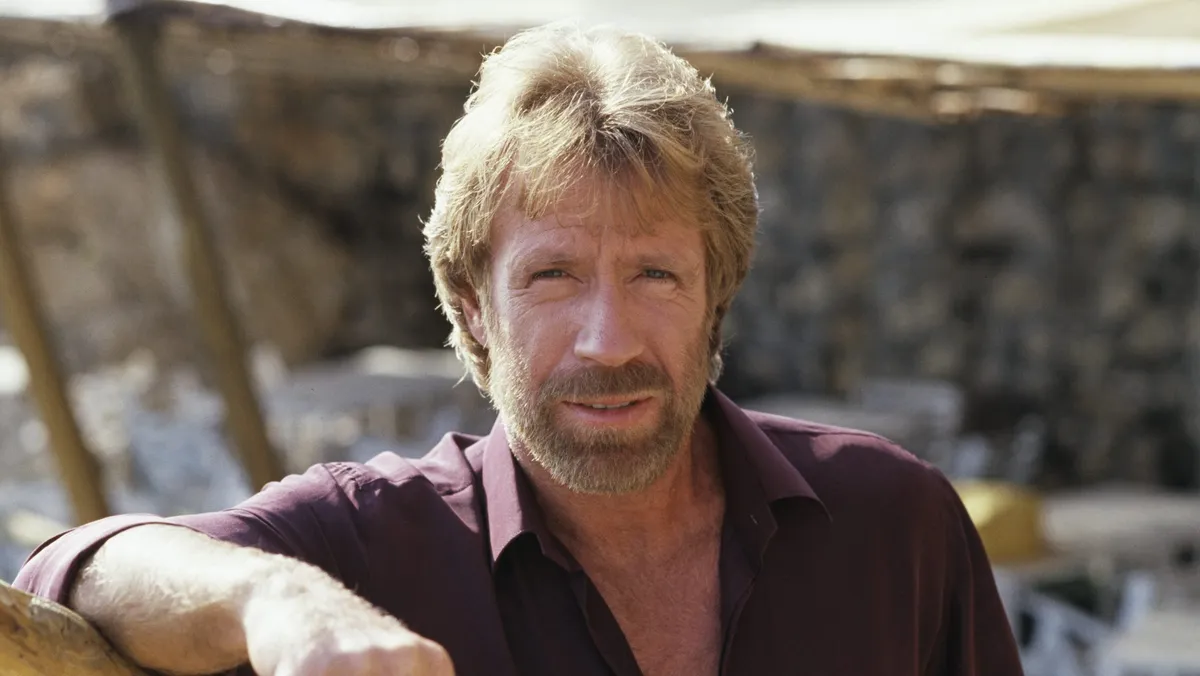
Chuck Norris, the six-time World Professional Middleweight Karate Champion who became America’s most iconic martial arts action star, passed away on March 19, 2026, at the age of 86. While the world remembers the internet memes and one-liners, the combat sports community lost something far more significant — a man who fundamentally changed how Americans viewed fighting, helped bridge the gap between traditional martial arts and modern mixed martial arts, and brought combat sports into living rooms across the country decades before the UFC existed.
His influence on grappling culture and MMA runs deeper than most casual fans realize. From his competitive karate career to his friendship with Bruce Lee, from creating his own hybrid fighting system to putting martial arts combat on primetime television, Chuck Norris helped build the foundation that modern combat sports stands on.
From Air Force Airman to Karate World Champion
Carlos Ray “Chuck” Norris was born on March 10, 1940, in Ryan, Oklahoma. His path to martial arts stardom began during his service in the United States Air Force, where he was stationed at Osan Air Base in South Korea in 1958. There, he discovered Tang Soo Do, the Korean martial art that would become the backbone of his fighting career. He trained obsessively, earning his black belt before returning stateside.
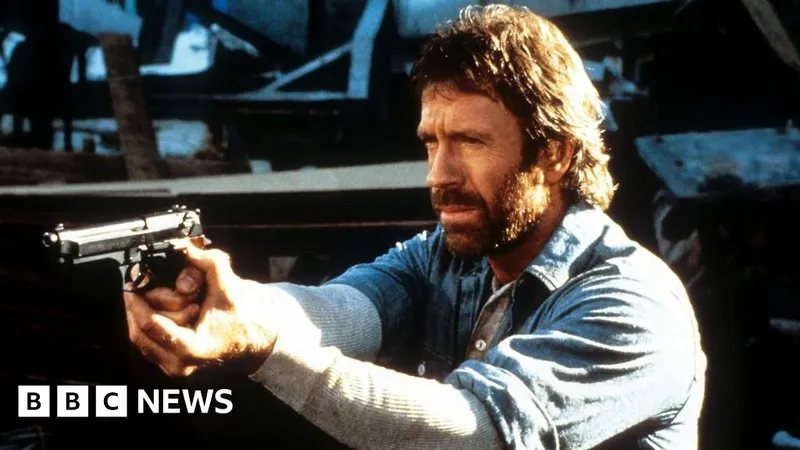
Back in the United States, Norris threw himself into competitive karate with a ferocity that quickly set him apart. Between 1965 and 1970, he won virtually every major title in American karate — the International Karate Championships in 1967 and 1968, the All American Championships, the National Tournament of Champions, and the crown jewel: the World Professional Middleweight Karate Championship in 1968. He held that title six consecutive years, retiring undefeated.
What made Norris special wasn’t just his win record. His fighting style was aggressive, fast, and innovative. He relied on devastating spinning kicks, precise timing, and a willingness to mix techniques from multiple disciplines at a time when most fighters stayed rigidly within their style’s playbook. That cross-training mentality would prove prophetic.
The Bruce Lee Connection That Changed Everything
Norris met Bruce Lee at a martial arts demonstration in 1964, and the two became fast friends. They trained together, pushed each other, and shared a philosophy that transcended the rigid boundaries of any single fighting style. Lee was developing Jeet Kune Do, his concept of absorbing what is useful and discarding what is not. Norris was doing something similar on the competitive circuit, blending Tang Soo Do with techniques from judo, grappling arts, and Western boxing.
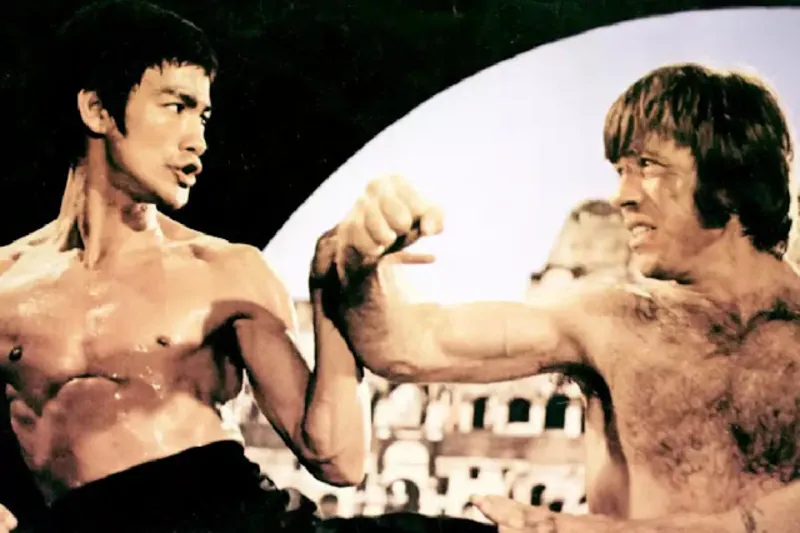
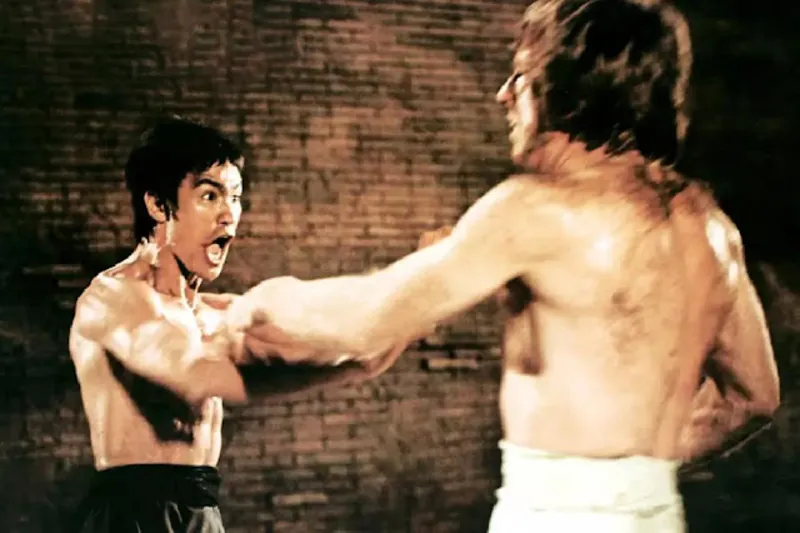
Their friendship led to one of the most famous fight scenes in cinema history. In 1972’s The Way of the Dragon, Lee cast Norris as his primary antagonist — a blond, hairy-chested American fighter named Colt who faces off against Lee’s character in the Roman Colosseum. The fight scene, which Lee choreographed, is widely considered one of the greatest martial arts sequences ever filmed. Lee reportedly bribed Italian officials to film illegally inside the actual Colosseum, and the result was electric.
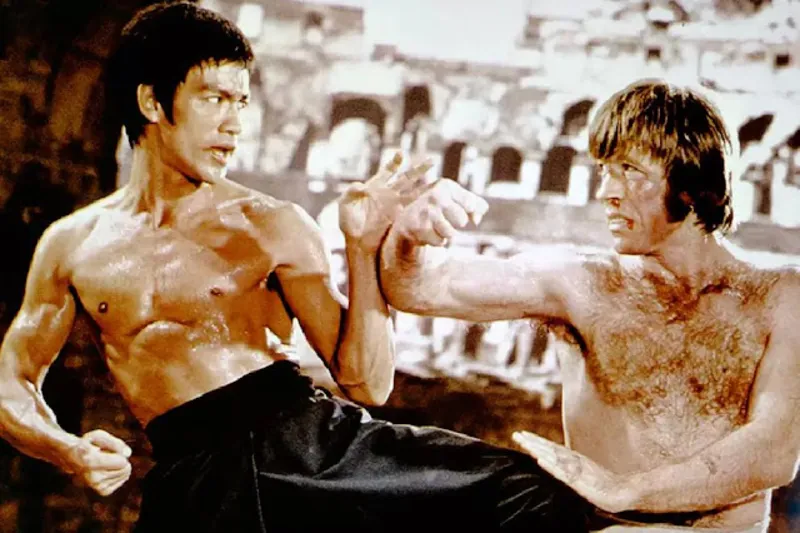
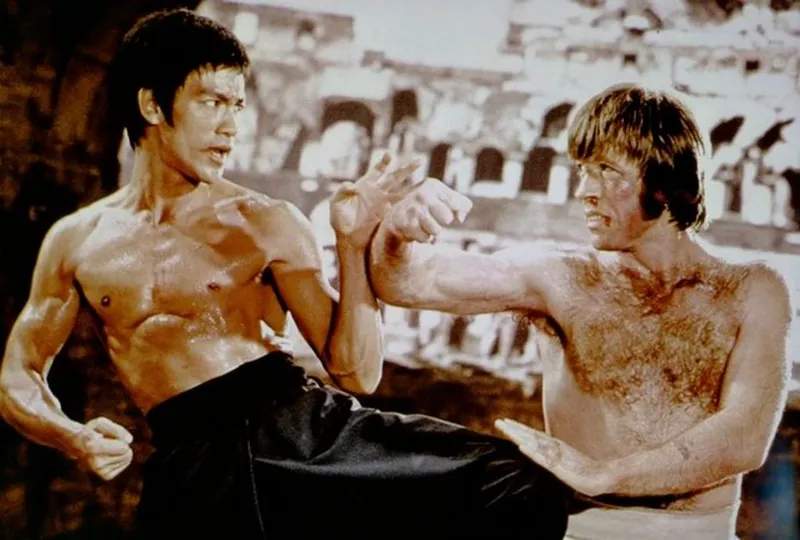
The scene showed Norris transitioning between striking and grappling — something audiences had never really seen before. The fight incorporated takedowns, ground control, and joint manipulation alongside the expected kicks and punches. For millions of moviegoers in 1972, this was their first exposure to the idea that a real fight involves multiple ranges and disciplines. It was a proto-MMA moment, decades before the term existed.
Building an Action Empire on Martial Arts Authenticity
After The Way of the Dragon, Norris could have faded into obscurity. Instead, on the advice of his student Steve McQueen, he took acting lessons and began building a career that would bring martial arts action to mainstream American audiences. Films like Good Guys Wear Black (1978), A Force of One (1979), The Octagon (1980), and the Missing in Action trilogy cemented him as the biggest American-born martial arts movie star of his generation.
Unlike many action stars who relied purely on choreography, Norris brought legitimate competitive credentials to every fight scene. He planted a heel in someone’s gut, spun once to knock them off balance with a boot to the chest, spun again to catch the shoulder with his instep, threw in a punch to vary the rhythm, and finished with a high kick to the head. His trademark roundhouse kick became the most imitated technique in action movie history. Audiences could sense the difference between a trained fighter and an actor pretending — and Norris was the real deal.
His films consistently featured themes that resonated with the combat sports community: discipline over brute strength, the warrior code, and the idea that martial arts training builds character rather than just fighting ability. These weren’t just entertainment choices. They reflected Norris’s genuine philosophy and helped legitimize martial arts in American culture at a time when many still dismissed it as exotic nonsense.
Walker, Texas Ranger: Fighting on Primetime TV
Norris’s biggest cultural impact arguably came through television. Walker, Texas Ranger ran for eight seasons (1993-2001) and roughly 200 episodes on CBS, consistently pulling in massive ratings. The show featured Norris as Cordell Walker, a decorated Vietnam veteran and Texas Ranger who used his martial arts skills to dispense justice on a weekly basis.
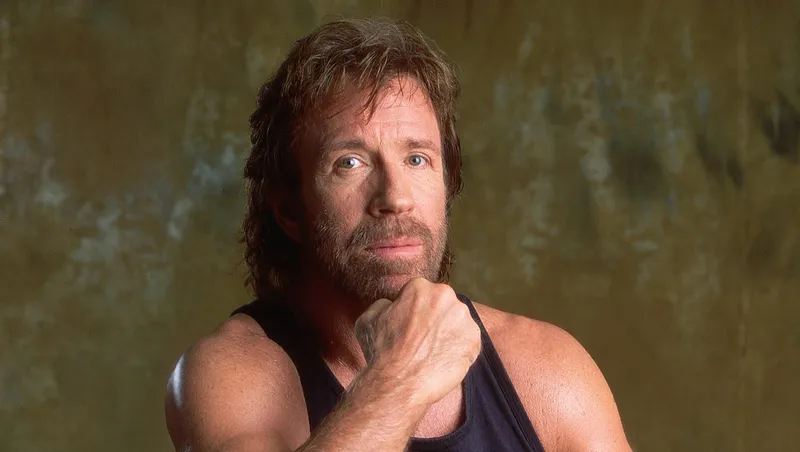
Every single episode featured extended fight sequences, and Norris insisted on performing his own stunts. For nearly a decade, tens of millions of Americans tuned in weekly to watch martial arts combat on network television. This constant exposure normalized fighting arts in a way that no movie could. It made combat sports accessible, entertaining, and — crucially — heroic. Walker wasn’t a violent thug. He was a moral man who used his training to protect the vulnerable. That framing mattered enormously for the public perception of martial arts.
The timing was significant too. Walker, Texas Ranger overlapped with the early years of the UFC, which launched in 1993. While the UFC was fighting for legitimacy against political opposition and media backlash, Norris was presenting martial arts combat as wholesome, admirable, and thoroughly American on one of the biggest networks in the country. He wasn’t directly promoting MMA, but he was softening the cultural ground that MMA needed to grow in.
Chun Kuk Do: A Hybrid System Ahead of Its Time
Perhaps the clearest evidence of Norris’s forward-thinking approach to combat sports was his creation of Chun Kuk Do — which translates to “The Universal Way.” Rather than sticking to a single traditional discipline, Norris built a system that blended Tang Soo Do, karate, judo, Brazilian jiu-jitsu, and various grappling arts into a cohesive whole.
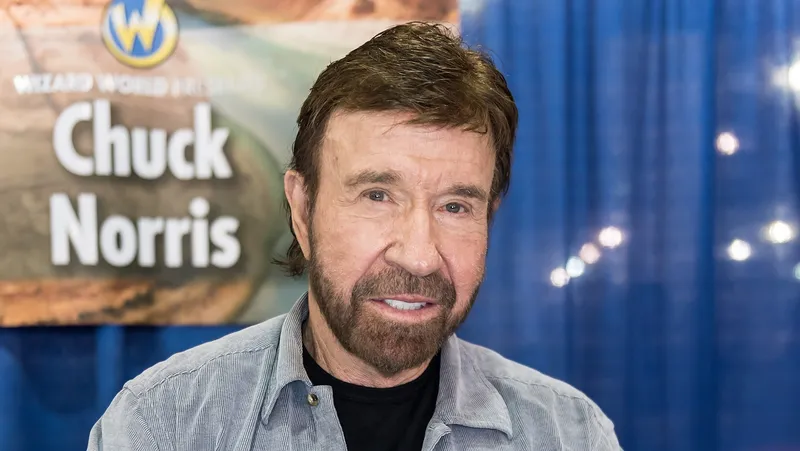
This was the same concept that would later drive the explosion of MMA — the idea that no single style is complete, that a true fighter must be competent on the feet, in the clinch, and on the ground. Norris was teaching this philosophy through his United Fighting Arts Federation (UFAF) decades before the Gracie family brought BJJ to America and forced the martial arts world to confront the reality of cross-training.
Norris held black belts in an extraordinary range of disciplines: Tang Soo Do, taekwondo, karate, Brazilian jiu-jitsu (under the legendary Carlos Machado), and judo (under Gene LeBell, the godfather of American grappling). He didn’t just collect ranks for show. He actively trained and integrated these arts into his teaching and his personal practice well into his 80s.
His BJJ training under Carlos Machado is particularly noteworthy for the grappling community. Norris didn’t approach BJJ as a celebrity looking for a belt — he earned his third-degree black belt through years of dedicated mat time and study. He helped bring Machado to the United States and gave the Machado brothers early exposure that helped establish their academy system alongside the more famous Gracie lineage.
The Norris Effect on MMA’s Rise
It’s impossible to fully quantify Chuck Norris’s contribution to the rise of MMA, but the threads are clear. He popularized cross-training when martial arts purists mocked it. He demonstrated through his competitive career that techniques from multiple styles could be combined effectively. He brought martial arts combat to mainstream American audiences through film and television, creating a generation of viewers who were already primed to appreciate what the UFC would eventually offer.
Multiple UFC champions have cited Norris as an early inspiration. His roundhouse kick became the gold standard that every striking coach references. His willingness to train with and learn from practitioners of other styles — at a time when many martial artists viewed other disciplines with contempt — modeled the open-minded approach that defines modern MMA training.
Dana White, UFC president, released a statement calling Norris “one of the true pioneers of martial arts in America” who “helped create the culture that made the UFC possible.” That assessment isn’t hyperbole. Without decades of Chuck Norris normalizing martial arts combat in American popular culture, the UFC’s path to mainstream acceptance would have been significantly harder.
The Internet Legend and the Man Behind It
The “Chuck Norris Facts” meme explosion of the mid-2000s turned Norris into perhaps the most famous martial artist alive, surpassing even Bruce Lee in terms of pure name recognition. “Chuck Norris doesn’t do push-ups — he pushes the earth down.” The jokes were absurd, but they worked because they were built on a foundation of genuine toughness that everyone acknowledged.
Norris embraced the memes with good humor, eventually publishing The Official Chuck Norris Fact Book. He was secure enough in his actual accomplishments to laugh at the exaggerations. As he told interviewers: “Did you know that I got bit by a king cobra? And after five days of agonizing pain, the cobra died.”
Behind the memes was a man who ran martial arts schools, established philanthropies for children through his Kickstart Kids foundation, supported veterans’ causes, and continued training daily well into his eighth decade. He wrote ten books, including martial arts instruction manuals, memoirs, and a conservative activist handbook. He was, by all accounts, genuinely committed to the martial arts lifestyle he promoted.
Legacy for the Grappling Community
For the no-gi and grappling community specifically, Norris’s legacy centers on several key contributions. He was among the first prominent American martial artists to seriously train Brazilian jiu-jitsu, helping establish the Machado lineage in the United States. His Chun Kuk Do system incorporated grappling techniques at a time when most American martial arts schools completely ignored ground fighting. His television and film work normalized the idea that grappling — not just striking — was a legitimate and exciting form of combat.
He proved that a champion striker could humble himself, put on a white belt, and start over on the mats. That’s a message the grappling community values deeply — the idea that real martial artists never stop learning, never stop evolving, and never let ego prevent them from expanding their skills.
Chuck Norris was 86 years old when he died, but his impact on combat sports will outlive us all. He took martial arts from the fringes of American culture and put them on movie screens and television sets across the country. He cross-trained before cross-training was cool. He earned his grappling credentials on the mat, not through celebrity privilege. And he did it all with a roundhouse kick that — memes aside — really was as devastating as advertised.
Rest in peace, Chuck. The combat sports world is better because you fought for it.
Browse our top-rated rashguards and no-gi gear at the RashguardGuy shop →