
IBJJF Absolute Grand Prix: 7 Lessons From Victor Hugo’s Win
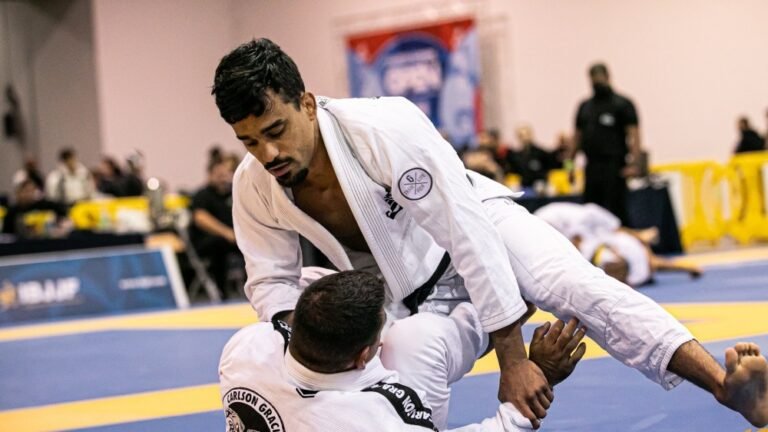
IBJJF Absolute Grand Prix 2026 gave no-gi fans a clear answer fast. Victor Hugo won the tournament, beat Pedro Marinho 15-2 in the final, and looked every bit like the most physically overwhelming athlete in the bracket. The bigger story, though, is not just who won. It is how the bracket showed the current no-gi meta in real time: size still matters, but only when it is paired with disciplined passing, clean positional decisions, and the patience to punish risky leg entries.

If you missed the event, here is the short version. Victor Hugo beat Marlon Tajik on points in the quarterfinals, submitted Javier Barter in the semifinals, and then pulled away from Pedro Marinho in the championship match. On the other side of the bracket, Marinho beat Diego Pato on points and submitted Gustavo Batista in under 30 seconds to reach the final. FloGrappling’s live results and card listings also confirmed a strong undercard, including Helena Crevar submitting Aghata Rabelo in a no-gi superfight that mattered almost as much to the future of the scene as the main bracket itself.
For Rashguard Guy readers, this event matters because it was not just another results page. It was a concentrated look at where elite no-gi grappling is heading in 2026. If you have been following our coverage of the ADCC 2026 world championship, the WNO 32 results, and our breakdowns of pressure-based passing like body lock passing in no-gi, the grand prix tied those threads together in one night.
Table of Contents
- IBJJF Absolute Grand Prix 2026 results
- How Victor Hugo won the final
- Why Pedro Marinho’s run still mattered
- What Michael Pixley vs Gustavo Batista told us
- Helena Crevar kept building her no-gi case
- What it means for no-gi in 2026
IBJJF Absolute Grand Prix 2026 results
The main bracket was small, but there were no soft spots. FloGrappling’s event card listed Victor Hugo, Pedro Marinho, Michael Pixley, Diego Pato, Gustavo Batista, Javier Barter, Nick Hartman, and Marlon Tajik in the field. That mix alone made the tournament worth tracking. You had proven heavyweight pressure passers, a dangerous smaller finisher in Diego Pato, a decorated wrestler making a black belt statement in Pixley, and enough submission threats to make every leg exchange risky.

| Round | Match | Result |
|---|---|---|
| Quarterfinal | Victor Hugo vs Marlon Tajik | Victor Hugo won on points |
| Quarterfinal | Javier Barter vs Nick Hartman | Javier Barter won by submission |
| Quarterfinal | Pedro Marinho vs Diego Pato | Pedro Marinho won on points |
| Quarterfinal | Gustavo Batista vs Michael Pixley | Gustavo Batista won on points |
| Semifinal | Victor Hugo vs Javier Barter | Victor Hugo won by rear-naked choke |
| Semifinal | Pedro Marinho vs Gustavo Batista | Pedro Marinho won by submission in under 30 seconds |
| Final | Victor Hugo vs Pedro Marinho | Victor Hugo won 15-2 on points |
That bracket makes the winner more impressive. Hugo did not just beat a random heavyweight field. He beat a flexible, dangerous Marlon Tajik, then finished Javier Barter, then solved Pedro Marinho after Marinho had already torn through his side of the draw. In a sport that sometimes overvalues highlight reels, Hugo won with something more durable: pressure, structure, and the ability to make every exchange feel expensive for the other guy.
How Victor Hugo won the final

FloGrappling’s live recap of the final tells the story. The first half was active but mostly even, with hand fighting, snaps, duck-unders, and no score through five minutes. Marinho briefly turned during a scramble, Hugo bull-rushed the position, came up for two, and immediately moved toward mount. That sequence was the pivot point. Once Hugo could convert size into stable top control, the match stopped looking like a coin flip.
The next key moment came when Marinho dropped back for a heel hook. That is the kind of attack that can change a bracket instantly, but against a bigger, balanced passer it also carries real downside. Hugo came up into side control, extended the score, returned to mount, and turned a close match into a dominant finish. By the end, the final score was 15-2, which sounds lopsided because it became lopsided. Hugo made the right reads at the exact moments when the match could still have swung.
This is what elite absolute no-gi winning looks like right now. It is not reckless pace. It is selective pressure. Hugo did not force bad scrambles when he did not have to. He waited for Marinho to give him transitions he could finish with control. That kind of discipline is why his tournament run felt so mature.
Why Pedro Marinho’s run still mattered
Pedro Marinho lost the final, but writing him off would miss the actual lesson. He beat Diego Pato 2-0 in a hard style-clash quarterfinal, then submitted Gustavo Batista almost immediately in the semifinal. That matters because it showed Marinho can still control smaller explosive movement and still threaten a fast finish against someone with elite black-belt experience.
The Pato matchup was especially useful. Pato is one of the sharpest smaller no-gi threats in the sport, and Marinho smothered the pace before leg entries could turn into momentum. In other words, Marinho gave fans a reminder that heavyweight no-gi is not just about being big. It is about knowing when to pressure, when to flatten a smaller athlete out, and when to deny the scramble altogether.
Then came the semifinal with Batista. The finish was so fast it almost feels like a typo, but that is part of the point. Marinho is still dangerous enough to end a high-level match before the tactical script even develops. He did not have enough left to solve Hugo in the final, but his route there still reinforced his standing as one of the most serious big-match no-gi competitors in the game.
What Michael Pixley vs Gustavo Batista told us

Michael Pixley’s quarterfinal with Gustavo Batista might wind up mattering more in hindsight than it did in the live moment. FloGrappling framed it as Pixley’s black belt debut against a multiple-time black belt world champion, and the match played out like a real test of tournament maturity. Pixley threatened from the front headlock and flashed enough d’arce danger to make Batista careful, but Batista’s guard work and score management were cleaner late.
That is useful information for no-gi fans because it highlights a recurring 2026 theme. Wrestlers crossing deeper into elite submission grappling can absolutely compete, but high-level black belts are still hard to out-manage over a full match if you give away penalties or fail to convert front-headlock threats into finishing sequences. Pixley did not look out of place. He looked dangerous. But Batista looked experienced in the specific way that wins tournament rounds.
If Pixley keeps sharpening his decision-making around passing urgency and penalty management, he is going to become a nightmare in big brackets. This match felt less like a setback and more like a preview.
Helena Crevar kept building her no-gi case
Yes, the bracket was the main attraction, but the undercard mattered. Helena Crevar’s no-gi superfight with Aghata Rabelo was one of the best signals of where the women’s side of elite grappling is going. According to FloGrappling’s live recap, Helena survived a tricky early sequence, wrestled up from K guard for points, then finished with a d’arce choke after defending a serious kneebar threat. That is a lot of high-level decision-making in one match.

The reason it matters here is simple. No-gi at the top level is getting more complete. Crevar was not just playing one lane. She moved between guard retention, leg entanglements, wrestle-ups, and front-headlock finishing. That blend is exactly what readers should watch if they want to understand the technical direction of the sport instead of just memorizing results.
And yes, Diego Pato deserves another note here too. He lost to Marinho, but just being willing to take that kind of absolute no-gi test says a lot about his standing. Smaller athletes who jump into brackets like this help show where technique can still stretch the size gap, even when the result does not go their way.
What it means for no-gi in 2026
IBJJF Absolute Grand Prix 2026 did not rewrite the sport overnight, but it clarified a few things. First, elite pressure passing remains brutally reliable when the athlete on top can also neutralize lower-body attacks without panicking. Second, smaller elite names can still be dangerous in openweight settings, but the path gets narrow if they fall behind on points early. Third, the best no-gi athletes in 2026 are not specialists in the old sense. They are layered. They can wrestle, pass, defend leg locks, and finish when a neck or back appears for half a second.
That is why Victor Hugo’s win matters beyond the check and the headline. He looked like the kind of athlete who can translate across formats. He can win a bracket, not just a superfight. He can survive small moments of danger without giving the match away. And in modern no-gi, that is often the line between being respected and being the last person standing.
If you are trying to track what this means for the rest of the year, connect this event to the bigger calendar. ADCC remains the prestige mountain, WNO still shapes style conversations, and IBJJF keeps producing technical snapshots that tell you which athletes are improving in ways that carry across rule sets. The smartest move is not to treat any one promotion as the whole sport. It is to watch how the same themes repeat across all of them.
Victor Hugo won the IBJJF Absolute Grand Prix 2026, but the wider takeaway is that no-gi keeps rewarding the athletes who can slow chaos down, hold position under stress, and punish bad choices instantly. That is not flashy language. It is just what the bracket showed.
Sources
- LIVE RESULTS From The IBJJF No-Gi Grand Prix — FloGrappling live match-by-match results used for the final, semifinals, quarterfinals, and Helena Crevar recap.
- The Full Card For The 2026 IBJJF No-Gi Grand Prix — FloGrappling event card confirming the absolute bracket field and superfight lineup.
- Victor Hugo — FloGrappling athlete profile used for background on the champion.
- Pedro Marinho — FloGrappling athlete profile used for background on the finalist.
- Michael Pixley — FloGrappling athlete profile referenced for Pixley’s wrestling-to-grappling context.
- IBJJF GP 2026: Helena Crevar ingressa no card contra Aghata Rabelo — FloGrappling pre-event coverage confirming the no-gi superfight matchup.
Browse our top-rated rashguards and no-gi gear at the RashguardGuy shop →