
No-Gi Hamstring Injuries: 7 Keys to Recover
A hamstring strain rarely announces itself with a pop. More often it shows up as a tight pull behind the knee mid-scramble, or a dead-leg feeling the next morning that makes stairs miserable. Samuel Chu and Monica Rho’s 2016 review in Current Sports Medicine Reports breaks hamstring strains into three grades, and the gap between them is the difference between missing one week of training and missing a full competition season. No-gi grappling adds its own wrinkle: a 2026 survey of 341 grappling athletes out of Leeds Beckett University found that major injuries — more than 28 days to return to normal training — made up 49.5% of everything reported across the sport. Lower-body soft tissue damage sits inside that number more often than most grapplers assume.
Why No-Gi Loads the Hamstring Differently
The hamstring’s job during a sprawl, a guard pull, or a leg lock escape is almost never to shorten and pull. It’s to lengthen under tension while decelerating the leg — an eccentric contraction, the same mechanism that tears a sprinter’s hamstring at full speed. A 2021 mechanism review in the Saudi Journal of Sports Medicine lists stretching, sliding, turning, twisting, and escape or take-off movements as classic hamstring strain triggers in wrestling-style sports, and no-gi grappling hits almost every one of those categories in a single scramble. The moment a sprawl against a double leg meets a partner who shoots low and fast, the hamstring is asked to stop hip flexion it never saw coming.
No-gi adds exposure that gi grappling limits. Without fabric to grip, scrambles move faster and legs get isolated more often — in ashi garami entanglements, in deep half guard, in the instant before a back take. The lower the friction, the more a trapped leg can get extended past where the hamstring wanted to stop.

The Three Grades of a Hamstring Strain, and What Each One Feels Like
Chu and Rho’s grading system is the one most sports medicine clinics still use. Grade I is a mild strain: no real loss of strength, some tightness, and low-grade inflammation that eases within days. Grade II is a partial tear: noticeable strength loss, swelling, and often visible bruising as the torn fibers bleed into the surrounding tissue. Grade III is a complete tear or rupture, with a sudden, obvious loss of function and sometimes a palpable gap in the muscle.
Recovery timelines vary more than most grapplers expect, and not just by grade. The same review found elite sprinters needed a mean of 16 weeks to return to full pre-injury performance after a high-speed strain, while professional dancers recovering from an overstretch-type injury averaged a mean of 50 weeks. No-gi grapplers usually land closer to the overstretch category — a trapped leg or a wide scramble stance looks a lot more like a dancer’s injury mechanism than a sprinter’s flat-out stride.

Where No-Gi Grapplers Actually Tear It
Four positions account for most of the hamstring strains that show up in no-gi gyms. Sprawling against a shot is the most common: the hips drop, the legs kick back, and if the sprawl lands a half-beat late, the hamstring eccentrically decelerates a leg that’s already moving at speed. Pulling guard on a slick or overly sticky mat is the second — when the back foot doesn’t release cleanly as the hips drop, the trailing leg gets stretched into hip flexion faster than the muscle can lengthen safely.
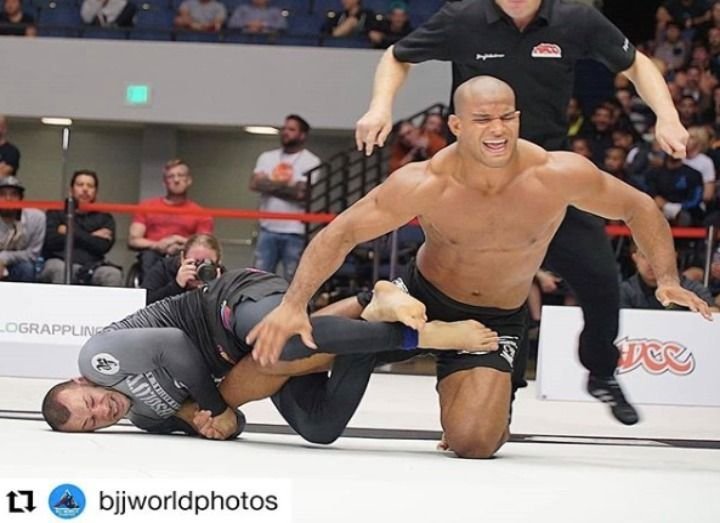
Leg lock entanglements are the third, and the one that surprises newer no-gi grapplers most. Once a leg is trapped in ashi garami or a similar position, your training partner controls how far that leg extends, not you. A partner who doesn’t feel you tap fast enough, or who finishes through a scramble instead of a clean setup, can push the hamstring and the knee past the point either joint wanted to stop at the same time.

The fourth is the explosive scramble: a back take, a berimbolo-style inversion, or a desperate escape where one leg plants hard while the other drives through a full range of motion in under a second. None of these four mechanisms involve a static stretch. All four involve a hamstring working hard while it’s already lengthened, which is exactly the loading pattern every hamstring injury study on this list flags as highest-risk.

Red Flags That Mean You See a Doctor, Not a Trainer
Most hamstring soreness after a hard scramble settles down in a day or two and loosens as you warm up. A handful of signs mean you stop self-treating and book an appointment instead:
- A sharp, specific pain you can point to with one finger, especially if it came with an audible pop
- Bruising that shows up at the back of the thigh within 24 to 48 hours, especially if it spreads toward the knee
- Any inability to bend the knee against resistance, or a leg that buckles under your own bodyweight
- Numbness, tingling, or a burning sensation running down the back of the leg
- Pain that hasn’t eased at all, even slightly, after three full days
- A visible dent, gap, or lump in the muscle belly itself
Bruising is the symptom grapplers most often shrug off because it looks worse than it feels in the moment. A strain severe enough to tear blood vessels and produce visible discoloration is, by definition, at least a Grade II injury, and that’s a different recovery conversation than a tight hamstring that loosens up by Thursday.
The Return Timeline No One Tells You
Grade I strains typically allow a return to light training in one to three weeks, once walking, bending, and isometric contraction are all pain-free. Grade II injuries run anywhere from two to twelve weeks before full-contact rolling makes sense, and that range depends heavily on how much of the muscle tore and how disciplined the rehab was in the first two weeks. Grade III tears are measured in months, not weeks, and often involve an orthopedic consult before anyone talks about a return date.
The number that should change how every grappler handles this injury is the reinjury rate. Chu and Rho’s review puts it at nearly one in three hamstring strains recurring, and the second injury is frequently worse than the first because it happens on tissue that hasn’t finished remodeling. Most of those recurrences happen in the first two weeks back, which is exactly when a grappler feels 90% recovered and decides that’s close enough for a hard round.

Rehab runs in three phases. Phase one is RICE and pain reduction, with slow, pain-free isometric holds once the acute swelling calms down. Phase two adds eccentric loading — the Nordic curl is the standard here — along with faster neuromuscular drills as strength returns without pain. Phase three is sport-specific: controlled drilling first, then light flow rolling with a partner who knows to ease off leg attacks, and only then full-resistance rounds.
Taping, Icing, and What Actually Helps a No-Gi Hamstring
In the first 48 to 72 hours, RICE still does the heavy lifting: rest, ice in short intervals, light compression, and keeping the leg elevated when you’re not moving it. The instinct to stretch a tight hamstring immediately after a strain is the wrong one — pulling on a muscle that’s already partially torn just reopens the injury at the same weak point. Static stretching has a role later, once pain-free range of motion has mostly returned, not in the first week.
Kinesiology tape won’t heal a hamstring, but it can help with proprioception once you’re back on the mat doing controlled drilling — it gives sensory feedback that discourages the hip from moving into the exact range that caused the injury. The bigger lever is training modification: drill at a pace where your partner telegraphs every entry, stick to positions that don’t load the back leg through a full range, and treat the first week back as data collection, not a comeback round.

Building a Hamstring That Doesn’t Give
Eccentric strength is the single best-supported protective factor against hamstring strains in the sports medicine literature, and the Nordic curl is still the exercise with the most evidence behind it. Two sets of six to eight reps, two to three times a week, builds the exact strength quality — controlled lengthening under load — that a sprawl or a leg lock entanglement demands in real time. Romanian deadlifts and single-leg hip hinges round out the picture by training the hip extension pattern that powers takedowns and guard retention alike.
The same logic that protects a hamstring protects a lot of the rest of the body grapplers worry about separately, including the knee joint sitting right below it — a hamstring that can decelerate a leg properly takes pressure off the ACL during the exact scrambles that tear both structures. None of this makes a hamstring injury-proof. It changes the odds from “any hard scramble is a coin flip” to “the muscle has actually been trained for the load it’s about to take.”

Grapplers who keep competing into their 30s and 40s aren’t the ones who never strain a hamstring. They’re the ones who treat the first twinge as information instead of an inconvenience, and who put the eccentric strength back in before they test the leg against a fully resisting opponent again.
Sources
- Chu, S.K., & Rho, M.E. (2016). Hamstring Injuries in the Athlete: Diagnosis, Treatment, and Return to Play. Current Sports Medicine Reports, 15(3), 184-190. — injury grading, recovery timelines by mechanism, reinjury rates, and rehab phases.
- Mechanism of Hamstring Strain Injuries in Sports: A Narrative Review. Saudi Journal of Sports Medicine (2021). — eccentric contraction mechanism and sport-specific injury triggers.
- Bell, J., Travis, E., & Jones, A. (2026). A Retrospective Self-Reported Audit of Injuries Amongst Grappling Athletes Competing in the United Kingdom. International Journal of Strength and Conditioning, 6(1), 1-14. — 341-athlete grappling injury severity data.