Hayabusa vs Venum vs Tatami: How Major No-Gi Brands Actually Size Rashguards
Order a medium rashguard from three different brands and you will end up with three different garments. One rides up at the waist after a single round of guard retention. Another swallows your hands inside cuffs that bunch at the wrist. The third fits perfectly — until the chest panel splits across the shoulders during a granby roll. The number on the label says the same thing. The patterns underneath do not.
Rashguard sizing is not a universal standard. Every brand inherits a body block from somewhere — a Japanese MMA cut, a Brazilian jiu-jitsu cut, a European football compression cut, or an American athletic-wear template — and that origin shapes how the garment lands on your torso long before the size chart gets involved. This guide breaks down how the major no-gi brands actually size their rashguards, what measurements matter, and why your t-shirt size is the worst possible reference point for ordering one.
Why Brand Origin Shapes Every Size Chart
Before you read a single sizing table, understand this: a brand’s pattern block — the master template their entire size run scales from — was drafted around a specific body type the founders had access to twenty or thirty years ago. A Japanese MMA brand drafted patterns around 5’7″ lightweight competitors. A Brazilian jiu-jitsu brand drafted around stocky middleweights with long torsos. A European football-derived compression brand drafted around tall, lean midfielders. The pattern got reproduced, scaled up and down, and shipped worldwide. The chart on the website hides all of that.
The Japanese cut
Hayabusa, Reversal, and the original Scramble line came up through Japanese MMA and shootboxing markets. The torso is shorter than American patterns, the shoulder yoke is narrower, and the sleeve length is cut for someone whose arms are proportionally shorter than their height suggests. A 6-foot grappler with long arms who orders a Japanese-cut large will frequently get cuffs that ride up to the forearm during a wrist-frame exchange. The fix is not sizing up — going from large to XL on a Japanese-cut block stretches the chest wider without adding meaningful sleeve length. The fix is choosing a different brand block entirely.
The Brazilian and American cut
Sanabul, Vulkan, Atama’s no-gi line, and most of the American-headquartered brands draft from a pattern that assumes longer torso, broader shoulders, and a roomier chest. Their mediums run almost a full size bigger across the chest than equivalent Japanese-cut mediums. This is the cut that fits most American grapplers without modification — but it is also the cut that bunches at the lower back if you have a short torso, because the body length was drafted for someone two inches taller than the height range on the chart claims.
The European cut
Tatami, Manto, and Hyperfly’s European-distribution line lean toward a compression-athletic block — long, lean, and narrower through the chest relative to the height it accommodates. A European-cut medium is often the right pick for a tall lightweight grappler who falls between sizes on American charts. The torso length runs honest. The sleeves run honest. The chest is the variable that catches American grapplers off guard, because the European medium chest measurement assumes a leaner build than what most American adult athletic-wear sizing implies.
Measuring Yourself Before You Look at Any Chart
Three measurements predict rashguard fit better than your t-shirt size, your weight, or your height. Take them with a soft tape measure, standing relaxed, wearing only the base layer you would normally have under a rashguard.
The first is chest circumference at the widest point, taken under the armpits and across the nipples. A standard medium rashguard from most brands is drafted for a 38 to 40 inch chest. The variance brand to brand on this measurement alone can be three full inches at the same labeled size.
The second is torso length from the base of the neck (the bony bump at the top of the spine) down to the natural waist. This is the measurement nobody takes and the one that determines whether the rashguard rides up. If your torso is longer than the size chart’s drafted range, no chest measurement adjustment will fix the ride-up problem.
The third is sleeve length from the center back of your neck, across the shoulder, down the outside of the relaxed arm to the wrist bone. A rashguard cuff that ends mid-forearm is not a cropped sleeve. It is a sleeve drafted for someone three inches shorter than you.
Hayabusa: Compact Torso, Honest Sleeves
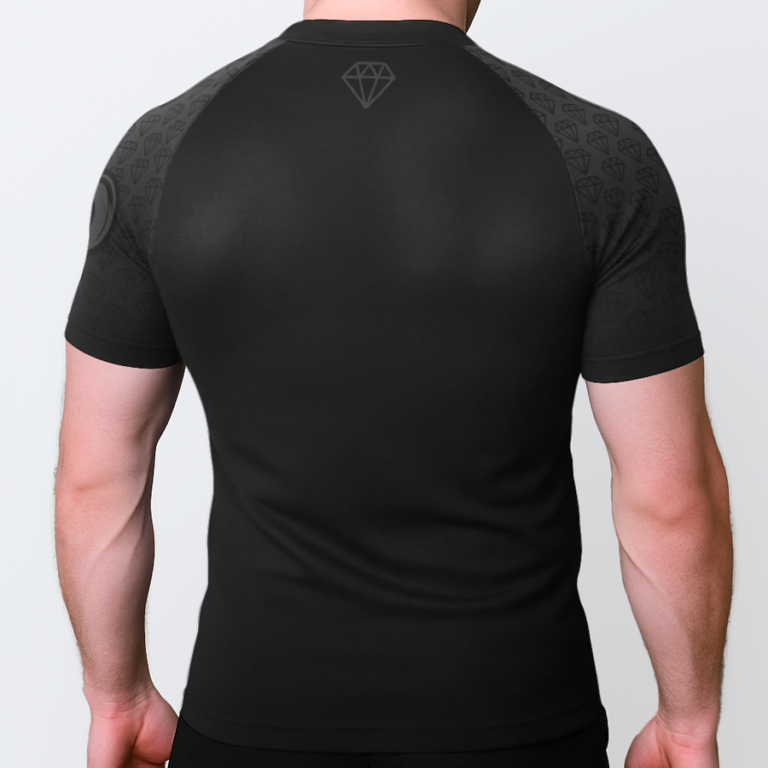
Hayabusa rashguards run true to their Japanese MMA pattern heritage. A medium is drafted for a 38 to 39 inch chest with a torso length around 27 inches from neck to hem. Sleeve length is honest — a Hayabusa medium long-sleeve hits the wrist on a 5’8″ to 5’10” grappler with proportional arms. The chest panel uses a four-way stretch that allows the brand to draft tighter through the body without sacrificing range of motion, which is why a Hayabusa medium feels like a true compression fit rather than a relaxed athletic fit.
The trade-off is consistent: tall lightweights find the torso too short, and tall middleweights find the chest panel too tight for their shoulder breadth. The brand has not historically offered a tall size, so the workaround for grapplers above 6 feet is sizing up to large and accepting a looser chest in exchange for a torso that actually covers the lower back during a forward roll.
Venum: The Athletic-Wear Hybrid
Venum’s rashguard block sits between Japanese and American patterns. A Venum medium runs slightly larger in the chest than a Hayabusa medium — closer to 40 inches drafted — with a torso length around 28 inches and sleeves drafted for a 5’10” to 6’0″ arm span. The chest panel uses a stiffer compression fabric than Hayabusa, which means a Venum medium feels more structured but stretches less. Grapplers with broader shoulders relative to their chest often find the shoulder yoke restrictive on a Venum medium even when the chest measurement is correct.
Venum’s published charts are reasonably honest, but the brand has shifted patterns several times over the past decade. A Venum rashguard from 2018 does not fit the same as a Venum rashguard from 2024 in the same labeled size. The newer cuts run tighter through the waist and longer through the body — closer to a European athletic compression silhouette.
Tatami: The Long, Lean European Block
Tatami draws from a European compression pattern. A Tatami medium is drafted for a leaner 37 to 39 inch chest with a torso length of 29 inches — the longest of any major rashguard brand at the medium size. Sleeves are drafted long, often hitting the back of the hand on shorter grapplers. This is the brand to look at if you are a tall lightweight or a tall middleweight with a narrower frame. It is the worst brand to size off your t-shirt for if you are a stocky grappler with a barrel chest, because the chest panel will not accommodate the shoulder width that comes with that build.
Tatami’s sizing chart is published with metric measurements first and includes a model height reference that is more useful than most. Use the model height as a starting point, but verify the chest measurement against your own tape, because the model heights skew taller and leaner than the average grappler shopping the brand.
Sanabul: The American Athletic Default
Sanabul rashguards run the largest of any major brand at equivalent labeled size. A Sanabul medium is drafted closer to a 41 inch chest with a relaxed torso length of 28 inches and sleeves cut for average American adult arm length. This is the rashguard that fits straight off the size chart for the majority of American grapplers in the 170 to 200 pound range. It is also the rashguard most likely to feel loose if you are coming from a Japanese-cut brand and expecting compression fit.
The fabric weight runs heavier than Hayabusa or Tatami, which adds structure but also adds heat retention. Sanabul rashguards do not breathe as well in extended training sessions, which is a real consideration for grapplers training in non-air-conditioned gyms or in tropical climates.
Manto, Hyperfly, and the Specialty Brands
Manto’s Polish pattern block runs closest to Tatami — long torso, lean chest, honest sleeves. Hyperfly’s American line runs closer to Sanabul; their European-distributed line runs closer to Tatami, which is a real source of confusion when grapplers compare notes across continents. Shoyoroll’s no-gi rashguards run on a slim American pattern that splits the difference between Hayabusa and Sanabul — compression-fit through the chest but with the longer torso of an American block.
Origin’s American-made rashguards run the most generous of any brand at the medium size, drafted closer to a 42 inch chest. The brand caters to a market that prefers a relaxed athletic fit rather than a compression fit, which is a deliberate design choice rather than a sizing error. If you order an Origin medium expecting a Hayabusa-style compression fit, you will be disappointed regardless of what the chart says.
When the Chart Lies
Every size chart published online is a marketing document first and a measurement reference second. Brands round up chest measurements to make their mediums look more accommodating. They publish torso length as the back-of-neck-to-hem measurement when the garment is laid flat, which does not account for the fabric’s stretched-on-body length. They give weight ranges as if weight predicts rashguard fit, which it does not — two grapplers at the same weight with different builds need different sizes from the same brand.
The single most useful piece of information any brand publishes is the model wearing the rashguard in the product photo, alongside that model’s height and weight in the description. If you can find that data, use it as a calibration point against your own measurements. If the brand does not publish it, treat the chart with skepticism and assume the medium runs one full size off the direction that matches the brand’s pattern origin.
Why Two Mediums in Your Drawer Is the Right Answer
Most experienced no-gi grapplers eventually end up with rashguards from two or three different brand pattern blocks in their gear bag. This is not gear collecting. It is the practical recognition that no single brand cuts a rashguard that works for every training scenario. The Japanese-cut compression piece comes out for competition and hard rolls where ride-up is unacceptable. The American athletic-cut piece comes out for long open-mat sessions where heat retention matters more than absolute compression. The European-cut piece comes out when the torso of the Japanese cut starts riding up after a long roll because the torso was always borderline-short.
Trying to force one brand to do everything by sizing up or down is how grapplers end up with a drawer full of rashguards they hate. The honest answer is that brand pattern blocks have real differences, and the best fit comes from matching the block to your build first, then verifying the size within that block second. The chart is the last thing to look at, not the first.

Sources
Brand pattern reference: Hayabusa, Venum, Tatami Fightwear, Sanabul, Manto.
Compression apparel sizing reference: Wikipedia — Compression garment.
Shop rashguards across major brands: Amazon — BJJ no-gi rashguards.
Browse our top-rated rashguards and no-gi gear at the RashguardGuy shop →