Ear Guards for No-Gi: The Protection Decision Most Grapplers Make Too Late
Most grapplers notice it the same way: a dull ache sitting just inside the outer ear after a hard session, a slight puffiness that takes a day or two to resolve. The first time it happens, it is easy to dismiss. The ear does not look like much. It does not hurt the way a knee or shoulder does. And then it happens again, and the swelling returns a little harder to push down, and one morning the ear feels different when you touch it — firmer, slightly uneven. By the time the shape has changed, the cartilage has already reorganized itself into something that will not go back.
Ear guards exist to interrupt that sequence before it becomes permanent. Understanding why no-gi training specifically accelerates it — and what the guard is actually doing mechanically — makes the decision to wear one straightforward rather than a cultural negotiation.
What Is Actually Happening Inside the Ear
The outer ear is a framework of cartilage covered by a thin layer of skin. That cartilage has no direct blood supply of its own — it depends entirely on the perichondrium, the connective tissue membrane wrapped around it. When the ear takes repeated impact or sustained friction — the kind that comes from being wedged under a training partner’s chest, dragged across a hip, or compressed in a headlock — blood pools between the cartilage and perichondrium. That accumulation is a hematoma.
If the hematoma is not drained within 24 to 48 hours, the body begins treating the space as an injury site to repair. Fibrocartilage fills it. The ear hardens. Over successive incidents without drainage, the deformity compounds. The cartilage that was once smooth and pliable becomes the irregular, thickened structure known colloquially as cauliflower ear — technically auricular perichondritis followed by fibrocartilage deposition.
The process is not painful the way most grappling injuries are painful. There is no single moment of injury that prompts an immediate response — only a slow accumulation of microtrauma that eventually becomes structural. That quiet progression is exactly what makes it so easy to ignore until ignoring it is no longer an option.
Why No-Gi Training Puts Ears at Specific Risk
Gi grapplers have a partial buffer built into the format. The collar and lapel give training partners fabric to grip rather than bare skin and cartilage. Clinch work happens with heavy cotton between bodies. In no-gi, that buffer disappears entirely. Training partners reach directly for under-hooks, two-on-one arm controls, neck ties, and body locks. Head position becomes central to nearly every exchange — from shot defense to front headlock to scrambles off failed takedowns.
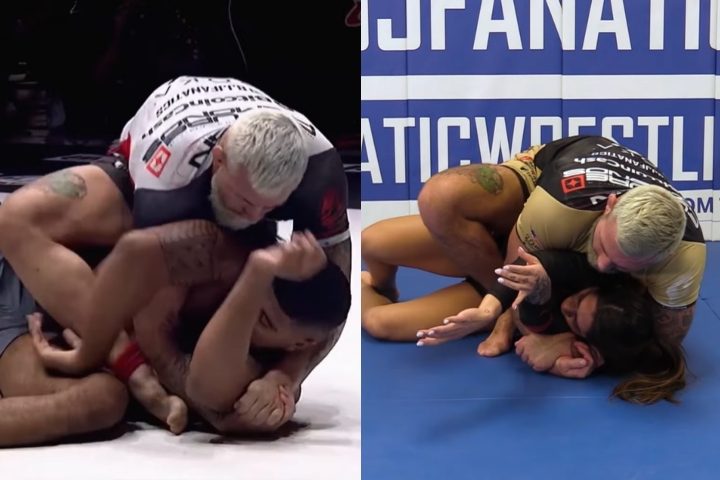
The ear absorbs friction from mat work in ways that do not register as discrete injuries in the moment. A guard pass where a knee slides across the side of the head. A wrestling scramble where an opponent’s forearm drags across the outer ear during a reversal. A headlock that grinds for twenty seconds of positional fighting. None of these feel like the kind of incident to report after training. Accumulated across months and years of consistent no-gi training, the effect becomes structural.
Athletes who arrive in BJJ with wrestling backgrounds frequently show some degree of ear deformity already in place — direct evidence that the no-gi grappling format has always generated this exposure, long before submission grappling developed its current competitive structure. The only thing that changed is whether the athletes wearing rash guards on the mat chose to address it.
The Culture Around Ear Guards and Why Grapplers Resist Them
In competitive wrestling, headgear is expected and normalized. From high school through collegiate and Olympic competition, wearing ear protection carries no social cost. The culture of Brazilian jiu-jitsu imported a different framework — one that drew from martial arts traditions where visible damage was sometimes treated as a credential. Cauliflower ear became associated with mat time, with experience that could not be faked, with proof that a practitioner had been in genuine training environments over a long period.
That framing has weakened considerably as the sport has matured. Athletes competing at ADCC and major no-gi events increasingly wear ear guards in training not because the stigma evaporated overnight but because the math of a full training career became too obvious to ignore. Chronic hematomas that require drainage mid-camp, impaired hearing from accumulated scar tissue, the persistent discomfort of ears that ache through every training week — these outcomes eventually outweigh whatever the ear looks like. Veterans of the sport talk about drainage procedures the way recreational athletes talk about ankle taping. It becomes normalized through repetition when it should never have been normal at all.
The fundamental framing error is treating ear guards as a response to damage rather than a prevention of it. Grapplers typically think about headgear after the first hematoma, when the correct moment is before the ear has ever been compromised. Cartilage that has deformed once is more vulnerable to re-injury than cartilage that has never been damaged — which inverts the logic of waiting until there is a visible reason to act.
What an Ear Guard Actually Does
Ear guards work on a straightforward mechanical principle: pressure distribution. The shell of the guard transfers compressive force across a larger surface area of the outer ear rather than allowing it to concentrate at any single point of cartilage. The forces involved in grappling do not disappear — the guard does not change the physics of a headlock — but it changes how those forces land against the tissue underneath.
The secondary function is friction reduction. A significant portion of ear trauma in no-gi comes not from direct impact but from sustained friction during scrambles and positional exchanges. The smooth exterior of a headgear shell gives that friction a path that does not transfer directly to the perichondrium. In exchanges where a training partner’s arm drags across the side of the head during a reversal or a takedown defense, the guard intercepts the contact before it reaches the cartilage.
Ear guards do not prevent all hematoma formation. A direct sharp blow can cause bleeding even with protection in place. What they do is reduce both the frequency and the severity of trauma events — which is what matters across a training career measured in years rather than individual sessions.
Choosing an Ear Guard Built for No-Gi Grappling
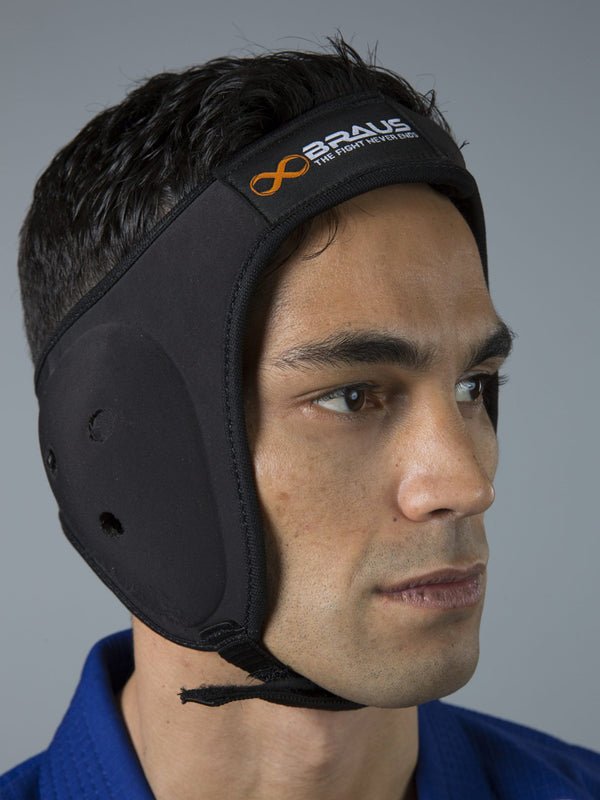
Wrestling headgear is the baseline product for most grapplers entering this category, and the engineering that went into it over decades of competitive use translates directly to no-gi training. The design features that matter most are not brand-specific — they are structural.
Shell Shape and Coverage
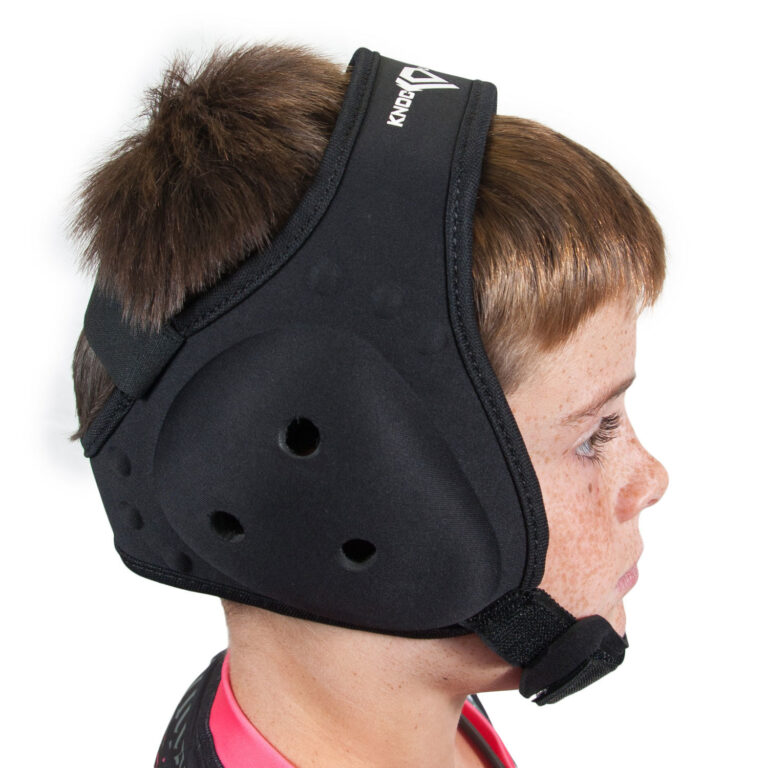
The shell should cover the full outer ear without pressing the cartilage directly against the skull. A fit that is too tight recreates the compressive problem the guard is supposed to prevent. A shell that floats too far off the head creates a lever arm that catches on training partners’ arms during clinch work and shifts out of position through scrambles. The right fit for no-gi is snug enough to remain stable through a takedown or reversal, loose enough to preserve normal hearing, and positioned so the cup sits over the ear without applying direct contact pressure to the cartilage beneath it.
Retention Straps and Anchoring
The retention system determines whether the guard stays functional through the kind of rapid head movement no-gi generates. A chin strap alone is frequently insufficient — the head rotates and shifts in wrestling exchanges in ways that pull a single-point attachment out of position. Guards with a top strap crossing the crown of the head and a rear strap anchoring at the base of the skull hold position more reliably through direction changes. Adjustability matters because strap elasticity changes as the material breaks in over weeks of use.
Ventilation and Training Comfort
No-gi training generates significant heat, and a guard that traps it makes training measurably more uncomfortable. The compliance problem is predictable: athletes remove the guard between rounds when it becomes uncomfortable, then stop bringing it to sessions where they know they will be hot. Perforated shells or open-cup designs allow air circulation without sacrificing coverage. The best ear guard for any given athlete is the one that stays on through a full session — which means comfort matters as much as protective rating when evaluating options.
Getting Through the Adjustment Period
Wearing ear guards changes spatial awareness in ways that take time to normalize. The guard adds bulk to the sides of the head, which affects how the fit feels in close positions — particularly in headlocks and front headlock exchanges where the shell contacts the training partner’s body. Hearing is slightly muffled, not dangerously so but noticeably in the first several sessions. Both effects are real and neither is permanent.
Most grapplers report that the adjustment takes two to four weeks of regular training before the guard stops registering as a foreign object. The failure point is abandoning the guard during that window because rolling feels different. The proprioceptive adaptation is genuine and complete once it finishes — but it only happens with consistent use. Wearing the guard twice and then leaving it in the bag for two weeks resets the adjustment each time.
Some athletes wear the guard through full sessions including drilling; others restrict it to live rounds. Either approach works provided it stays on during the exchanges that actually generate ear trauma. Live rolling, wrestling rounds, and positional sparring are where the exposure accumulates. Drilling at low intensity produces negligible friction and impact and is not where the damage originates.
When the Ear Has Already Been Compromised
If a hematoma has already formed, the case for ear guards becomes stronger, not weaker. A swollen, softened ear is more vulnerable to re-injury than undamaged cartilage. Training on a fresh hematoma without protection risks turning an incident that could have been isolated into a repeating pattern — one where each additional session compounds the structural damage.
Standard medical guidance involves drainage by a physician within 24 to 48 hours of hematoma formation, followed by a compression dressing to prevent re-accumulation while the tissue heals. Ear guards worn consistently after drainage maintain protection through that healing window. The combination — prompt drainage followed by consistent protection in the subsequent weeks — is what prevents a single incident from becoming the first of many.
The grapplers who avoid significant ear deformity across long training careers share a recognizable pattern: they did not let the first incident become the second before they changed something. Ear guards are inexpensive relative to the cost of repeated medical drainage procedures and the permanence of accumulated cartilage damage. The decision to wear one is considerably easier than the decision to stop training the way you have been training. That is the correct way to think about it.
Sources
Mayo Clinic — Patient Education
FloGrappling — No-Gi Competition Coverage
Image credit: brausfight.com