How Many Rashguards You Need Under $50: A Rotation Plan for Hard Training Weeks
Most budget rashguard advice gets one thing backwards. It treats the question as \”which single rashguard under $30 or $50 should I buy?\” — when the real question for anyone training no-gi four or more times a week is how many of them you need to keep the rotation honest. One $50 rashguard worn five days a week is worse than three $20 rashguards rotated properly, and the math on that gets more brutal the harder you train.
This guide is for the grappler who has already decided that the budget tier is where they live. You are not buying the $90 Shoyoroll. You are buying the Amazon sub-brand, the Sanabul base layer, the Hayabusa Geo on sale, or the unbranded three-pack a teammate keeps recommending. Good. Now let’s talk about how many to stack, how to cycle them, and why the answer changes depending on whether your gym runs hot, cold, or somewhere in between.
The Math of Rotation at the Budget Tier
A rashguard has three states in any given 48 hours: on your body, soaking wet in a gym bag or hamper, or drying somewhere in your apartment. At any moment, exactly one of those states is the one you can put on tonight. So the question of how many you need is really a question of how fast each rashguard moves through the wet-to-dry cycle, and whether your training schedule outpaces it.
The cheap-tier polyester-spandex blends that dominate under $30 actually dry reasonably quickly — sometimes faster than the heavier $80+ options with reinforced panels and silicone grips. But they also stink faster, pill faster, and lose elasticity faster. Rotation is what keeps that decay from compounding. Wearing the same rashguard three days in a row at the budget tier is how you end up replacing it in six weeks instead of six months.
4-Day Trainer: A 3-Pack Approach Under $50
If you train four times a week — say Monday, Tuesday, Thursday, Saturday — three rashguards is the floor. Two will leave you wet on Tuesday if Monday’s gear hasn’t dried, and you will eventually grab a damp one out of the hamper and regret it. Three lets you wear one, wash one, and have one in reserve at all times.
At the under-$50 budget for the whole stack, the multi-pack route is the most efficient. Search for budget rashguard three-packs on the major marketplaces — you can usually land three short-sleeve no-gi rashguards in the $30–$45 range, which works out to $10–$15 each. The build quality at that price is exactly what you expect: thin, fast-drying, no silicone grippers at the waist, basic flatlock seams that will hold for six months of normal rolling.
5-6 Day Trainer: Why 5 Rashguards Beats 3
Once you cross into five or six sessions a week, the three-rashguard rotation collapses. You need at least one rest day for the wash cycle, and if you do laundry every two or three days like most apartment-dwellers, three shirts gets you Monday, Tuesday, Wednesday, and then you are out. Five rashguards under $50 each means you can train Monday through Saturday without ever putting on something that smells like Wednesday’s no-gi class.
At five units, the per-shirt budget drops to $10 if you stay strictly under $50 total, which is the territory of unbranded multi-packs and clearance stock. A more realistic move is to spread the budget: two $20 rashguards from a known brand for competition or open mat days, plus a three-pack of generics at $30 for the lifting and drilling sessions where you sweat through the gear but care less about the print holding up.
Drying Time Is the Real Constraint
The rotation only works if the wet rashguard actually dries before its slot comes back around. In a humid climate — Taipei in May, Florida in August, anywhere with monsoon season — a hung rashguard can take 18 to 24 hours to dry indoors. In a dry climate with good ventilation, the same shirt is wearable in six hours. This single variable is why the same three-pack works fine for one grappler and leaves another permanently behind on laundry.
If you live somewhere humid and you train daily, add a unit to whatever rotation count seems right on paper. Five becomes six. Three becomes four. The extra $10–$15 spend buys you a week without putting on a still-damp shirt — which, in BJJ, is also how you accelerate skin infection risk and ringworm cycles. It is not a luxury cost; it is part of the same training-hygiene budget as your mat wipes.
Where the $30 Tier Falls Short on Volume Buying
The honest weakness of the under-$30-per-shirt tier is that you cannot buy these in true bulk and expect uniform performance. Run the same three-pack twice and you may get two slightly different fabric weights, off-spec sizing on one of the six shirts, or a print that fades twice as fast as the others. The factories rotate fabric lots constantly at this price point.
What this means practically: if you find a budget rashguard that fits well and survives a month of hard rolls, buy two or three more of that exact SKU immediately, while the lot is still the same. Do not assume \”oh I’ll grab another in three months when this one wears out.\” In three months the same listing may ship you a thinner, looser-fit version with no notice. This is the single biggest mistake new grapplers make with budget gear.
The Stink Cycle: Why Cheap Rashguards Need Rotation
Polyester blends at the budget tier hold bacteria longer than higher-end fabrics with antimicrobial treatments. That is not a marketing line — it is a function of fiber density and finishing chemistry, and it shows up as the permanent funk that a $15 rashguard develops by month four no matter how aggressively you wash it. Rotation slows this. A rashguard worn once and washed promptly has roughly half the bacterial load at the next wear compared to one worn twice between washes.
Concretely: do not double-wear cheap rashguards. The whole point of buying more units at a lower per-unit price is so you never have to. If you are tempted to wear yesterday’s rashguard \”because it’s only slightly damp,\” you bought too few. Add a unit.
Bulk Buying Tactics That Work Under $50
Stack the multi-pack and the solo
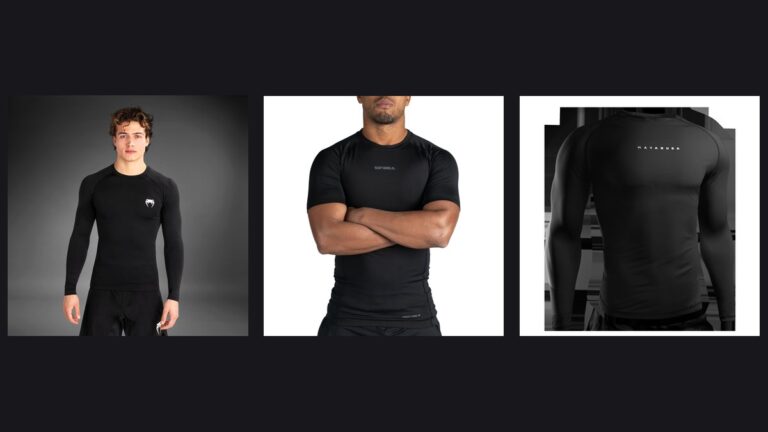
The cleanest budget play: one $25–$30 rashguard from a brand you recognize (Sanabul, Hayabusa Geo line on sale, Anthem Athletics) for the days you want to feel like your gear is intentional, plus a $20–$25 three-pack of generics for the rest of the week. Total stack: four rashguards, total spend: under $55. That is two days of variance per shirt, which is exactly the rotation cushion you need at four-to-five sessions a week.
Mix sleeve lengths
Short sleeves dry faster and run cooler. Long sleeves give you elbow coverage for guard retention and skin protection on mats you don’t trust. Buying three of one length and skipping the other is a common rookie move at this price point. Stock at least one of each so you can match the rashguard to the session — long sleeve for the open mat with strangers, short sleeve for the drilling class with your usual partners.

Skip the loud prints on the cheapest tier
The under-$15 rashguards with the most aggressive graphics — skulls, dragons, neon geometry — are also the ones whose prints peel and crack the fastest. The sublimation quality at that price doesn’t support heavy-ink designs over six months of weekly washes. Solid colors and small chest logos hold up significantly longer. If you want loud, spend $25–$30 on a single statement rashguard and keep the rest plain.
When to Replace vs Add to the Rotation
A budget rashguard has roughly two failure modes. First: the elastic at neck or sleeves gives up, the shirt rides up during scrambles, and it becomes useless for live rolling even though the fabric is fine. Second: the underarm or seam stitching opens, usually after a particularly aggressive butterfly hook elevation or a stack pass. Either failure means retirement, not repair.
When one shirt in a five-rashguard rotation dies, do not immediately replace it. Train for two weeks on four shirts and see if the rotation still works. Often it does, and you save the $10–$15 for the next pack. If you find yourself reaching for damp gear, then replace — and ideally with the same SKU as the survivors, while the lot is still current.
Climate Matters: Hot Gym vs Cold Gym Rotations
Hot gyms — anywhere without strong AC in summer, anywhere in the tropics, any second-floor space above a restaurant — burn through rashguards roughly 30% faster than cold gyms. More sweat means more bacterial load, longer dry times, and more aggressive detergent cycles, all of which break down the cheap polyester faster. If your gym sits at 28°C+ year-round, plan to retire each budget rashguard in four to five months rather than six to eight.
Cold gyms — basements, dedicated facilities with AC running through summer — let you stretch the same five-pack to eight or nine months. The cost-per-session math gets significantly better, and the case for buying a known brand at $25 instead of three generics at $8 each weakens. In a cool, dry gym, the cheapest tier actually performs almost as well as the mid-tier.
A Sample 5-Day Loop on a $50 Budget
Here is what a working rotation looks like for someone training five no-gi sessions a week with a total rashguard spend of $50 or less, doing laundry every three days:
- Monday: Long-sleeve generic black, $10 from a three-pack. Worn for guard work and drilling.
- Tuesday: Short-sleeve Sanabul or Anthem solid, $22 on sale. Live rolls.
- Wednesday: Second long-sleeve generic from the three-pack. Open mat.
- Thursday: Third short-sleeve generic, $10. Drilling.
- Friday: Rest or lift day — laundry runs.
- Saturday: Back to the Sanabul (now clean) for competition class.
Total stack: four rashguards, total spend: roughly $52 (close enough to the $50 ceiling that one sale or coupon brings it under). No double-wears, no damp shirts, no scrambling on laundry day. The variance in fit and feel between the generic and the branded shirt is actually useful — your body learns to perform in different cuts of gear, which matters more than people admit when you eventually compete in whatever the event organizer hands you.
The Bottom Line on Volume vs Single-Buy
Spending $50 on one rashguard is a fine choice if you train twice a week. For anyone past that, the same $50 should be buying three or four shirts, not one. The point of the budget tier is not that each individual shirt is great — it isn’t — but that owning enough of them lets you train hard without ever putting on something damp, stinking, or under-dried. That is what protects your skin, your training partners, and your ability to actually show up six days a week without your gear bag becoming a biohazard.
Stop buying one rashguard. Start buying a rotation. The math at $30 and $50 per shirt is built around volume, and once you treat it that way, the under-$50 tier stops looking like a compromise and starts looking like the obvious answer for hard training weeks.
Sources
- Amazon — BJJ rashguard search
- Amazon — BJJ rashguard 3-pack search
- IBJJF — official rules and uniform standards
- FloGrappling — no-gi event coverage
Training BJJ in Taipei? TaipeiBJJ.com has training resources and gym guides for the Taipei BJJ community.
Browse our top-rated rashguards and no-gi gear at the RashguardGuy shop →