Ear Guard Fit in No-Gi: How to Size, Adjust, and Make Your Protection Actually Work
Most grapplers choose ear guards the same way they choose everything else — by brand, by price, or by what someone else at the gym is wearing. The fitting process, if it happens at all, is usually limited to pulling the headgear on and deciding it doesn’t immediately fall off. That’s not fit. That’s the baseline for putting something on your head. Actual fit — the kind that keeps ear guards in place through scrambles, trips, and explosive clinch work — requires a different level of attention, and it starts before you ever step on the mat.
Cauliflower ear forms from repeated trauma to the ear’s cartilage — the kind of impact and friction that’s routine in no-gi grappling. Guards exist to interrupt that process by absorbing and distributing force before it reaches the cartilage. But they can only do that job when they’re positioned correctly, held at the right tension, and sized to the specific dimensions of your head. An ear guard that shifts during a guillotine attempt isn’t protecting anything. Understanding fit isn’t about getting comfortable — it’s about making the gear functional.
Why Fit Is a Mechanical Problem
Ear guards fail grapplers for one reason more than any other: they move when they shouldn’t. The mechanics of why they move are straightforward. If the ear cup doesn’t fully cover the ear, any lateral movement leaves part of the ear exposed. If the headband creates uneven pressure, the entire assembly rotates under load. If the chin strap sits too loosely, the whole unit rides up during head-to-head contact. Each of these failure modes is predictable and preventable — but only if you understand what proper fit looks like before you’re trying to troubleshoot it mid-roll.
The goal is a guard that acts as an extension of your head rather than an accessory sitting on top of it. In no-gi, where there’s no collar or lapel to grip, opponents are constantly pressing, grabbing, and controlling your head directly. That contact is exactly the contact your ear guards need to stay stable through. Getting the fit right means understanding each adjustment point and what it controls — headband placement, ear cup centering, and chin strap tension each solve a different part of the retention problem.
Starting with Head Circumference
Every major ear guard manufacturer publishes a size chart based on head circumference. That measurement goes around the widest part of your skull, roughly one inch above your ears. Measure with a soft tape or a piece of string, then check it against the manufacturer’s size range. Most adults fall between 21 and 23 inches, which typically maps to medium or large depending on the brand. The charts differ enough between manufacturers that a medium from one brand may fit like a large from another, so the chart for the specific model you’re buying is the one that matters.
Head circumference gives you a starting size, not a final answer. Within a given size, the fit can vary considerably depending on head shape. A head that’s longer front-to-back than it is side-to-side will fit differently in a round-profile headband than a head that’s proportionally wider. Some ear guard models have a more oval opening; others run essentially circular. If you’ve tried on headgear that felt unstable at the correct circumference size, head shape is usually the reason. Trying different models at the same nominal size is worth the effort if your initial purchase keeps rotating off center.
Positioning the Ear Cups Before Fastening Anything
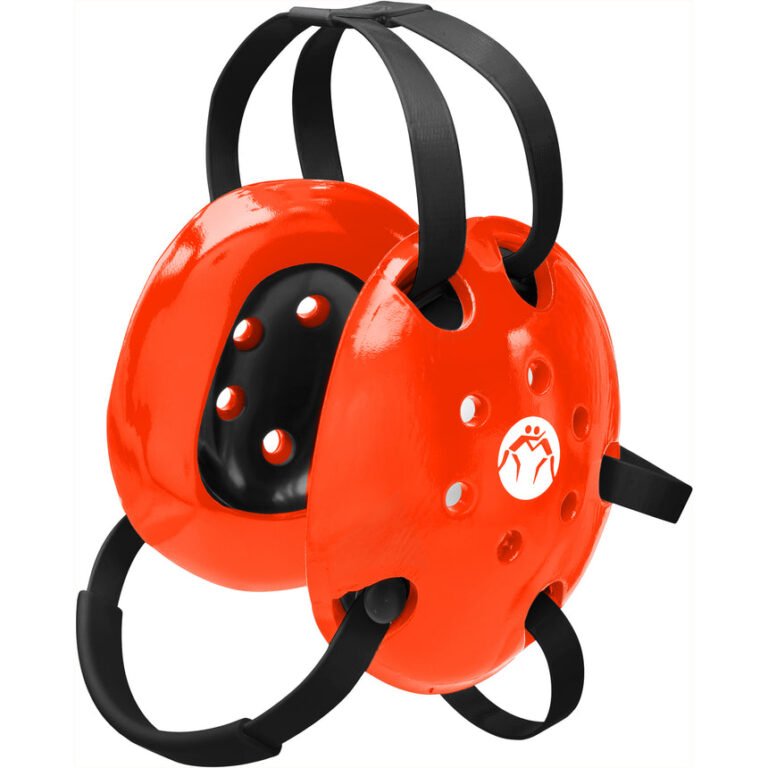
The most common fitting mistake is fastening the chin strap before the ear cups are properly positioned. The sequence matters. Put the headband on first, without tightening any straps, and manually center the ear cups over your ears. The cup should fully enclose the ear — no part of the ear should extend past the cup’s rim. If the rim cuts across the bottom of your ear, the unit is sitting too high. If the top of your ear is exposed, it’s sitting too low. Move the headband until the coverage is complete, then note that position before you fasten anything.
Once the cups are centered, the back of the headband should sit at roughly the level of the base of your skull — not riding up toward the crown, not dropping toward your neck. Headbands that sit too high tend to tilt the ear cups downward, shifting them off center. Headbands that ride too low create leverage problems when the guard gets grabbed or pressed in a clinch. The correct position is a natural band of contact across the back of the head at a level that feels stable without being forced. When you shake your head side to side sharply, the band shouldn’t slip in either direction.
The Chin Strap: Tension Without Constriction
Once ear cup position is set, the chin strap controls retention. The strap should be snug — tight enough that you can’t easily slide a finger under it, loose enough that your jaw can open fully without discomfort. Grapplers frequently overtighten, thinking more tension means better retention. What actually happens is the strap becomes a pressure point under the jaw that creates discomfort during extended rolling and leads to loosening it mid-session, which defeats the purpose entirely. The right tension is the least tension that keeps the guard in place through a hard round, not the most tension you can tolerate.
In no-gi, chin strap design matters more than it does in wrestling. Wrestling matches involve controlled takedown exchanges and relatively brief moments of sustained head contact. No-gi grappling involves extended clinch work, prolonged top-control scrambles, and moments where your opponent is pressing your head into the mat for significant stretches of time. A strap that’s comfortable in a two-minute wrestling match may be intolerable in a twenty-minute no-gi session. Softer, wider straps distribute pressure better across the chin. Single-strap designs are simpler to adjust and re-set. Y-strap or split-strap designs stabilize the unit differently and are worth testing if you find that single straps tend to shift laterally on your chin during heavy rolling.
What the Break-In Period Actually Involves
New ear guards are stiffer than ear guards that have been trained in. The plastic or composite material of the ear cups hasn’t yet conformed to the specific contours of your ears, and the straps haven’t settled into their adjusted positions. This means a pair that fits correctly out of the package will fit even better after several sessions — but it also means the first few sessions are likely to feel less comfortable than subsequent ones. Understanding this helps you distinguish between a pair that needs to break in and a pair that genuinely doesn’t fit.
The break-in process is mostly passive — it happens through normal training. Foam and padding compress to match the specific shape of your ears. Strap material softens slightly. The headband curves to your skull’s profile under repeated use. Most guards need three to five training sessions before they reach a stable fit. During that window, minor readjustment between rounds is normal. What shouldn’t happen is the guard consistently rotating in the same direction every single round — that’s a size or cup positioning issue, not a break-in issue. Note where the guard moves and in which direction, not just that it moves, and you’ll diagnose the problem faster.
When Fit Changes Over Time
Ear guards don’t hold their fit indefinitely. Foam padding compresses over months of use, which can alter the cup contact and reduce their ability to distribute impact force effectively. Straps stretch. Buckles lose their locking range. Headband elasticity degrades. The guard that fit well six months ago may be a meaningfully different object today. Grapplers who train frequently should reassess fit every few months — not because they need to replace gear constantly, but because the adjustments that made it work initially may need to be reset as the materials age.
The visible signs that fit has degraded include: the chin strap running out of adjustment range at its tightest setting, the ear cups no longer sitting flush against the ear without being manually held there, and the headband rotating despite proper initial tension. These aren’t signs that you need a higher-end pair — they’re signs that the current pair has reached the end of its useful life. Budget ear guards may reach that point in six months of regular training. Higher-end models can last two or three years with proper care. Either way, the evaluation is the same: does it still hold position through a full, hard round of live no-gi rolling?
Fitting for the Training Context You Actually Have
A pair of ear guards that fits well during drilling may perform differently during live training. Drilling typically involves moderate contact at controlled speeds, with cooperative partners who aren’t actively trying to move your head. Live training involves explosive movements, resisted head positions, and moments of full-pressure scrambling where someone is actively working to change the angle of your skull. The fit check that matters most is the one you do after a hard round — not the one you do in the locker room mirror before class. If the guard held position throughout, the fit is working. If it migrated or had to be readjusted, the fit needs attention.
Some grapplers find that their guards migrate during certain techniques but stay put during others. A guard that shifts consistently during single-leg takedown defense, for instance, may be responding to the lateral head pressure specific to that position. A guard that slips during extended turtle defense may be responding to sustained downward crown pressure. Each pattern is diagnostic — it tells you where the fit is compromised and what kind of adjustment addresses it. Treating every migration as the same generic fit problem means you’ll never isolate the right fix. Map the technique, find the pressure, and adjust accordingly.
Fit as the Actual Prevention Mechanism
All of this — the sizing, the cup positioning, the strap tension, the break-in period, the reassessment over time — serves one purpose: ensuring that when your ear takes a hit, the guard is where it needs to be to absorb that impact. Cauliflower ear is not an inevitable outcome of no-gi grappling. It’s a preventable injury that requires gear to be used correctly, which means gear that fits correctly, worn consistently from the beginning of training rather than after the damage has already started accumulating.
The grapplers who avoid cauliflower ear are not always the ones with the most expensive guards. They’re the ones who treated fit as a technical problem worth solving — the same way they treat any other aspect of their training that requires precision to get right. Get the measurement right, position the cups correctly, set the strap at a tension you can actually train through an entire session, give the pair time to conform to your ears, and check back as the gear ages. That process is unglamorous, but it’s what actual protection requires — not just owning the gear, but making it work.
Sources
- Cauliflower Ear — Wikipedia
- FloGrappling — No-Gi Grappling Coverage
- Wrestling Ear Guards — Amazon Search
Image credit: customfitguards.com