BJJ Spats Guide: What They Are and Why No-Gi Grapplers Wear Them
Two white belts walk into a no-gi class. One wears compression shorts and a rashguard, the other comes in board shorts. By the end of the first round, the guy in board shorts has rug burn on both knees. By week three, the one in compression shorts has mat rash on his calves — because he skipped spats.
Spats are the piece of no-gi gear most beginners put off buying. They seem optional. After a few months on the mat, they stop being optional. Here is what BJJ spats actually are, when they help your game, when they get in the way, and what the top no-gi grapplers in the world actually wear.
What Are BJJ Spats?
BJJ spats — sometimes called grappling tights or compression pants — are full-length leggings designed specifically for grappling. They run from waist to ankle, use a blend of polyester and spandex (typically 80/20 or 85/15), and are constructed with flatlock stitching: seams that lie completely flat against the skin so there are no raised edges to create hotspots during long training sessions.
The difference between BJJ spats and regular athletic compression tights comes down to construction. BJJ-specific spats use heavier-denier fabrics that resist abrasion and are stitched at every seam to handle constant friction, pulling, and mat contact. Standard compression tights from sporting goods stores are built for running or cycling — they are not designed for grappling. Most tear or pill within weeks of regular mat use.
BJJ spats also sit lower at the waistband than athletic tights, which prevents them from rolling down during scrambles. A spat that creeps down to your hips mid-round is worse than no spat at all.
BJJ Spats vs. Grappling Shorts — The Honest Comparison
Most no-gi gyms do not require either. You can show up in board shorts and nobody will stop you. But the gear you train in changes how you move, how your skin holds up, and in some positions, how your submissions land.
Grappling shorts give you maximum freedom of movement for wrestling. If your game centers on takedowns, double-legs, and transitional scrambles, shorts let your hips move without compression. The reduced friction between you and your training partner can also work in your favor when defending guard passes — slippery legs are harder to control and pin down.
The tradeoff is straightforward: no skin protection. After three rounds of knee-on-belly and guard work on a rough mat surface, your shins and calves will show every contact point.
Spats solve the mat burn problem entirely. They also add grip. As Hayabusa notes in their no-gi gear guide, spats “create more friction on your legs, giving you the ability to hit submissions more easily.” That is not marketing language — any leg locker who trains regularly in both will tell you the same thing. Polyester-spandex has more surface friction than bare skin, and that matters when you are finishing heel hooks, locking triangles, or holding a body triangle through late rounds.
The tradeoff: heat retention in summer, and some wrestlers find full-length compression changes the feel for their takedown mechanics initially.
The dominant setup used by most serious no-gi grapplers is both at once: spats underneath grappling shorts. You get the protection and submission grip of the compression layer with the waistband freedom and hip mobility of the shorts on top. At ADCC — the most prestigious no-gi competition in the world — athletes who wear spats are required to also wear shorts over them. Spats-only is not allowed in competition. If you are building a training setup for ADCC 2026 in Krakow (September 12–13), that spats-plus-shorts combination is what you need to train in consistently.
5 Benefits That Actually Matter in Training
Mat burn protection gets all the attention, but the real case for spats runs deeper than just keeping your skin intact.
1. Skin survives high-volume training. Mat burn is not dramatic — it is just constant friction slowly removing skin from your legs. Grapplers training four or five sessions per week without spats develop perpetual open sores on their shins and calves. This is not just uncomfortable; open skin on the mat is a staph and ringworm entry point. Spats eliminate the problem at the source rather than treating it after the fact.
2. Leg lock grip is genuinely better. The friction difference between fabric and bare skin shows up most clearly in leg entanglements. When your calf is pressed against your opponent’s hip in a heel hook position, spats hold position in a way bare skin does not. The same applies to finishing body triangles in late rounds when sweat has made everything slick. This is one of the reasons Gordon Ryan stipulated in his 2026 challenge match terms that both athletes wear full-length spats — he framed it explicitly as a grip-equity measure to prevent slick-skin defensive advantages in leg lock exchanges.
3. Barrier against mat bacteria. Your legs contact the mat constantly during guard work. The compression layer puts a physical barrier between your skin and whatever is on the mat surface. It is not a perfect barrier, but it is a meaningful one. Grapplers at high-volume commercial gyms where mat cleaning is inconsistent should treat spats as part of their infection prevention, not just a comfort choice. As BJJ Fanatics covers in their spats breakdown, the hygiene benefit is one of the most consistently reported advantages from regular spats users.
4. Post-training soreness decreases. Compression increases venous return — blood flows back from the working muscles more efficiently. The research on compression garments and performance during exercise is mixed, but the post-training soreness reduction is consistently reported in practitioner feedback. For grapplers training daily or on back-to-back days, anything that cuts next-day soreness has real cumulative value over a training cycle.
5. Muscles stay warm through drilling. At the start of a session when you are moving slowly, spats keep your quads and hamstrings at operating temperature faster than bare legs. This matters most for grapplers who move directly into technique drilling without a long warmup — the compression maintains tissue temperature through lighter-intensity reps in a way that shorts alone cannot.
When Spats Actually Work Against You
Gear guides rarely admit this, so let’s be direct: there are scenarios where spats are a genuine disadvantage.
Wrestling-focused training is the main one. Wrestlers who rely on tactile feedback through their legs for takedowns — sensing a weight shift before a double-leg, adjusting hip position during a single-leg carry — sometimes find that full-length compression dampens that sensory information. If you train with high-level wrestlers and focus heavily on takedown mechanics, experiment with training those reps in shorts-only and switching to spats for guard work and submission exchanges.
Heat and humidity create a real problem. Full-length compression on your legs in a non-climate-controlled gym during summer will cause you to sweat significantly more and tire faster. The warmth that helps during drilling becomes a liability once you are fully warmed up and working at full intensity. Grapplers in hot climates often train in shorts-only during peak summer months and return to spats in fall.
Some high-guard and inverted guard positions feel slightly restricted in full-length spats compared to bare legs or shorts. Three-quarter length spats — ending just below the knee — were developed partly for this reason and split the difference between protection and mobility for flexible guard players.
Finally, know your competition ruleset before you show up. Most IBJJF no-gi events require shorts over spats. ADCC requires shorts, with spats allowed underneath. Some local submission wrestling events enforce shorts-only rules. Competing in spats-only at the wrong event means a wardrobe change on the venue floor.
How to Choose the Right BJJ Spats
The spats market has expanded considerably in the past five years. Most options from established grappling brands are adequate; the differences that actually matter come down to four things.
Fabric weight: Heavier-denier fabrics are more durable but slightly less mobile. For no-gi grappling, target at least 200gsm. Lighter competition tights will abrade and pill within months of regular training.
Seam construction: Every seam on the inner leg is a potential friction point. Flatlock stitching — where the seam lies completely flat — is essential for hard training. Check the inner thigh seam specifically; that is where most gear fails first.
Waistband design: A wide (3–4 inch) waistband with drawstring or elastic grip keeps spats in position through scrambles and guard pulls. Narrow waistbands roll and bunch. For no-gi guard work, this matters more than most buyers realize — a drifting waistband mid-round breaks your focus at exactly the wrong moment. For the technical side of guard entries, the guard pulling guide covers how your lower-body setup affects the pull.
Print durability: Sublimated prints — where the dye is pressed into the fabric rather than applied on top — will not crack or fade. Screen-printed graphics on spats are a reliable sign of budget construction. Buy once from a brand that sublimated properly rather than twice from one that did not.
For a complete no-gi gear setup, see the full rashguard guide — the same construction principles that apply to rashguards apply directly to the spats you pair them with. Matching fabric weights and sublimation quality across both pieces means both hold up on the same timeline.
What the Top No-Gi Grapplers Actually Wear
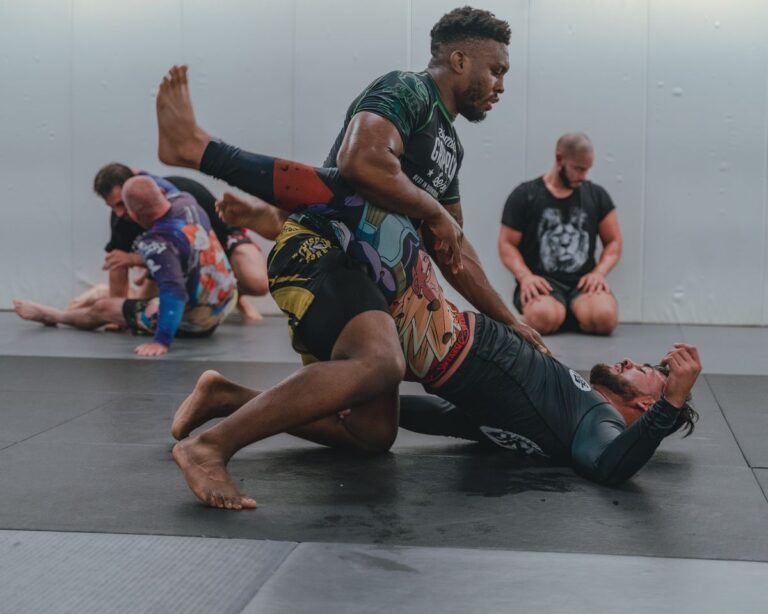
Nicky Rodriguez, one of the top-ranked no-gi heavyweights in the world, competes in the spats-under-shorts combination consistently — visible in his B-Team training sessions and competition appearances at WNO. At the Craig Jones Invitational, where he competed against Kade Ruotolo, both athletes wore standard spats-plus-shorts. The setup is not a style preference at the elite level; it is close to universal.
The trend across no-gi competition has moved firmly toward spats plus shorts over the past decade. At ADCC 2024, the overwhelming majority of athletes across all weight classes wore this combination. Competitors in shorts-only were a visible minority, mostly wrestlers whose game prioritizes takedown mechanics over leg lock offense — and even then, several switched to spats for the later rounds.
Declan Moody, competing at WNO 30 in the fall of 2025, wore the spats-plus-shorts combination throughout the event. As did most of the field. The gear choice at the top of no-gi grappling has largely settled: spats under shorts, rashguard on top. What varies is brand preference and waistband height.
For the gripping and control sequences that lead into leg lock territory, the no-gi grip fighting breakdown covers the upper-body mechanics that set up everything downstream — including the scrambles where spat friction becomes relevant.
The bottom line: spats are not a luxury item or a fashion choice. They are functional gear that extends your training longevity, improves leg entanglement mechanics, and keeps your skin intact through high-volume training. If you are training no-gi more than twice a week and not wearing spats, you are leaving both protection and grip on the table.
Sources
- Hayabusa: BJJ Spats vs. Grappling Shorts — Functional breakdown of the differences between spats and shorts for no-gi training, including grip mechanics.
- BJJ Fanatics: The Functional Benefits of Spats — Practitioner-written analysis of hygiene, grip, and recovery benefits in no-gi grappling.
- FloGrappling: ADCC Rules Guide — Official ruleset covering attire requirements for ADCC no-gi events, including the shorts-over-spats requirement.
- BJJ Eastern Europe: ADCC 2026 Krakow — Confirmation of ADCC World Championships, September 12–13, 2026.