
What the Label Doesn’t Tell You: A Guide to Women’s No-Gi Rashguard Construction
The women’s no-gi rashguard market has never been more crowded. Every brand now runs a dedicated women’s line, complete with curated colorways and campaigns featuring elite grapplers. But behind the aesthetic choices, the construction details that actually determine whether a rashguard survives two hundred mat sessions—or falls apart after twenty—are rarely what gets discussed. Understanding how to read a rashguard’s build quality before committing to it is one of the most underrated skills a woman can develop when investing in no-gi gear.
Why Construction Varies So Much in Women’s Rashguards
Women’s rashguards didn’t historically exist as a distinct product category in BJJ gear. For years, women were buying men’s cuts and making do with sizing approximations. When brands began building women-specific designs, many applied the same manufacturing logic as men’s rashguards—adjusting dimensions rather than rethinking construction. That legacy shapes the current market in ways that aren’t obvious at first glance.
The two variables that matter most—fabric composition and seam engineering—are rarely front-and-center in product descriptions. A brand might advertise a rashguard as “four-way stretch” without specifying the nylon-to-spandex ratio, or describe seams as “flatlock stitched” without explaining how many rows of thread that involves. Learning to decode what’s actually being said, and what’s being left out, is where real evaluation begins.
Fabric Composition and What the Numbers Mean
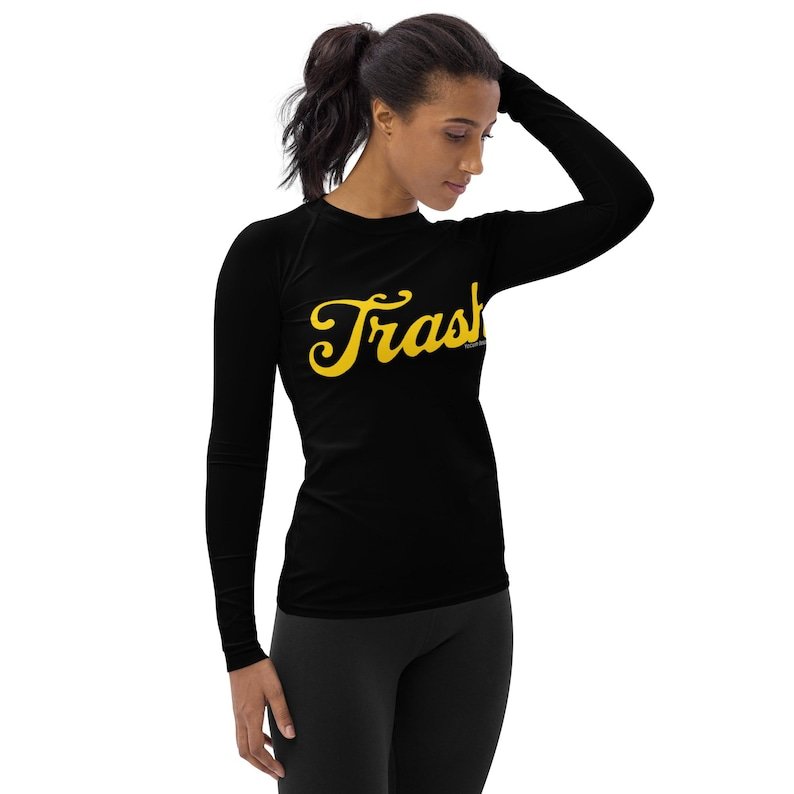
The dominant materials in quality rashguards are nylon and polyester, with spandex—also sold as elastane or Lycra—providing the stretch component. The ratio between these materials determines almost everything about how a rashguard performs and ages on the mat.
Nylon vs. Polyester as the Base Fabric
Nylon is softer against skin, holds color better over repeated washing, and typically feels more premium during extended training sessions. Polyester costs less to produce, dries quickly, and resists odor-causing bacteria more effectively over time. Neither is strictly superior—the real indicator of quality is the blend. A rashguard skewed heavily toward polyester—say, 80% polyester with 20% spandex and no nylon—will often feel rougher and lose its color more visibly after repeated laundering at training intensity.
The best women’s rashguards for no-gi training tend to use a nylon-dominant or balanced nylon-polyester blend, with spandex content in the 15 to 22 percent range. Below 12 percent spandex and the garment loses compression recovery quickly—within 60 to 80 sessions, the rashguard begins to feel loose at the torso and sleeves. Above 25 percent and the fabric becomes overly elastic, reducing structural integrity during live rolling where lateral pulls are constant and unpredictable.

How Compression Mapping Differs for Women
Compression in a rashguard serves two functions: muscle support during training and a reduction in skin friction during scrambles. For women, compression mapping matters differently than it does for men because of differences in shoulder-to-chest-to-waist proportions. A rashguard that compresses correctly at the torso may bind at the chest or pull across the upper back—not because the size is wrong, but because the panel cut was designed around male anatomy and scaled.
Women-specific rashguards that actually address this problem use either a higher panel-count cut or a specifically constructed chest panel. A basic rashguard design might use five or six panels across the torso. A properly engineered women’s design may use eight to ten, with dedicated shoulder and chest panels that distribute compression without creating the binding or gaping that plagues unisex fits. When a brand’s women’s rashguard is built on a modified men’s template rather than a female-specific block, you’ll feel it within the first round of live training.
Seam Engineering: Where Most Rashguards Actually Fail
Fabric gets the attention. Seams cause the failures. This is the consistent pattern among competitive athletes who cycle through multiple rashguards per year: the fabric may still look acceptable when the seams begin to separate. Understanding seam construction is how you predict a rashguard’s real lifespan before you’ve trained a single session in it.

Flatlock Seams and Why Thread Count Matters
Flatlock stitching is standard for performance rashguards because it lies flat against the skin instead of creating a raised ridge. But not all flatlock stitching is equal. A two-row flatlock uses two parallel lines of thread. A three or four-row flatlock distributes stress across more thread contact, which matters significantly in high-friction zones—under the arm, across the shoulder, and along the side seam.
In no-gi grappling, side seams and underarm seams experience the most stress during takedowns, guard work, and scrambles. A rashguard with single or two-row flatlock at these points will typically begin separating around the 50 to 80 session mark under regular training load. Three-row or coverstitch flatlock at stress points is a reliable indicator of a rashguard built to last past 150 sessions. You can feel the difference by running a thumb across the seam—a wider seam band with a firmer ridge under pressure indicates more thread rows and better stress distribution.
Hem and Cuff Construction
The waistband and sleeve cuffs are secondary failure points that are easy to evaluate before buying. A rashguard with a bound hem—where a separate band of elastic or fabric encloses the raw edge—holds its shape far longer than one with a simply turned and stitched hem. Sleeve cuffs that roll or curl after a few washes indicate insufficient binding or improper hem construction, which leads to grip catching and friction during guard work.
For women training in long-sleeve rashguards, the wrist cuff is particularly critical. A loose or rolling cuff creates friction during guard passes and becomes a contact point for a training partner’s grip during submission grappling. A properly constructed wrist cuff should retain its shape and elasticity through at least 80 to 100 wash cycles before showing signs of stretch-out. If it’s already rolling after two washes, it’s not going to improve.

How to Physically Test a Rashguard Before Committing
The most reliable pre-purchase test for a women’s rashguard isn’t a size chart—it’s a set of physical checks that reveal construction quality quickly. If you can handle the garment before buying, pull the side seam laterally with both hands and observe whether the stitching shows distress or whitening under stretch. Quality flatlock stitching at stress seams should stretch with the fabric and spring back without visible thread strain. If the seam gapes or threads visibly separate under moderate pull, that zone will fail early.
Roll the rashguard lengthwise from hem to collar and observe whether the fabric bunches unevenly. Uneven bunching often indicates inconsistent tension during manufacturing, which translates to uneven compression during training and faster wear in tight spots. A well-constructed rashguard should roll evenly with no obvious thick or thin zones across the body panels.
If purchasing online, the size chart matters less than the fit map. Look for brands that publish garment measurements—not just body measurements—at each size. A rashguard listing only body measurements forces you to guess at seam placement, which is unreliable for women whose proportions don’t match the brand’s assumed target. Garment measurements let you compare directly to a rashguard you already know fits correctly.

What the First Wash Tells You About Longevity
The first wash cycle is one of the best indicators of a rashguard’s real lifespan. After one cold-water machine wash and an air dry, inspect the seams for any signs of puckering or thread separation. Check the waistband and sleeve cuffs for rolling or curling. Run a hand across the fabric surface to feel for any pilling—which in the first wash cycle indicates a low-quality fiber blend that will degrade rapidly under mat friction.
Color retention after the first wash also tells a story. Some print softening after the first wash is normal with sublimated graphics, but significant fading—particularly at fold points like the shoulder seam or sleeve hem—suggests a lower-grade sublimation process that won’t survive a full training season. The dye in quality sublimated rashguards is heat-transferred into the fiber itself rather than applied on top, and a well-executed sublimation should show almost no visible color shift through the first ten to fifteen washes.
What you want after wash one is a rashguard that looks and feels nearly identical to how it arrived. No rolling hems. No seam puckering. No surface pilling. A rashguard that passes this check has cleared the most common early failure modes. One that fails it will continue to degrade in proportion to how it started—and training sessions will accelerate whatever weakness showed up first in the wash cycle.
Matching Construction Quality to Your Training Load
The practical takeaway from understanding construction is that not every women’s rashguard needs to meet the highest build standard. Someone training two sessions per week has very different longevity requirements than an athlete competing at ADCC Trials and logging five mat sessions a week. A mid-range rashguard with solid flatlock seams and a clean nylon-polyester blend will serve the recreational grappler well for two seasons. That same rashguard may start showing stress at seam zones by month four under heavier training load.
The most common mistake women make when buying rashguards isn’t overspending—it’s underspending relative to their training volume. A $35 rashguard that fails at 40 sessions costs more per session than a $70 rashguard that lasts 200. Viewing construction quality through the lens of cost-per-session rather than sticker price is how experienced grapplers evaluate gear. The best rashguards for women in no-gi aren’t the most expensive options available—they’re the ones whose construction is calibrated to the demands being placed on them and built to meet those demands honestly.
Sources
FloGrappling — Competition footage and gear coverage for no-gi BJJ and submission grappling.
ADCC — Official source for ADCC ruleset, competitor standards, and women’s division records.
Women’s No-Gi Rashguards on Amazon — Browse current options and compare fabric specifications and training reviews.