Fabric First: How to Buy the Best BJJ Rashguard for No-Gi Grappling in 2026
The BJJ and grappling rashguard market in 2026 has never been more crowded — or more confusing. Between established brands, athlete-backed startups, and overseas manufacturers undercutting on price, picking the best rashguard for no-gi training takes more than scrolling through Amazon reviews or trusting whoever your gym is sponsored by. Most buying guides hand you a ranked list and call it done. This one works differently. The goal is to give you a framework for making the call yourself, because the right rashguard depends entirely on how you train.
Rethinking What Best Means for Your Training
No rashguard is universally the best. That framing is marketing, not reality. A rashguard built for a competitive no-gi athlete training six days a week has different requirements than gear for someone who rolls twice a week for fitness and never competes. The brands worth buying from understand this distinction and build accordingly. The brands worth avoiding sell the same product to everyone with different graphics on it.
Before spending any money, get clear on three things: how often you train, whether you compete, and what environment you train in. A purple belt who enters ADCC-format submission wrestling events a few times a year has completely different needs from a blue belt who rolls at an open mat once a week for fun. Most of the confusion around rashguard buying comes from skipping this step and going straight to price comparisons.
Fabric Composition: Where the Decision Starts
Almost every serious BJJ rashguard in 2026 is built from some variation of polyester-spandex or nylon-spandex blend. Both work on the mat. The difference is in how they age and how they feel against skin during extended rolling.
Polyester-spandex is the industry standard — the backbone of most branded rashguards you see on FloGrappling broadcasts and at major no-gi events. Polyester holds sublimated prints exceptionally well, which explains the consistent visual quality of premium gear. The tradeoff is elasticity recovery over time. High training volume stretches polyester out faster than nylon, particularly across the torso and shoulders where scrambles generate the most stress on the fabric.
Nylon-spandex blends have a softer hand feel and better elasticity retention over the long run. This is why premium no-gi brands have been gradually shifting toward nylon-dominant constructions in their competition lines. Athletes competing at ADCC Worlds or on major FloGrappling cards log enough mat hours to notice fabric degradation across a single training camp. The downside of nylon is cost: it is more expensive to source and that difference passes through to retail pricing.
Regardless of whether the base fabric is polyester or nylon, spandex content in the 15 to 20 percent range is the sweet spot. Below 12 percent, the rashguard will not recover its shape after sustained rolling. Above 20 percent, you are paying for compression marketing claims that do not meaningfully translate to improved performance on the mat. The numbers matter, and they are not always disclosed — but they are often findable in the detailed specifications on brand websites.
How the Design Gets Applied
If you are buying anything other than solid black or white, understanding how the design was applied to the fabric matters more than most grapplers realize. Sublimation printing embeds dye directly into the fabric fibers — the graphic becomes part of the material itself. It does not add texture, does not crack under friction, and does not fade noticeably over a normal gear lifespan. Screen-printed designs sit on top of the fabric, crack under repeated washing, and peel away from high-friction zones after sustained rolling. Any rashguard worth buying in 2026 is fully sublimated. If the product listing does not specify sublimation, that is a signal to keep looking.
Seam Construction: Where Rashguards Actually Fail
More rashguards fail at the seams than at the fabric itself. The two constructions to know are flatlock and overlock, and the difference is pronounced in grappling in a way that does not apply to most other athletic wear.
Flatlock seams sit flush against the skin with no raised ridge. In grappling, raised seams catch fingers during grip breaks, create friction hotspots during ground contact, and cause skin irritation that compounds over long training sessions or multi-match competition days. Every serious no-gi brand uses flatlock construction throughout — it has become a baseline quality indicator for the category. Run your finger along any seam before buying. If you feel a ridge, it is overlock construction.
Overlock seams (sometimes called serged seams) are cheaper to produce and common on budget rashguards. They are not catastrophic for general athletic use, but they wear faster at the specific stress points that grappling creates — the underarm seam, the side seam, and the neck opening. At training volumes above two or three sessions per week, the longevity difference becomes visible within the first year of use.
The Compression Question
The compression conversation in BJJ rashguards has gotten overcomplicated by category marketing. Brands advertise graduated compression and performance compression as if those terms carry regulated definitions and measurable performance benefits. In a grappling-specific context, the reality is more straightforward.
What compression actually does on the mat: it keeps the rashguard from bunching and riding up during scrambles, provides minor proprioceptive feedback that some grapplers find useful for body awareness in tight positions, and reduces fabric movement against skin during clinch work and guard passing. These are real and useful benefits. What compression does not do: meaningfully increase blood flow, accelerate recovery, or improve performance in any way that has been demonstrated in grappling-specific research.
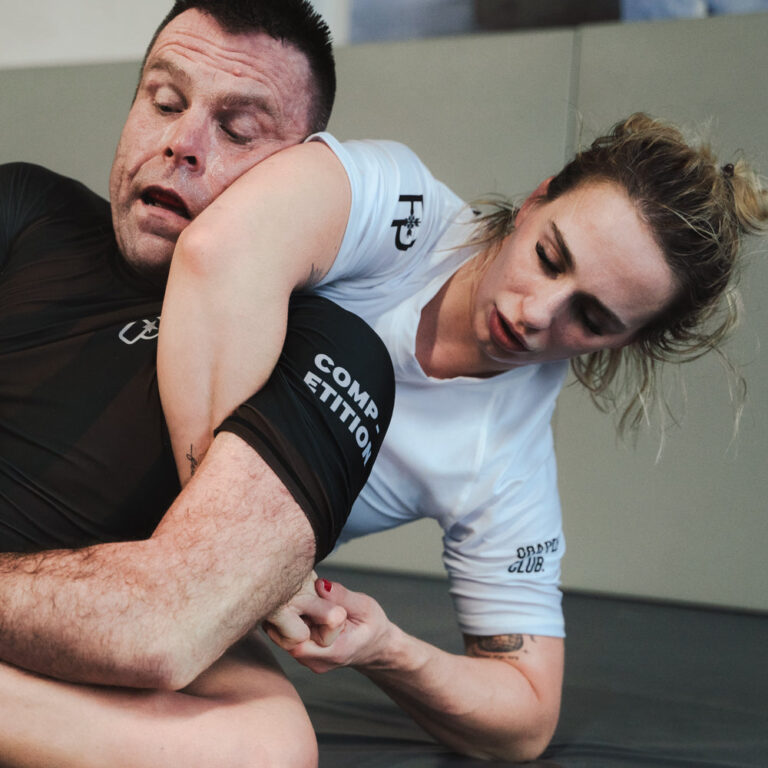
The practical question is fit rather than compression rating. Watch Gordon Ryan or any top competitor at ADCC — their rashguards fit closely but are not painted on. Full shoulder rotation and unrestricted deep breathing are non-negotiable for grappling performance. A rashguard that limits range of motion in the name of compression is a performance liability, not an asset. If you are between sizes, size up. A rashguard that is slightly loose is a minor aesthetic inconvenience. A rashguard that restricts your guard game or your underhook is actively working against you.
Sleeve Length and the Competition Variable
Long-sleeve rashguards are the standard for most BJJ training environments and are required for IBJJF no-gi competition. Short-sleeve versions offer less mat burn protection but better heat dissipation — a real consideration for training in warm, humid environments without air conditioning. No-sleeve versions exist but function primarily as base layers under board shorts rather than as standalone training tops.
The competition variable matters more than most new grapplers anticipate. IBJJF no-gi competition requires long-sleeve rashguards with specific color-coding tied to belt rank. ADCC and most submission wrestling formats are more permissive about sleeve length. Buying a short-sleeve rashguard and then discovering your target event mandates long-sleeves is an avoidable and frustrating mistake. Check the specific ruleset for your events before committing to a sleeve length.
Reading for Durability Before You Commit
You cannot know how a rashguard holds up over two years of training without training in it for two years. But there are indicators that point toward or away from durability before making a purchase.
Fabric weight is a rough but useful proxy. Rashguards in the 180 to 220 GSM range tend to last longer than lighter constructions. Lighter fabrics feel excellent initially but thin out faster under the combination of frequent washing and mat friction. Stitching density is another signal worth checking — hold the rashguard up to a light source. Dense, tight stitching shows as a more opaque, solid fabric panel. Visible gaps in the weave suggest the material will stretch and thin out faster under sustained training volume.
Brand history also matters in a market this crowded. Labels that have been producing BJJ-specific gear for more than a decade have survived through product iteration, and that process is visible in their current lineups. Every major brand has had failures — rashguards that shrank aggressively after the first wash, seams that split under the first hard training session, prints that faded after a month. The brands still operating at the top of the no-gi market have addressed those failures. Newer entrants may produce excellent gear, but they have not been stress-tested at scale the same way.
What the No-Gi Market Looks Like in 2026
The rashguard market in 2026 is segmented into three practical tiers. At the premium end, brands like Hyperfly, Tatami, and Scramble are producing rashguards in the sixty-five to one hundred ten dollar range using high-quality fabric construction and refined detailing — built explicitly for high training volume and priced accordingly. The mid-tier covers roughly thirty-five to sixty-five dollars and includes strong options from brands like Sanabul and Venum that perform well for regular training without competition-level demands. Below that, the budget tier is genuinely mixed: some acceptable training gear and plenty of products that will not survive six months of consistent rolling.
The trap that catches most new grapplers is buying budget to start and replacing gear more frequently, ultimately spending more over two years than a single mid-tier purchase would have cost. A rashguard that lasts three years at seventy dollars is a better investment than one that needs replacing every five months at twenty-five. The math consistently favors mid-tier for anyone training more than twice a week.
The premium tier makes financial sense for grapplers training four or more times a week, running competition-focused training camp schedules, or competing actively enough to need gear that performs under pressure and survives the wash cycles that follow. At that training volume, the fabric quality and construction durability of a ninety-dollar rashguard pay off in both performance and replacement frequency over time.
Making the Call
The best rashguard for BJJ and no-gi grappling in 2026 is not a single product. It is the intersection of your fabric preference, your fit requirements, your training volume, your competition context, and your budget. Start with a clear picture of how you train. Let that drive the decision — not the athlete endorsement on the product page, not the discount code in a YouTube description, not whatever your training partner happens to be wearing.
The evaluation checklist is short: confirm flatlock seam construction throughout, confirm full sublimation printing, verify the fit allows full range of motion across the shoulders and through the hips, and match sleeve length to your competition ruleset. Everything else — brand name, color scheme, graphic design — is secondary. Gear that clears those four bars from a brand with a track record in BJJ-specific construction is the best rashguard for your game in 2026.
Sources
ADCC Submission Wrestling World Championship
BJJ Rashguard Options — Amazon