Does Spider Guard Work in No-Gi? 8 Truths About Wrist Control Without Sleeves
Every white belt who spends a few months in the gi eventually gets put in spider guard — feet on biceps, both sleeves pinned, hips off the mat. It’s one of the first “real” open guards most people learn, and it’s a staple of competition Jiu-Jitsu at every level. So when those same grapplers switch to no-gi, a natural question comes up: does spider guard still work without the sleeves to grip?
The honest answer is no, not in the form it exists in the gi. But the idea behind it — using your feet and hands together to control distance and posture before an opponent passes — doesn’t disappear. It just gets rebuilt around wrist control, and that version is far less reliable than the original. Here’s what actually happens when grapplers try to run spider guard in a no-gi match, why it breaks down, and what’s replaced it at the top level of the sport.
1. Spider Guard Is Built Entirely on Sleeve Grips
Spider guard only works because of one specific piece of equipment: the gi sleeve. The position depends on pinning an opponent’s sleeve at the wrist with your hand while your foot presses into their bicep, using the fabric as a fixed anchor point that doesn’t rotate, slide, or compress. That combination is what lets a much smaller grappler control a much larger one — the sleeve grip locks the arm at a specific angle, and the foot on the bicep turns that lock into a lever against the opponent’s posture.
Take the sleeve away and the entire mechanism changes. There’s no fabric to grip, no fixed pinch point, and no way to lock the wrist at a set angle without it rotating in your hand. The position doesn’t get harder in no-gi — it becomes a different position built on different mechanics.
2. What “No-Gi Spider Guard” Actually Means
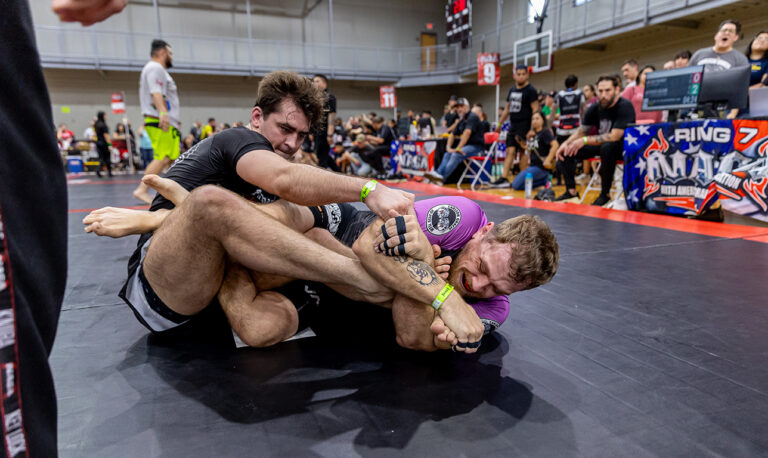
When people say “no-gi spider guard,” they’re describing a wrist control substitute: instead of gripping fabric, you wrap your fingers around the opponent’s bare wrist — typically using a thumb-and-fingers grip just above the hand, where the bone is narrowest — while your foot still presses into the bicep or shoulder. The framework looks similar from a distance: feet up, arms extended, hips mobile. But the grip itself is a completely different animal.
A sleeve grip is static. A wrist grip is a contest. The opponent’s wrist is round, mobile at multiple joints, and actively trying to escape your hand the entire time you’re holding it. That single difference is why no-gi spider guard behaves nothing like its gi counterpart, even when the leg and hip positioning looks identical.

3. The Grip Problem: Sweat Beats Wrist Control
Wrist control is one of the first things any no-gi grappler learns to fight for and one of the first things they learn to escape. A trained opponent rotates their wrist, drives their hand through your grip, or simply out-muscles the hold — and once sweat gets involved, even a technically sound wrist grip slips. Sleeves don’t sweat. Skin does.
This is the core reason no-gi spider guard rarely survives more than a few seconds against a skilled passer. The guard player isn’t just maintaining a position — they’re re-establishing a losing grip fight over and over, using energy that gi spider guard never demanded in the first place. Competitors who’ve spent real hours on this note that the grip fatigues far faster than the position itself.
There’s also a simple counter that ends the exchange almost immediately: the two-on-one. If the guard player is gripping one of your wrists with one hand, using your free hand to clamp both of yours onto that same wrist gives you more grip strength at the exact point of contact. In the gi, that counter doesn’t work nearly as well because the sleeve — not the wrist itself — is the thing being gripped, and fabric doesn’t concede to raw hand strength the way skin does. In no-gi, the two-on-one turns a 50/50 grip fight into one the top player almost always wins.
4. Where It Still Shows Up: Scrambles, Not Sustained Guard
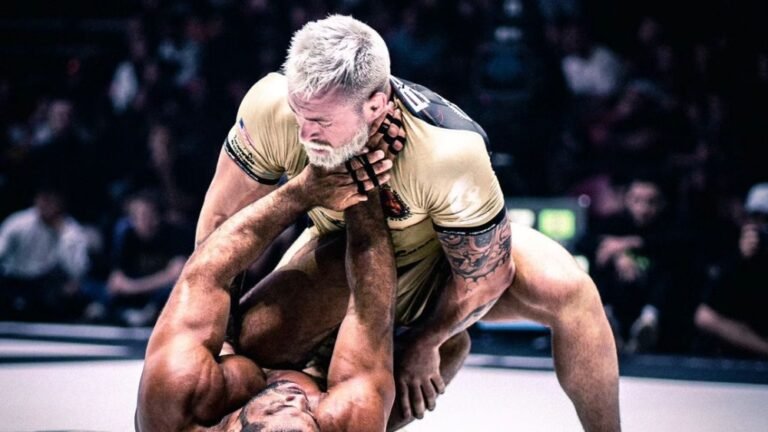
Wrist control on the feet or bicep does appear in no-gi matches — briefly. Watch enough grappling and you’ll see a competitor flash a foot to the bicep with wrist control during a scramble, using it to stall a pass for a second or buy time to reset to a stronger position like De La Riva or a leg entanglement. That’s a legitimate use of the mechanics. It’s just not the same thing as playing spider guard as a primary system the way a gi competitor would.
The distinction matters for how you train it. Treating wrist-control spider guard as a transitional tool — a half-second bridge between positions — is realistic. Treating it as a guard you can live in for a full round is where grapplers get flattened out and passed.
5. Why Ashi Garami and De La Riva Took Its Job
Modern no-gi grappling didn’t lose spider guard’s function — it replaced it with systems built for bare skin instead of fabric. Leg entanglement positions (ashi garami and its variations) dominate the current game because they control an opponent using bone-on-bone leverage rather than a grip that can be peeled off. De La Riva guard, which pairs a hook behind the leg with an underhook or wrist tie, does the same distance-management job spider guard used to do, but the primary control point is the leg hook, not the hand.
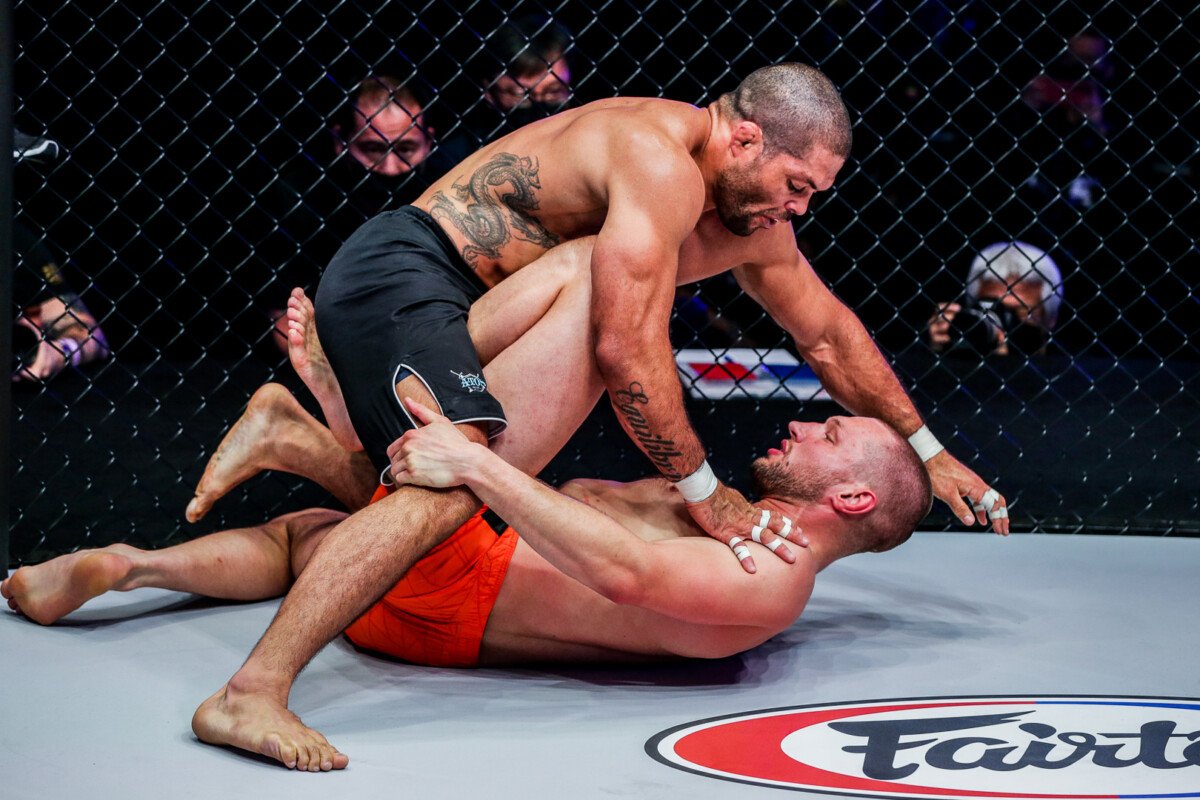
That shift shows up clearly at the highest levels of the sport. At ONE Championship’s submission grappling events, guard players win exchanges by fighting for underhooks, collar ties (where a shirt collar exists), and leg entries — not by trying to pin a bare wrist in place. When Reinier de Ridder grappled Andre Galvao in a submission grappling super-fight, the control that decided top-position exchanges came from body weight, cross-face pressure, and wrist isolation used to set up a pin — not from either athlete trying to sustain a spider-guard-style frame off the bottom. The grip-dependent guard game that works in the gi has largely been engineered out of elite no-gi competition in favor of positions that don’t rely on grip strength alone.

6. When Wrist Control Guard Actually Works
There’s one matchup where a wrist-control spider guard approximation earns its keep: against a much larger, much stronger opponent who relies on brute force to pass rather than technical grip fighting. Smaller, faster grapplers can use the same bicep-and-wrist framework gi players use — not to hold the position indefinitely, but to interrupt a pass attempt just long enough to build a leg entry or scramble back to a stronger guard. It’s a speed tool, not a control tool.
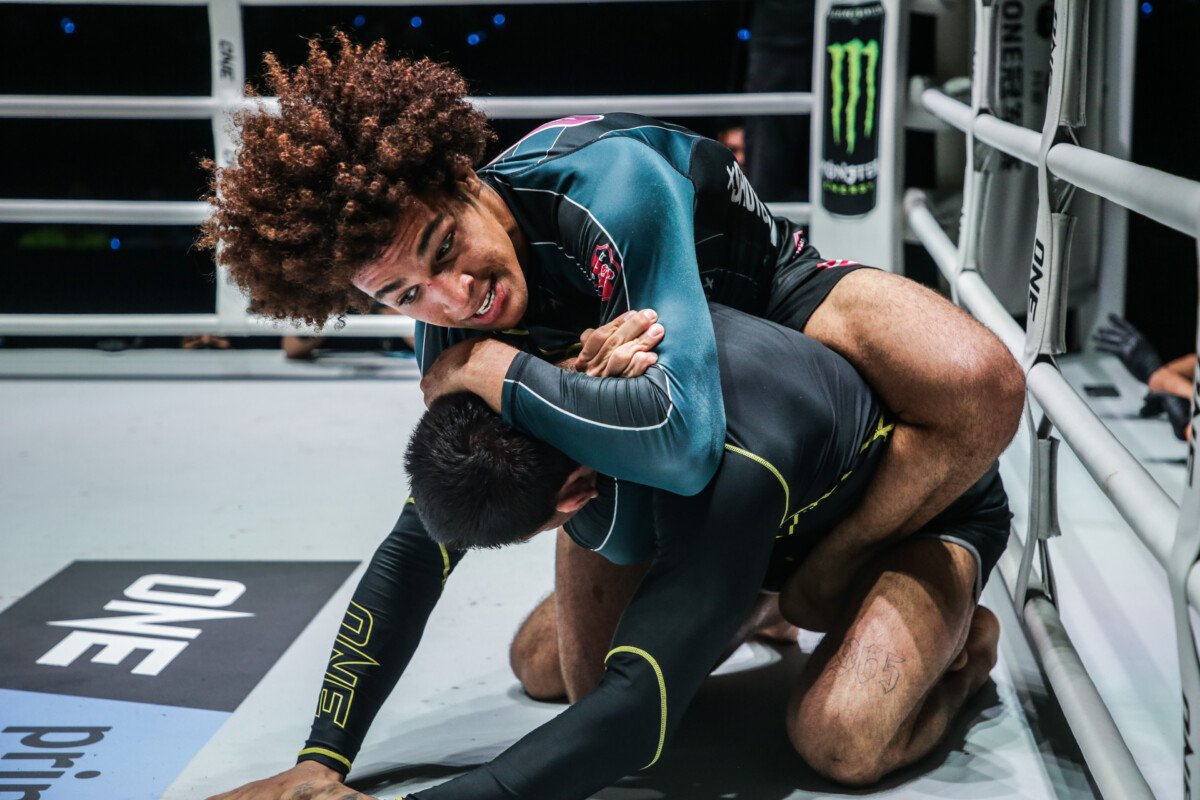
This is closer to how a lot of successful smaller competitors actually use their guard in no-gi: not by out-muscling anyone at a single grip exchange, but by cycling through positions fast enough that no single grip ever has to hold for long. Kade Ruotolo’s entire submission grappling résumé is built on exactly this kind of movement — constant re-entries and position changes rather than parking in one guard and hoping a single grip holds up. The wrist-to-bicep frame is one tool in that rotation, not the anchor of the whole game.
The same logic applies on the women’s side of the sport, where speed and grip-fighting IQ regularly beat size. Mayssa Bastos and Helena Crevar have both built no-gi careers around constant positional pressure rather than static control — proof that a guard game doesn’t need a locked-in grip to be effective, as long as it never stops moving.

7. Build the Skill Anyway — It Transfers Everywhere Else
Even though it doesn’t hold up as a standalone guard, training wrist control has value that extends well past spider guard. The same grip mechanics used to fight for a wrist in a guard attempt are what stop a pass attempt during grip fighting, set up a back take when an opponent overreaches, and defend against an opponent trying to control your own wrists in top position. Drilling the grip itself — thumb position, timing the grab before the opponent’s hand is moving, breaking the grip when you’re on the receiving end — builds hand skills that show up in scrambles far more often than a sustained spider guard hold ever would.
The mistake is expecting a no-gi wrist grip to do what a gi sleeve grip does. It won’t. But as a supporting skill inside a faster-moving, leg-entanglement-heavy guard game, it’s worth having in the toolbox — you just can’t build your whole no-gi guard around it the way spider guard is built around the sleeve in the gi.

8. How to Drill Wrist Control Without Wasting Mat Time
If you want the skill without the false confidence, drill it as a grip-fighting exercise, not as a guard-retention exercise. Start standing or on your knees with a partner and work pure wrist-control exchanges — who can secure the grip first, who can break it fastest, who can convert a secured grip into a two-on-one before the other person reacts. Keep the reps short. The value is in the speed of the exchange, not in how long you can hold the grip once you have it.
From there, add it into live guard-passing rounds with one rule: if your opponent starts fighting your wrist grip for more than two or three seconds, you have to let go and transition — to a leg entry, an underhook, or a scramble — rather than trying to win the grip fight outright. That rule forces you to use wrist control the way it actually functions in a real no-gi match: as a brief interruption, not a position you live in.

The Bottom Line
Spider guard doesn’t translate to no-gi because its entire mechanism — a static sleeve pin combined with a foot on the bicep — depends on equipment that isn’t there. What grapplers call “no-gi spider guard” is really a wrist-control variation that flashes in scrambles and works as a speed tool for smaller athletes, but it can’t function as a sustained guard the way the gi version does. If you’re building a no-gi guard game from scratch, put your training time into leg entanglements and De La Riva-style hook control first, and treat wrist control as a supplementary skill rather than a core position.