Reading a Rashguard Spec Sheet: What Matters Before You Buy in 2026
Search “best rashguards for BJJ and grappling 2026” and you get the same recycled ranking on every site: ten products, an affiliate link under each, and almost no explanation of why one panel survives two years of mat friction while another pills and sags after a month. Rankings go stale the day a brand changes its supplier. What does not go stale is knowing how to read the spec sheet yourself. Learn to decode the fabric blend, the seam type, the compression rating, and the print method, and you can walk up to any rashguard on the rack — this year or in five — and judge it on the spot.
This is a buyer’s field guide for no-gi grapplers, not a list. We are going to take a rashguard apart on paper so you stop buying on logo loyalty and start buying on construction.
Why “best of” lists keep failing grapplers
A ranked list assumes every grappler trains the same way, sweats the same amount, and washes their gear the same number of times. None of that is true. A competitor cutting weight in a hot room needs different moisture management than a hobbyist drilling twice a week. A 95kg heavyweight stresses seams in ways a 60kg featherweight never will. The “number one rashguard of 2026” for one athlete is a returns-shelf reject for another.
The honest answer to “which rashguard is best” is another question: best at what, for whose body, under what load? Once you can read the spec sheet, that question answers itself. Here is the order of operations.
The fabric blend is the whole story
Almost every quality no-gi rashguard is some ratio of polyester to spandex (elastane), and that ratio tells you more than the brand name. The most common construction sits around 80 to 88 percent polyester and 12 to 20 percent spandex. Polyester is the structural face fabric — it resists abrasion, dries fast, and holds sublimated ink. Spandex is the stretch and recovery — it lets the garment move with a scramble and snap back to shape afterward.
Polyester versus nylon face fabrics
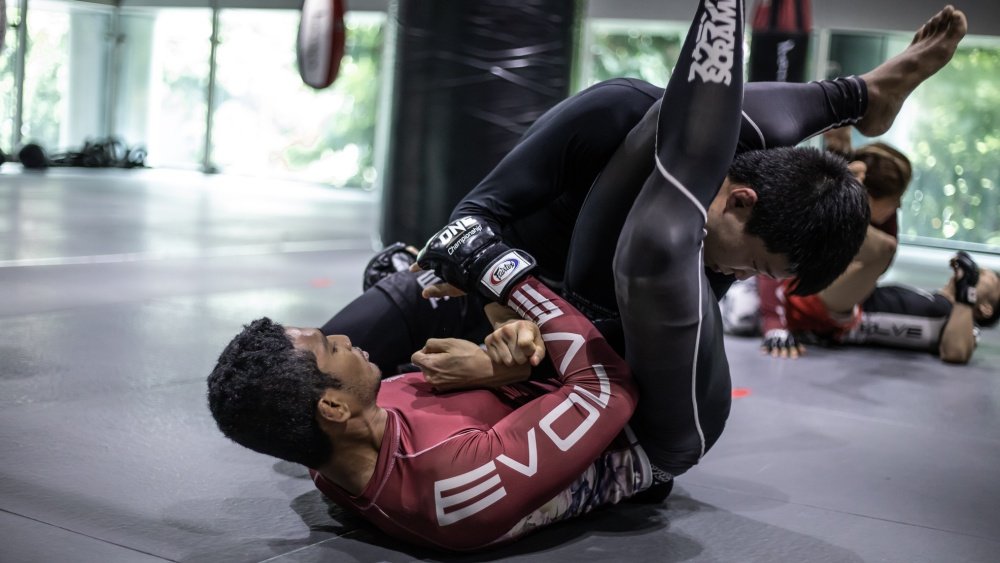
Some brands use nylon (polyamide) instead of polyester for the main body. Nylon feels softer and slightly more luxurious against the skin, and it is genuinely tough, but it absorbs more water and dries slower — a real disadvantage in a no-gi round where you are already a sweat slick by minute three. For pure training and competition use, a polyester-dominant face fabric is usually the smarter buy. Nylon blends earn their place in rashguards marketed for water crossover use, but for mat grappling, fast-drying polyester wins.
Why the spandex percentage decides longevity
Spandex is the first thing to die. Heat, chlorine, sweat salt, and aggressive detergent all degrade elastane fibers, and once they go the rashguard stops recovering — it bags out at the elbows and rides up the torso. A blend with too little spandex (under 10 percent) feels stiff and restrictive in guard retention. Too much (over 22 percent) stretches beautifully out of the bag but loses its recovery faster. The 12 to 18 percent window is the sweet spot most serious no-gi brands land on for a reason.
Also look for a GSM (grams per square meter) figure if the brand publishes it. A heavier knit (220 to 280 GSM) is more durable and opaque but warmer; a lighter knit (160 to 200 GSM) breathes better but shows wear sooner. Neither is “best” — match it to your training climate.
Seams are where rashguards die
Ask any grappler who has owned a dozen rashguards where the failure happens, and the answer is the seams — almost never the panels. The seam construction is the single most reliable predictor of how long the garment lasts, and it is the spec that cheap rankings ignore entirely.
Flatlock versus overlock stitching
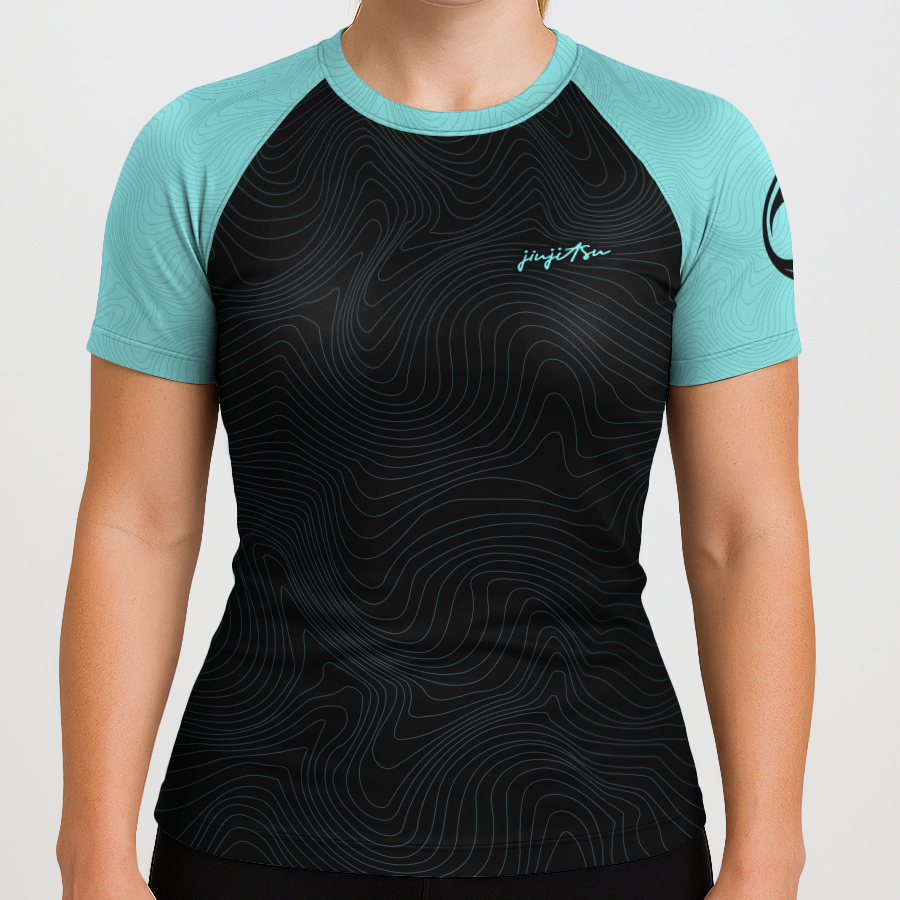
Flatlock seams lie flat against the skin, distribute tension across a wide stitch, and do not chafe under a tight grip or an underhook. They are what you want in a grappling garment. Overlock seams — the kind on a cheap gym tee — create a raised ridge that can rub raw spots during long sessions and tend to pop under shear load when an opponent grips your sleeve and drives. Some premium rashguards go further with bonded or taped seams, which eliminate the stitch ridge almost entirely.
When you handle a rashguard before buying, turn it inside out and run a thumb along the underarm and side seams. Flat, wide, dense stitching that does not gap when you stretch the panel apart is the green light. A thin, raised seam that shows daylight when stretched is the garment telling you exactly where it will fail.
Compression, fit, and the squeeze test
A rashguard is supposed to be a second skin. If it bunches, an opponent can grab the slack; if it slides, it stops protecting you from mat burn and another athlete’s skin. True compression garments publish an mmHg pressure rating, but most rashguards do not — they rely on the spandex content and cut to create a snug, supportive fit rather than medical-grade graduated compression.

The practical test: put it on and raise both arms overhead as if framing off a stack pass. The hem should stay near your waist, not climb to your ribs. The sleeves should reach the wrist without pinching the forearm. Pinch the fabric over your sternum — a good fit lets you lift maybe a centimeter of material, no more. If you can grab a fistful, size down; if it feels like a tourniquet on your shoulders, size up. Brand sizing varies wildly, so the squeeze test beats any size chart.
Sublimation versus heat transfer: reading the print
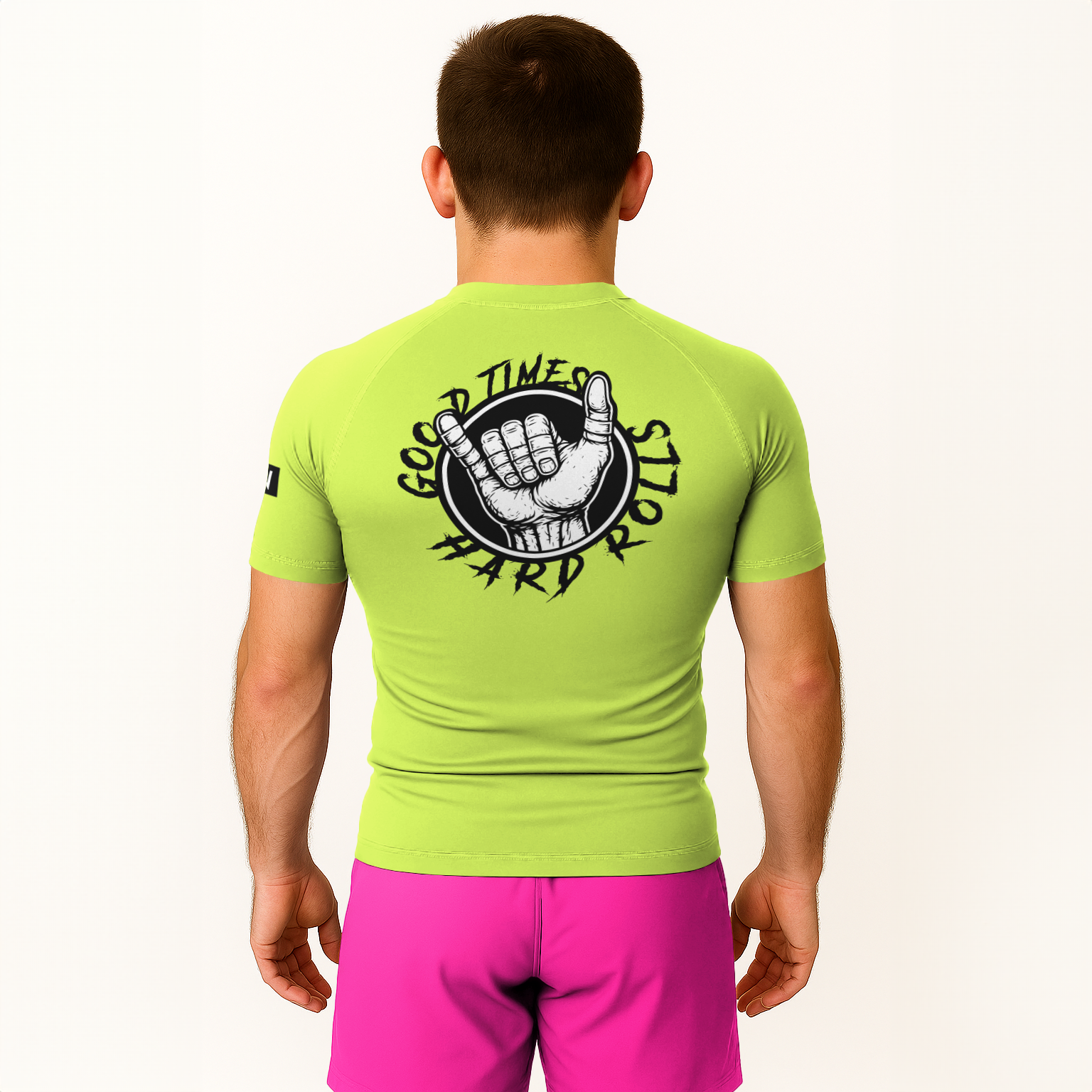
The graphics on a rashguard are not just style — the print method tells you about build quality. Dye sublimation bonds the ink into the polyester fibers themselves, so the design becomes part of the fabric. It never cracks, peels, or stiffens, and it does not trap heat. This is the standard for any rashguard worth buying for grappling.
Heat-transfer or screen-printed graphics sit on top of the fabric as a layer of plastic-feeling film. Under the constant flexing and friction of grappling, that layer cracks, lifts at the edges, and eventually flakes off — and while it is still attached, it blocks the fabric from breathing in that spot. If you run a fingernail over a logo and feel a hard, separate plasticky patch, it is a heat transfer. A sublimated print feels exactly like the surrounding fabric. That single touch tells you whether the brand built the garment for grappling or for the hanger.
Competition legality in 2026
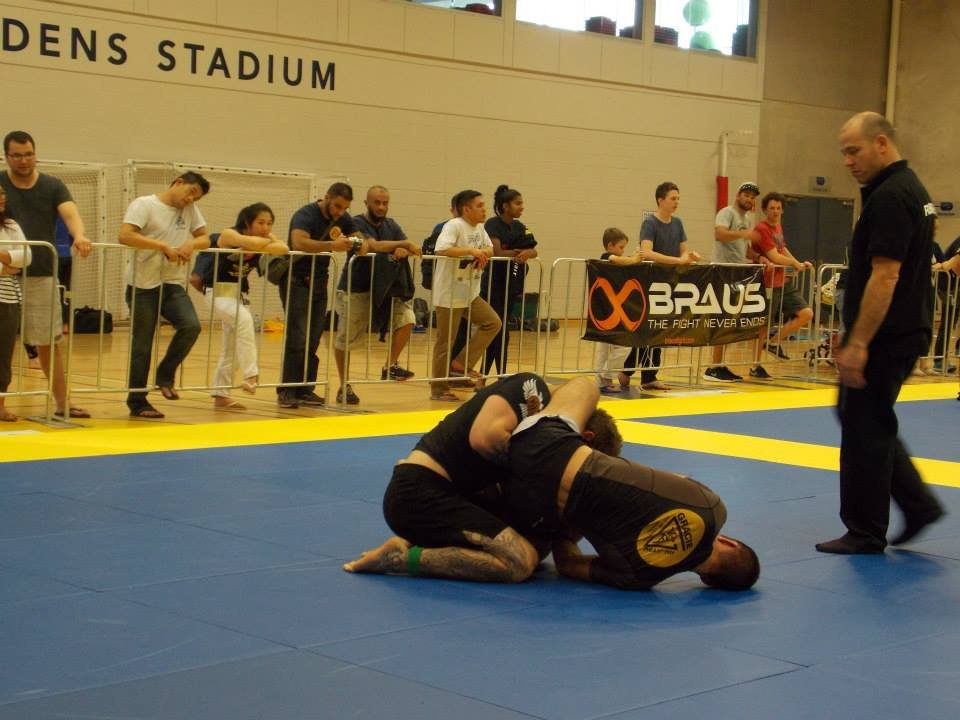
If you compete, the spec sheet has to clear the rulebook before anything else matters. Under IBJJF no-gi rules, your rashguard must cover from the torso to at least the elbows (for short sleeve) or full sleeve, and ranked divisions require the rashguard to reflect your belt rank with the appropriate color covering at least ten percent of the garment. Tournaments that run ranked no-gi will turn you away at the bracket for the wrong color split — a detail no “best of” list ever flags.
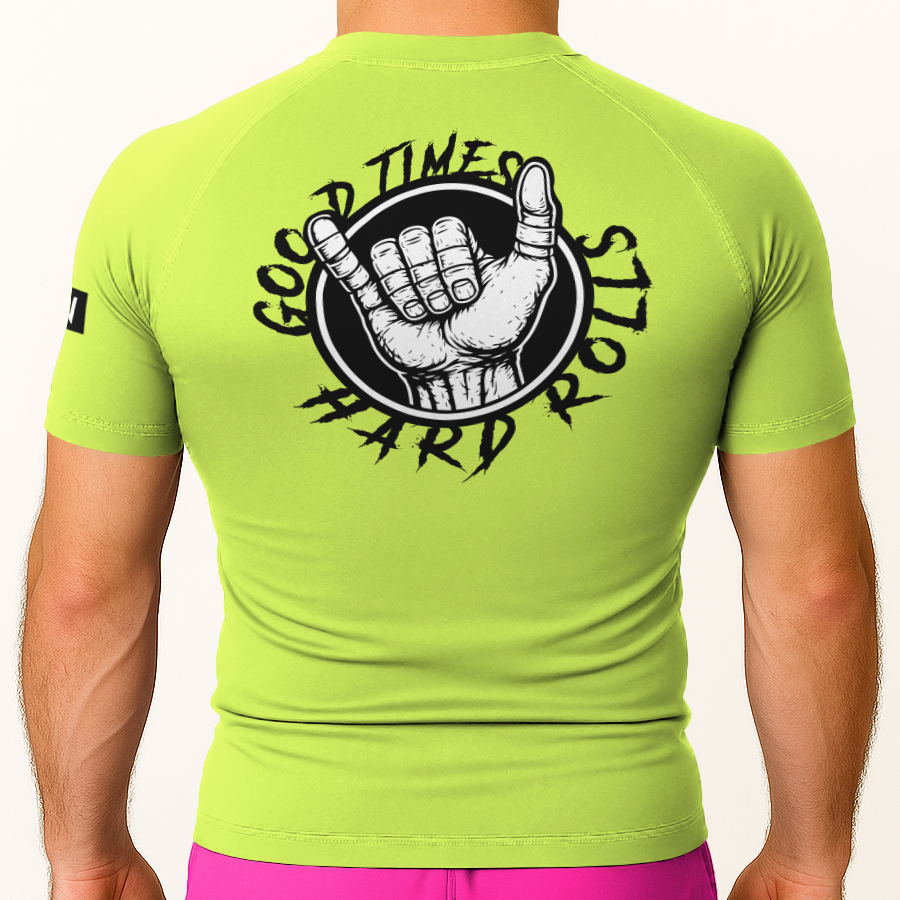
Submission-only and ADCC-style events are generally far more relaxed about graphics and color, but still expect a snug, non-baggy garment with no zippers, pockets, or hard fittings an opponent could catch a finger on. Before you buy a competition rashguard, confirm which ruleset your target event uses and whether it runs ranked divisions. Buying a beautiful all-black rashguard is a waste if your league requires a rank-colored panel.
Durability under real mat abrasion
Mat friction is brutal in a way ordinary sportswear never faces. Every scramble drags the fabric across a vinyl surface under your full bodyweight, and every grip exchange shears the sleeves. The spec details that predict survival are dense flatlock seams (covered above), a polyester-forward blend in the 220-plus GSM range for training pieces, and reinforced stitching at the shoulder and underarm — the two highest-load zones.
Washing habits matter as much as the build. Cold wash, no fabric softener (it coats the fibers and kills moisture-wicking), and air-dry instead of tumble heat, which is the fastest way to murder spandex recovery. A well-built rashguard cared for this way lasts years; the same garment hot-washed and tumble-dried bags out in months. The spec sheet sets the ceiling on durability — your laundry decides whether you reach it.
Match the rashguard to how you train
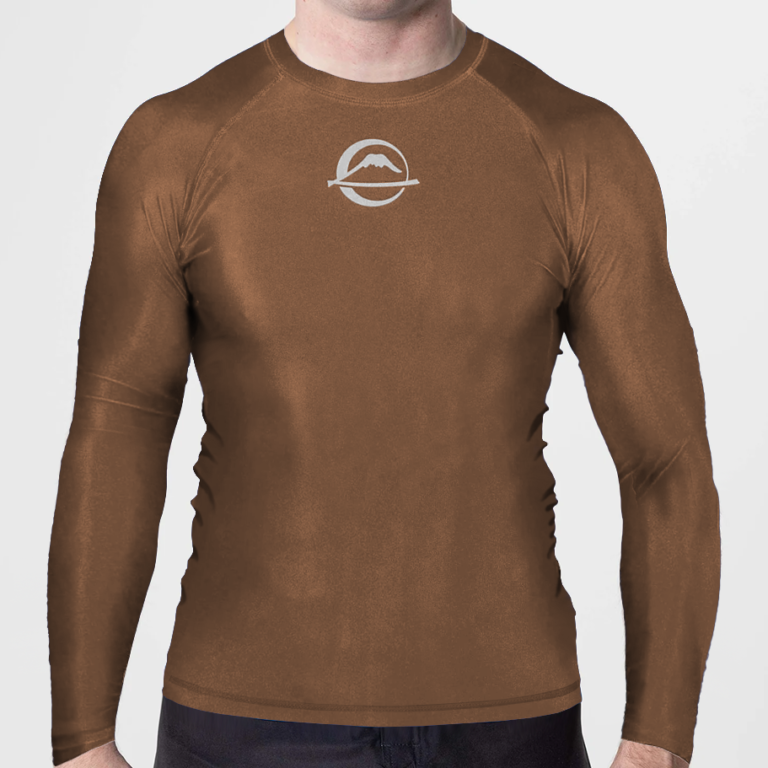
Short sleeve versus long sleeve is not a style choice — it is a coverage choice. Long sleeve protects the full arm from mat burn and skin-to-skin contact (a real factor in reducing the spread of ringworm and staph), and it adds warmth in a cold gym. Short sleeve runs cooler in a hot room and gives the forearms more direct grip feel. Many serious no-gi athletes own both and rotate by season and venue.
Think in terms of roles rather than a single “best” purchase. A heavier, plainer training rashguard takes the daily beating. A lighter, rank-correct competition piece stays fresh for events. If you train in a humid climate, prioritize the lightest fast-drying polyester knit you can find; in a cold gym, lean heavier. The right rashguard is the one whose spec sheet matches your actual training reality.
What to actually buy in 2026
Skip the rankings and shop the spec sheet. For a daily training rashguard, look for an 80 to 88 percent polyester blend, 12 to 18 percent spandex, flatlock or bonded seams, sublimated graphics, and a heavier GSM if you grapple hard. For competition, add the ruleset check — ranked color split for IBJJF, snug-and-snag-free for submission-only. When you know those numbers, you can compare any two rashguards in seconds, regardless of which brand happens to be trending this year.
Ready to compare real options against these criteria? Browse current no-gi rashguards and filter by the specs above: no-gi BJJ rashguards, long sleeve grappling rashguards, and ranked IBJJF rashguards. Read the material and seam details on each listing before you commit — now you know exactly what you are looking at.
Sources
- Wikipedia — Rash guard (construction and materials)
- IBJJF — official rules and no-gi uniform requirements
- ADCC — submission grappling event standards
- Wikipedia — Spandex (elastane fiber properties)
- Wikipedia — Dye-sublimation printing
Browse our top-rated rashguards and no-gi gear at the RashguardGuy shop →
Shop on Amazon
BJJ Rashguards on Amazon →
As an Amazon Associate we earn from qualifying purchases.