How Rashguards Should Fit: Three Checks Before You Train
A rashguard that fits wrong stops being protective gear and starts being a liability. Too loose and your partner gets fistfuls of fabric for collar drags and underhook controls. Too tight and you are fighting your own shirt before the round even starts. For no-gi grapplers, the rashguard is the closest thing to skin — and the wrong fit will follow you through every roll, every transition, every minute on the mat.
This guide walks through what proper fit actually looks like on a no-gi rashguard, why most fit problems trace back to one of three measurements, and how to tell whether the rashguard you already own is helping you or quietly working against you.
Why Rashguard Fit Matters in No-Gi BJJ
A rashguard does three jobs at once: it prevents skin-on-mat abrasion, it blocks transfer of bacteria and fungal infections between training partners, and — in no-gi — it removes a major source of grip for your opponent. All three jobs depend on the rashguard staying snug to your skin from neck to wrist on a long sleeve, or neck to bicep on a short sleeve.
When the rashguard moves independently of your skin, three things break down at once:
- Skin friction returns. The fabric slides against your skin instead of staying put, generating the exact mat-burn the rashguard was supposed to prevent.
- The garment becomes a grip. Loose fabric at the chest, sleeves, or shoulders gives your partner something to hold, turning your rashguard into a de-facto gi jacket.
- Coverage gaps appear. A rashguard that rides up exposes your lower back during stack passes; one that bunches at the shoulders exposes your traps during crossfaces.
A correctly fitted rashguard moves as one piece with your torso. You should not notice it during a roll. If you do notice it, the fit is wrong.
The Compression Test — Three Checks Before You Buy
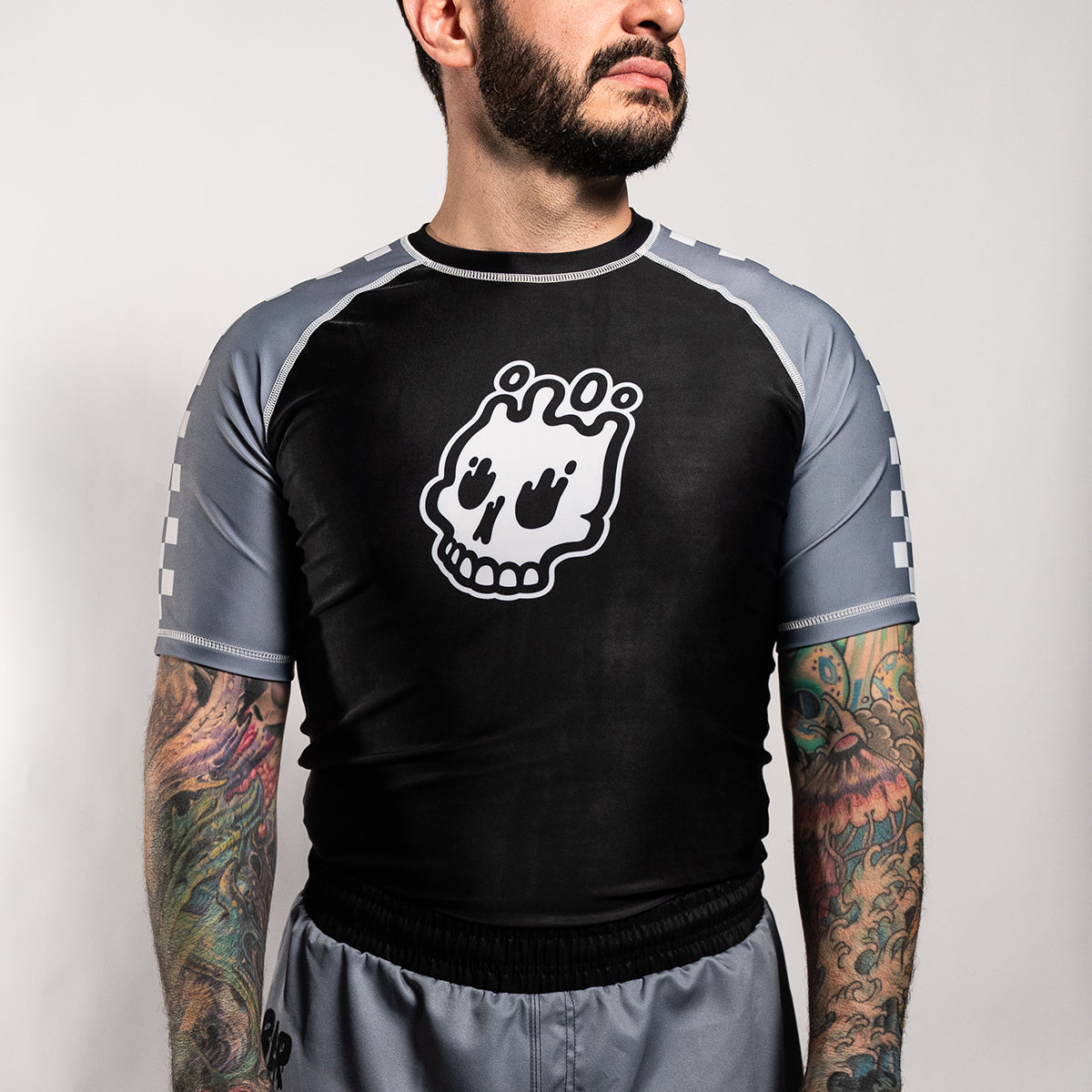
The simplest fit test takes 30 seconds and does not require a measuring tape. Put the rashguard on and run these three checks in order.
1. The Pinch Test (Torso)
Reach across your chest and try to pinch the fabric between your thumb and forefinger. On a properly fitted no-gi rashguard, you should be able to grab the fabric but not pull it more than 1 to 2 cm off your skin. If you can lift the fabric 3 cm or more away from your body, the torso is too loose. If you cannot pinch any fabric at all — meaning the material feels bonded to your skin — the rashguard is too small and will restrict your breathing under load.
The pinch test matters most across the lats and the lower back. These are the regions that bunch first under guard pulls and compression passes, and they are also where a loose rashguard offers your opponent the most usable fabric.
2. The Sleeve Stretch (Long Sleeve Only)
Extend both arms straight forward at shoulder height. The cuffs should reach the base of your thumb — covering the wrist but not extending past the heel of the hand. Now raise both arms straight overhead. The sleeves should not retract past your wrist bone. If the cuffs pull back to mid-forearm when your arms go up, the sleeves are too short and will ride up every time you grip a collar tie or post on a pass attempt.
The opposite problem — sleeves that pool fabric around the wrist when your arms hang at your sides — means the cuff diameter is too wide. Loose cuffs are wrist-control gifts to your opponent.
3. The Neck Seal
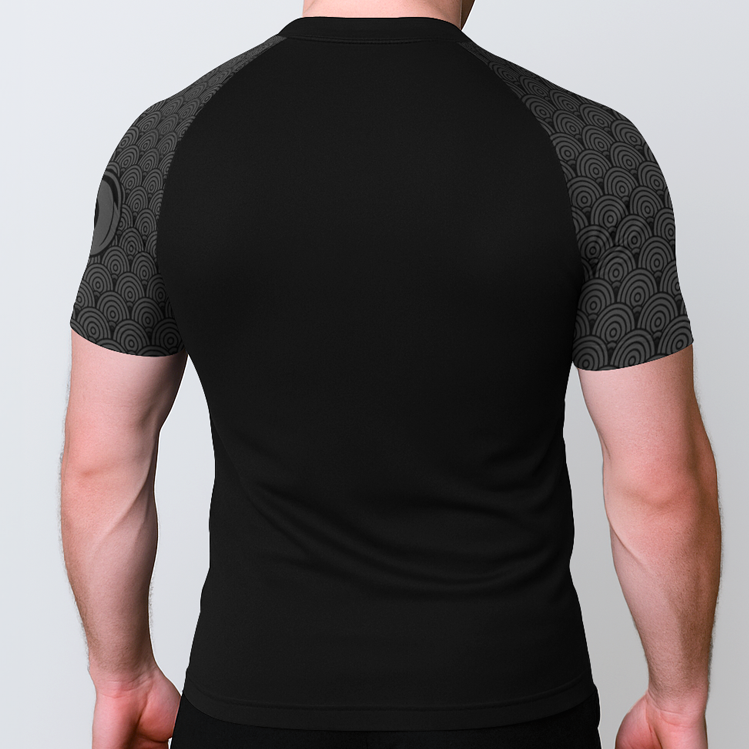
The collar should sit flush against the base of your neck with no visible gap. Tilt your head forward. If you can see down inside the rashguard at the chest, the neckline is cut too low or too wide. A high, snug neckline keeps the rashguard anchored when your partner is driving a crossface or shoulder pressure into your collarbone. Without that anchor, the entire shirt rotates around your torso and exposes shoulder skin to the mat.
A rashguard that passes all three checks at the store will most likely still fit correctly after 30 washes. One that fails even one check on day one will fail worse over time.
Common Fit Mistakes Grapplers Make
Buying for Room to Grow
The instinct to size up and let it shrink in the wash comes from gi sizing, where pre-shrinking is real. Rashguards are typically polyester-spandex blends that do not shrink meaningfully. A rashguard you bought one size too big on day one will still be one size too big after a year of washes — and you will have given your training partners 365 days of grip fabric in the meantime.
Confusing Compression with Painful
A compression-fit rashguard should feel snug but not punishing. If the fabric leaves deep imprints in your skin after a one-hour class, restricts your shoulder mobility on a high-reach guard, or causes numbness in your forearms, the sizing is wrong — the rashguard is not waiting to be broken in. Real compression fabric stretches to your body shape. It does not crush it.
Ignoring the Hem
The bottom hem of the rashguard should sit at or slightly below your hip bone — not bunched at the waist, not riding up to the navel. Some rashguards include a silicone gripper strip along the inside of the hem to prevent ride-up. If your current rashguard rides up during inversions, granby rolls, or guard retention scrambles, look for a silicone hem on your next purchase. The fabric strip adds about 2 g to the garment and eliminates 90 percent of ride-up complaints.
Sizing Across Brands — Why a Medium Is Not a Medium
Rashguard sizing varies wildly across brands. A Medium from one major no-gi brand can run a full size larger or smaller than a Medium from another. The reason is that most companies build their size charts around a fictional average grappler, and that average shifts depending on which market the brand designs for — US, Brazilian, Japanese, and European brands all use different base measurements.
The practical workaround: ignore the letter on the label (S, M, L, XL) and always check the brand’s published chest-circumference and torso-length measurements before ordering. Measure your chest at the widest point with the tape parallel to the floor, and measure your torso from the base of your neck to your hip bone. Match those two numbers against the brand’s chart — not against another brand’s chart, and not against the size you wear in everyday t-shirts.
If a brand only publishes a single weight-and-height range (for example, Medium fits 170 to 180 cm and 70 to 80 kg), assume the sizing is loose and consider going down a size if you are at the lower end of either range.

Long Sleeve vs Short Sleeve — Different Fit Priorities
Long-sleeve and short-sleeve rashguards have overlapping but distinct fit priorities, and many grapplers misapply long-sleeve sizing logic to short sleeves or vice versa.
For long-sleeve rashguards used in competition or hard training, the sleeve diameter from bicep to cuff matters as much as the torso fit. A baggy sleeve gives your opponent two-on-one wrist controls with built-in grip fabric — turning every collar tie into a sleeve grab. Most major no-gi competitions require a compression-fit rashguard specifically to remove this advantage.
For short-sleeve rashguards used in everyday training, the sleeve cuff should sit at mid-bicep with no daylight visible between the cuff and your arm when your arms are at rest. A short sleeve that flaps around your tricep is functionally a t-shirt — it provides skin coverage but offers no compression and no grip-denial. If your partner can pinch the sleeve hem and pull it away from your bicep, the short sleeve is too wide.
When to Replace a Rashguard
Even a perfectly fitted rashguard has a working life. Replace yours when you notice any of the following warning signs:
- The fabric has lost its snap-back. You stretch the chest panel and it returns to shape slowly, or with visible looseness.
- Pilling has formed in the high-friction zones (underarms, lower back, inner forearms). Pilling reduces the smooth surface that prevents mat burn.
- Stitching at the cuffs, neckline, or side seams has frayed or pulled.
- The print or sublimation has begun cracking at the chest or shoulders. Cracked sublimation usually signals fabric breakdown underneath.
- The rashguard no longer passes the three-check fit test: pinch, sleeve stretch, neck seal.
For grapplers training four or more days per week, a quality polyester-spandex rashguard typically holds its fit for 12 to 18 months before noticeable breakdown. Lower-grade rashguards from generic fitness brands often break down in 3 to 6 months under the same training load.

Fit Differences Between No-Gi Rashguards and General Compression Shirts
A general athletic compression shirt and a BJJ rashguard look similar at a glance but are built differently. BJJ rashguards typically use heavier-weight fabric (in the 220 to 280 GSM range), reinforced flatlock stitching to handle ground friction, and a longer torso cut designed specifically to resist ride-up during ground work. A general compression shirt from a mainstream sports retailer is often lighter (140 to 180 GSM) and cut shorter for upright sports like running, cycling, or weightlifting.
If you are tempted to substitute a generic compression shirt for a BJJ rashguard to save money, expect ride-up at the waist on the first roll, faster fabric breakdown from mat abrasion, and seams that fail in three to four months under grappling load instead of the 12 to 18 months you would get from a purpose-built no-gi rashguard.
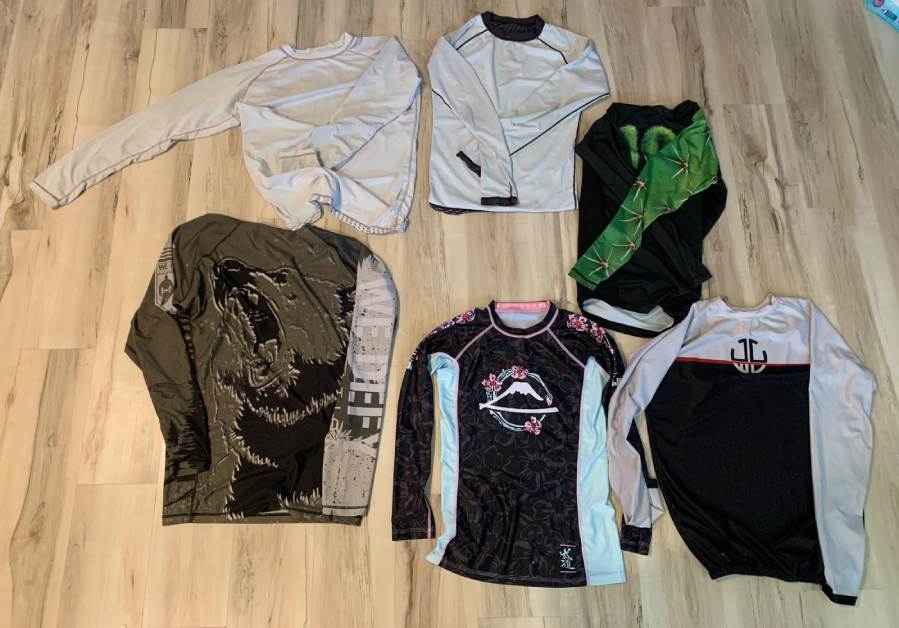
Final Fit Check — Before Your First Hard Roll
Before you trust a new rashguard in live training, run a private movement test at home. The store fitting room only tests one position — standing upright. Grappling is not.
- Stand and tilt your torso forward, then twist 90 degrees each direction. The rashguard should follow your torso without bunching at the side.
- Get into a standing combat base, then sit through both directions. The hem should stay below your hip bone and not creep toward your waist.
- Lie on your back, bridge up, and shrimp to both sides. Check the shoulder seams — if the rashguard rotates so the shoulder seams end up on your collarbone or upper bicep, the cut is wrong for ground work.
- Reach overhead with both arms and rotate at the shoulder. If you feel the rashguard pulling at the lats or under the armpit, the chest sizing is too tight.
A rashguard that passes this home movement test will perform on the mat. One that fails any of the four checks will fail more dramatically once a 90 kg training partner is dragging on your sleeve and posting on your hip.

The Bottom Line on Rashguard Fit
Rashguard fit is not a subjective preference — it is a measurable property of the garment that determines whether the rashguard helps or hurts your grappling. The three core checks (pinch, sleeve stretch, neck seal) take under a minute. The brand-by-brand sizing variance is real and worth measuring around. And the difference between a properly fitted rashguard and a sloppy one shows up immediately on the mat, usually as a partner finding grips you did not realize you were offering.
Buy for compression, not comfort. Measure before ordering. Replace before the fabric quits on you. A rashguard that passes the fit test will quietly do its job for a year or more — and you will stop thinking about it the moment the round starts, which is exactly the point.
Sources
- Wikipedia — Rash guard (history and construction)
- Wikipedia — Submission grappling (no-gi context)
- FloGrappling — No-gi competition coverage
- Browse no-gi BJJ rashguards on Amazon
Browse our top-rated rashguards and no-gi gear at the RashguardGuy shop →